
The US-Iran conflict has hit the "pause button"! Brent crude oil plummeted over 7% and fell below $90, while gold prices surged by $40 as the market awaits the Federal Reserve's "life-and-death decision."
 Complete. Here is the key summary
The United States has suspended airstrikes against Iran, putting the U.S.-Iran confrontation on "pause" and easing geopolitical tensions. As a result, international oil prices plummeted, with Brent crude falling below the $90 mark; gold prices surged nearly $40 to $4,096 per ounce. Market sentiment quickly reversed from a war premium, and the subsequent trend will depend on multiple variables and the progress of diplomatic negotiations this week
According to Zhitong Finance APP, after experiencing 13 consecutive days of military strikes, the confrontation between the United States and Iran suddenly hit the pause button last weekend, causing a violent shake in the global commodity market. On Monday (July 27), during the Asian trading session, international benchmark Brent crude oil futures opened and plummeted over 7%, falling below the $90 per barrel mark; WTI crude oil futures also dropped more than 5%, trading around $84 per barrel. Meanwhile, spot gold opened nearly $40 higher, briefly reaching $4096 per ounce, with an increase of over 1%.
This sudden market reversal stemmed from the tacit agreement reached between Washington and Tehran over the weekend— the U.S. paused airstrikes on Iran, while Iran simultaneously halted retaliatory actions. Market sentiment quickly reversed from the extreme pricing of "war premium," but whether this rebound is a trend reversal or a fleeting moment depends on the interplay of multiple variables this week.
Pause in Hostilities: A "Diplomatic Window" After 13 Days of Continuous Strikes
On July 24, President Trump broke the routine of approving military strike plans daily for the past two weeks, ordering the U.S. military not to strike Iran that day. Subsequently, the U.S. military did not carry out new airstrikes for two consecutive nights. U.S. Ambassador to the United Nations Mike Wallace stated on Sunday that the pause was to "leave more space for diplomatic negotiations."
Iran also pressed the pause button simultaneously. Iranian military spokesman Akraminia confirmed that due to the absence of U.S. strikes, Iran had paused its retaliatory actions according to a "tit-for-tat" strategy. Meanwhile, an Omani delegation has arrived in Iran to discuss new arrangements for reopening the Strait of Hormuz. The Iranian Foreign Ministry spokesperson stated that talks between Iran and Oman on the safe navigation management of the strait were "productive and made some progress."
However, the fragility of the ceasefire cannot be ignored. Iranian sources expressed "more skepticism than optimism" regarding the U.S. side's sincerity in the ceasefire, believing it to be more of a tactical adjustment rather than a genuine change of heart. Trump himself sent mixed signals—stating that Iran "is serious this time," while also threatening that "if necessary, it can be escalated to a higher level."
Oil Market Shock: Brent Crude Instantly Drops Below $90, Still Up 30% This Month
As soon as the "pause" news broke, the oil market plummeted. The global benchmark Brent crude oil fell over 7% within minutes of opening, briefly dropping below $90 per barrel, before recovering to around $92. WTI crude oil futures fell about 5.5%, trading at $84.40 per barrel. European natural gas prices also plummeted, with a decline of up to 7.8%.
The backdrop to this crash is the previous wild surge in oil prices—affected by the U.S.-Iran conflict spreading from the Strait of Hormuz to the Red Sea, Brent crude has surged about 30% this month, briefly surpassing $100 per barrel last week. The conflict has lasted nearly five months, raising widespread concerns about its impact on global inflation.
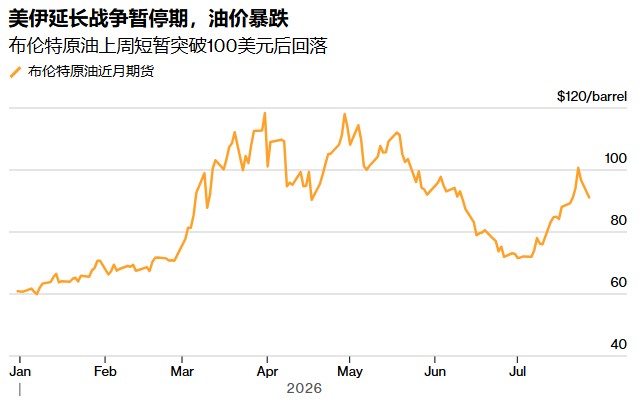 Even if the United States suspends strikes, the conflict in the Red Sea region continues to spread. The Yemeni Houthi forces claimed to have attacked three Saudi oil tankers within 48 hours and continue to impose a maritime blockade on vessels associated with Saudi Arabia. Yanbu, which has become Saudi Arabia's main oil export port since the effective closure of the Strait of Hormuz, handling millions of barrels of crude oil daily, as well as the Saudi Aramco refinery and export terminal in Jizan, are both under threat.
MST Marquee senior energy analyst Saul Kavonic commented: "The suspension of strikes and reports of progress in negotiations have raised expectations for a return to a de-escalation path. However, all key issues, including Iran's control over the Strait and its missile and nuclear programs, remain difficult to resolve, and any ceasefire is likely to be only temporary."
Gold Rebounds: From Safe-Haven Suppression to Easing Inflation Concerns
In tandem with the sharp drop in oil prices, gold has seen a long-awaited rebound. Spot gold opened nearly $40 higher at $4,096.33 per ounce, an increase of about 1%. Silver surged even more dramatically, rising over 2.8% during the session. The logic behind gold's rise is clear and direct: the pause in the US-Iran conflict has alleviated oil supply risks, leading to a cooling of inflation concerns; the drop in oil prices has also partially eased the pressure on the Federal Reserve to raise interest rates, with the dollar index opening lower and falling by as much as 0.23%.
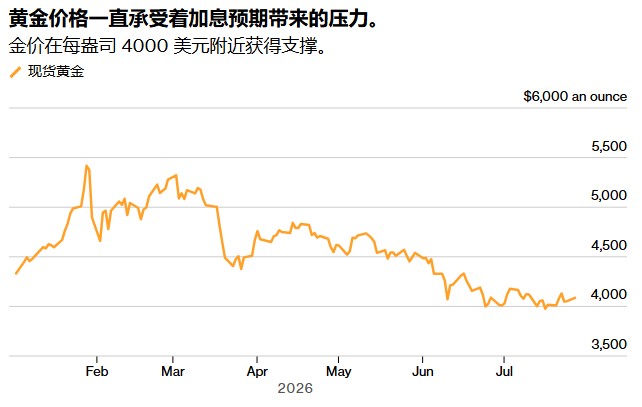
However, the rebound potential for gold prices remains constrained by multiple factors. Independent metal trader Tai Wong pointed out that although gold and silver seem to be bottoming out around $3,950 and $55 respectively, if the conflict escalates sharply, the possibility of prices falling below these levels cannot be ruled out. The probability of the Federal Reserve raising interest rates this year remains as high as 92%, and combined with doubts about Iran's sincerity regarding a ceasefire, the short-term upside for gold prices is limited.
Since the outbreak of the US-Iran conflict at the end of February, gold has fallen more than one-fifth from its historical high of nearly $5,600 per ounce. Currently, around the $4,000 mark, gold is caught in a tug-of-war between "geopolitical inflation" and "interest rate expectations."
Pricing Basis: The Federal Reserve's "Complex Equation"
This sudden geopolitical shift has made this week's Federal Reserve meeting even more enigmatic.
Just a few weeks ago—when the June CPI recorded the largest single-month decline since April 2020—the market's bets on a rate hike in July were once lowered to about 10%. However, within just a few weeks, a triple shock has reversed this narrative: renewed conflict in the Middle East has pushed Brent crude oil above $100, the Trump administration announced new tariffs of 10% to 12.5% on 60 countries, and the ongoing AI investment boom continues to drive demand. As of last week's close, federal funds futures indicated that the probability of a 25 basis point rate hike this week had risen to about 36%.
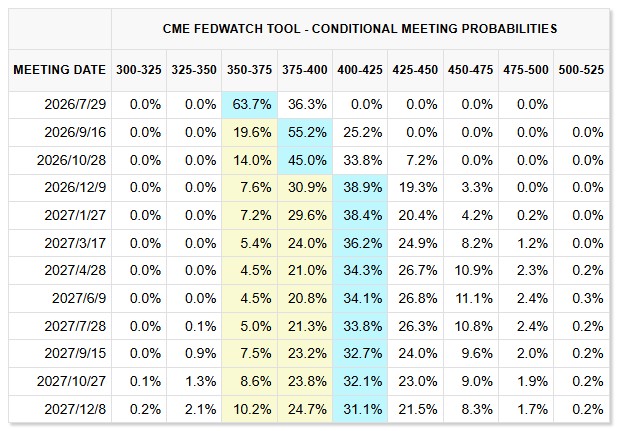 The sharp drop in oil prices on Monday undoubtedly provides new ammunition for the wait-and-see rhetoric. But the question is: the Federal Reserve is referencing June's inflation data, not the intraday fluctuations in oil prices from July. The previous surge in oil prices had already heightened market concerns about the persistence of inflation, and the effects of the new round of tariffs and the AI investment boom on prices have yet to be fully accounted for. Analysts point out that this meeting "may be the most unpredictable one in years."
The hawkish forces within the Federal Reserve have also reached a critical mass. Dallas Fed President Logan and Cleveland Fed President Mester have both called for interest rate hikes, and both have voting rights for this meeting. Citigroup expects that if there are more than two dissenting votes, it will be interpreted by the market as a stronger hawkish signal.
The Federal Reserve will hold a policy meeting from July 28 to 29. This meeting has been dubbed by the market as "the most unpredictable one in years." The surge in oil prices and rising energy costs have heightened inflation risks, but recent U.S. inflation and employment data have been relatively mild, providing a rationale for keeping interest rates unchanged. The upcoming interest rate decision by the Federal Reserve makes this game exceptionally complex. While the sharp drop in oil prices alleviates inflation anxiety, the previous spike above $100 has significantly raised expectations for interest rate hikes. Amid the intertwining of "geopolitical pause" and "policy suspense," global capital markets are facing one of the most uncertain weeks in recent years