
The digital asset reserve company model has cooled down, with multiple enterprises turning to AI for self-rescue, but investors remain skeptical
 Complete. Here is the key summary
Affected by the downturn in the cryptocurrency market, Digital Asset Reserve Company (DAT) models have cooled, with more than a dozen companies turning to the AI field for self-rescue. Despite attempts to regain investor favor by leveraging the AI hype, the transformation has not been effective, as seen by the significant decline in stock prices of K Wave Media and Alpha Compute Corp. Most DAT companies are facing operational difficulties or are seeking transformation, while AI infrastructure has become a strong sector in the U.S. stock market due to investments from tech giants
According to Zhitong Finance APP, as cryptocurrency prices continue to decline, the once-popular Digital Asset Treasury (DAT) model is rapidly cooling, and more related companies are turning to the artificial intelligence (AI) field in hopes of regaining investor favor. However, from the current market performance, this transformation has not yet achieved significant results.
Since announcing the shift from Bitcoin reserve business to data center development in May this year, K Wave Media (KWM.US) has seen its stock price drop by a cumulative 71%. AlphaTON Capital, which holds alternative cryptocurrency assets, renamed itself Alpha Compute Corp. (ALP.US) in April this year and shifted to AI business, and its stock price has also dropped by a cumulative 33%.
Statistics show that in recent months, at least a dozen digital asset treasury companies have begun to layout AI-related businesses to cope with the continued downturn in the cryptocurrency market.
Toufic Adlouni, managing partner of the Canadian law firm Renno & Co, stated that there is currently strong market interest in AI, and more companies are looking to shift to sectors with greater growth potential. He pointed out that the vast majority of digital asset treasury companies are either seeking transformation or have already fallen into operational difficulties.
Digital asset treasury companies were one of the hottest concepts in the capital market last year. These companies typically issue stocks or use balance sheet financing to purchase digital assets like Bitcoin, and during the cryptocurrency bull market, their stock prices even rose more than the value of the cryptocurrencies they held.
However, as cryptocurrency prices have sharply declined, many DAT companies' stock prices have fallen below the net asset value of their holdings, and management has begun to gradually abandon this business model.
At the same time, AI infrastructure construction continues to attract significant capital inflows.
Tech giants like Alphabet (GOOGL.US) and Microsoft (MSFT.US), as well as AI companies like OpenAI and Anthropic, are continuously expanding their investments in data centers, making the data center industry chain one of the strongest performing sectors in the U.S. stock market this year.
Almost all of the top ten best-performing stocks in the S&P 500 this year are related to data center construction, including SanDisk (SNDK.US), which has risen over 500%, as well as Dell Technologies (DELL.US), Intel (INTC.US), and Micron Technology (MU.US).
In contrast, as of July 24, Bitcoin has cumulatively dropped 49% from its peak last October, with a year-to-date decline of 27%; Ethereum has cumulatively dropped 38% this year, down 62% from its historical high in August 2025.
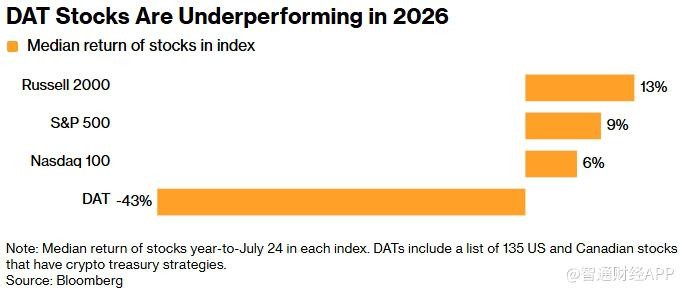
As a result, DAT concept stocks have overall suffered a significant setback. Media statistics show that the median decline of digital asset treasury company stocks in the U.S. and Canada has reached 43% this year Gregory Sichenzia, founding partner of Sichenzia Ross Ference Carmel LLP, stated that last year, digital asset reserve companies were almost invincible, but now this business model has rapidly lost market appeal.
He revealed that his law firm was involved in a large number of private financing projects for DAT companies last year, but has not received any related financing business since October of last year. Instead, there has been an increasing number of companies consulting about AI data centers, space exploration, and small nuclear reactor opportunities in the AI-related industries.
The digital asset reserve model was first adopted by Strategy (MSTR.US) Chairman Michael Saylor in 2020, where the company continuously bought Bitcoin, deeply binding its stock price to the cryptocurrency price. Benefiting from the rise in Bitcoin prices to around $125,000 in October 2024, Strategy's stock price had cumulatively increased by over 300% since the end of 2019.
However, as Bitcoin prices fell thereafter, Strategy's stock price has cumulatively dropped by about 81%, and the company has begun to gradually reduce its Bitcoin holdings.
It is worth noting that not all companies transitioning to AI have performed poorly.
CoreWeave (CRWV.US), which was previously engaged in Bitcoin mining, has successfully transitioned to AI cloud computing services, with a current market value of approximately $40 billion, and its stock price has cumulatively risen by about 80% since its listing in March 2025.
Additionally, Bitcoin mining companies such as Hut 8 (HUT.US), Iren (IREN.US), and TeraWulf (WULF.US) have also regained some investor attention by repurposing their data centers for AI computing services, leading to a rebound in their stock prices.
However, some industry insiders believe that the crypto industry has not completely lost its appeal.
Daniel Forman, a partner at Lowenstein Sandler, stated that investors still maintain interest in other applications of blockchain technology, but the market enthusiasm for the digital asset reserve business model has clearly cooled. He remarked, "As it stands, the DAT model we are familiar with may have reached its end."