
CME Launches Single-Stock Futures: Supports Near 24-Hour Trading of Popular US Stocks, Targeting Retail Market
 Complete. Here is the key summary
The CME has officially launched single-stock futures on 55 US equities and micro contracts on 22 underlyings, covering star stocks such as NVIDIA and Tesla, with support for nearly 23 hours of trading per day. Several retail brokers have characterized this launch as "the most important catalyst for retail growth this year." This move is also seen as a strategic initiative by the CME to counter the rise of perpetual contracts and consolidate its market position
The CME Group is making a significant entry into the single-stock futures market, providing investors with new tools to express long and short views around the clock, thereby further expanding its derivatives footprint.
On Monday, the CME announced the official launch of cash-settled single-stock futures contracts on 55 US stocks, along with micro contracts on 22 of these underlyings.
These products will trade on the CME’s Globex platform from Sunday evening through Friday afternoon, with only a one-hour maintenance window each day. This allows investors to react quickly outside regular US stock trading hours—for example, during earnings seasons or major events.
The underlying stocks include star names such as NVIDIA, Tesla, and Apple.
Michael Cyprys, an analyst at Morgan Stanley, pointed out in a research report that several retail brokers have characterized this launch as "the most important catalyst for retail growth this year," with more than 35 retail partners planning to complete their preparations within the first day to the first week.
Perpetual contracts (perps) are increasingly becoming a new threat to traditional exchanges. The CME’s launch of single-stock futures is also viewed as a strategic move to address this trend and consolidate its market position.
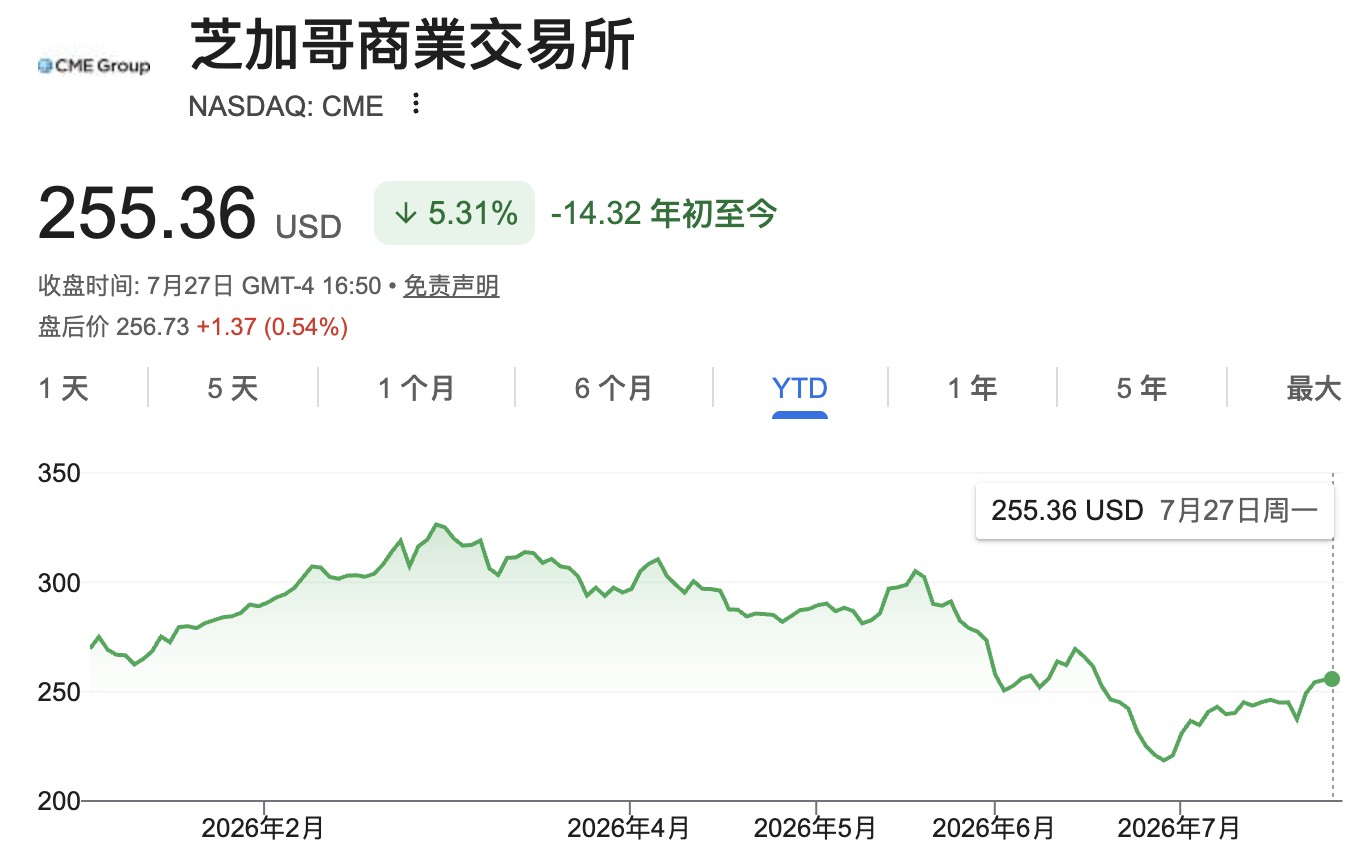
CME’s stock price has fallen 5.3% year-to-date, closing slightly up 0.02% on Monday.
Product Design: A Simpler Leveraged Tool Than Options
The CME stated that single-stock futures are designed to provide a simpler way to express long and short positions compared to options. Unlike options, single-stock futures do not involve time decay or exposure to changes in implied volatility, while requiring only a small amount of margin, resulting in higher capital efficiency.
All contracts are cash-settled, with the final settlement price based on the official closing price of the underlying stock on the expiration date. Holding the contract does not confer ownership of the relevant company. Standard contracts correspond to 100 shares of the underlying, while micro contracts correspond to 10 shares.
The CME stated that it will further expand the range of underlyings based on client demand and listing standards.
Perpetual Contracts Pose Potential Competitive Pressure
Among the underlyings launched, SpaceX is particularly noteworthy—as one of the most anticipated IPOs on Wall Street recently, international platforms had already offered perpetual futures trading on it before its official listing, including the decentralized platform Hyperliquid.
Perpetual contracts (perps) are increasingly becoming a new threat to traditional exchanges.
These futures contracts with no expiration date are currently not legal in the US, but there are signs of regulatory easing—Kalshi and Coinbase have both received approval from the US Commodity Futures Trading Commission (CFTC) this year to offer cryptocurrency-related perpetual contracts. The market generally views this as a precursor to regulators potentially opening up to equity-based perpetual contracts in the future.
As a result, traditional exchanges like the CME have come under significant pressure this year, with investors worried that the rise of perpetual contracts will erode their traditional trading business. The CME’s launch of single-stock futures is also seen as a strategic move to address this trend and consolidate its market position.