
South Korean Retail Investors Pivot from FOMO to JOMO: "Those Who Didn't Buy Stocks Are the Winners!"
 Complete. Here is the key summary
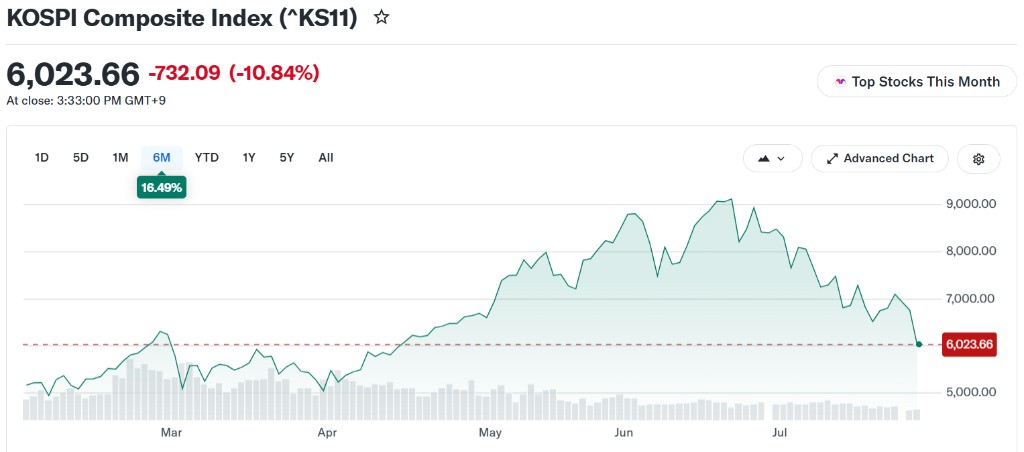
The South Korean stock market has experienced severe volatility, with the KOSPI index plunging more than 33% from its high of 9,000 points, triggering multiple circuit breakers. Investor sentiment has rapidly shifted from FOMO (Fear Of Missing Out) in the first half of the year to JOMO (Joy Of Missing Out), with retail investors feeling relieved for staying on the sidelines. Despite heavy losses from the market crash, some analysts view the pessimism as a contrarian buying signal and have raised their target prices for the second half of the year
The South Korean stock market underwent a dramatic reversal within a month, leading to a theatrical shift in investor sentiment. Last month, as the KOSPI index broke through the 9,000-point mark and aimed for 10,000, the market was permeated by FOMO (fear of missing out), with the feeling that "I'm the only one who didn't get on board." However, as the index subsequently plummeted by more than 30%, the psychology of JOMO (joy of missing out)—"thank goodness I didn't enter the market"—is rapidly spreading among retail investors.
On Tuesday, the KOSPI index crashed by 10.76%, marking its largest single-day drop since 1998. The cumulative decline from the historical high of 9,063.84 points set on the 18th of last month has exceeded 33%. The KOSDAQ index for growth stocks also fell below the 700-point threshold on the same day, hitting its lowest level since April last year. Both markets triggered circuit breakers sequentially. So far this year, the KOSPI has triggered circuit breakers eight times, accounting for more than half of the total historical record of 14 instances.
The market crash has inflicted heavy losses on retail investors, causing both standby funds and margin balances to retreat, while investment sentiment has shrunk sharply. Meanwhile, divergence has emerged in the securities industry: some analysts view extreme pessimism as a contrarian buying signal, while other institutions have raised their KOSPI target price for the second half of the year to 9,000 points.
Retail Investor Sentiment Makes a 180-Degree Turn, JOMO Replaces FOMO
In the first half of this year, the KOSPI soared, and investors who had not entered the market generally felt intense FOMO pressure. At that time, semiconductor leaders Samsung Electronics and SK Hynix led the gains, with SK Hynix briefly approaching the 3 million South Korean won mark during intraday trading. Those without positions were stimulated by friends' "get-rich-quick stories" and felt considerable anxiety.
As the market trend reversed, the tone in online investment communities changed rapidly. Posts such as "It's a huge blessing that I didn't buy when I said I would" and "Those who didn't buy are the winners" appeared frequently. A netizen (aged 25) who had not entered the market stated, "In the first half of the year, every time I heard friends say they earned enough from stocks to buy a car, I felt bitter. But later, when I heard that the friend who vowed to buy a Genesis could no longer even afford a used car, I thought, 'Thank goodness I didn't enter the stock market,'" adding that he "has no plans to trade stocks in the future either."
FOMO and JOMO appear opposite on the surface but share the same root—they are both re-evaluations of one's choices after the results are known.
Crash Data: Frequent Circuit Breakers, Leading Stocks Halved
The intensity of this downturn is intuitively reflected in the data. The KOSPI has fallen more than 33% from its high, while the KOSDAQ has retreated to 701.33 points, its lowest level since April last year. According to data from Investing.com, South Korea's major indices have recorded the largest declines among global major markets over the past month, forming a sharp contrast with the U.S. S&P 500 Index, which fell by only about 0.39% during the same period.
At the individual stock level, Samsung Electronics has cumulatively fallen 31% from its high, while SK Hynix has dropped by 38%. According to an analysis by Korea Investment & Securities, as of the 27th, 42% of the 872,000 Samsung Electronics investors were in loss, and the proportion of losing investors among the 400,000 SK Hynix holders reached as high as 57%. With further sharp declines in share prices on the 28th, the proportion of losing investors is expected to rise further.
On that day, the KOSPI and KOSDAQ markets sequentially triggered sell-side pauses and circuit breakers. So far this year, the KOSPI has triggered circuit breakers for the eighth time; out of the total historical record of 14 triggers, more than half occurred this year alone.
Capital Accelerates Exit, "Ammunition" and Leverage Shrink Simultaneously
The depletion of retail investors' "ammunition" confirms the shift in sentiment. Data from the Financial Investment Association shows that as of the 24th, investor deposit funds stood at 105.6370 trillion South Korean won, a decrease of about 31 trillion won from the high of 136.8313 trillion won on the 23rd of last month, dropping to the lowest level in about five months. Trading volume also contracted, with the total trading amount in the domestic stock market at 34.5238 trillion South Korean won, a decline of more than 33% compared to 51.8113 trillion won at the beginning of this month.
Leveraged funds are also contracting. The balance of credit transaction financing fell to 32.6717 trillion South Korean won, the lowest in about four months, a decrease of about 6 trillion won from the high of 38.6328 trillion won. Between June 24 and July 24, the total actual reverse trading amount from forced liquidations amounted to 997.1 billion South Korean won, indicating that forced liquidations continued to occur during the sharp decline.
Analysts point out that retail investor pessimism and capital outflows may constitute pressure during any future rebound—if investors seize the opportunity to sell off holdings to reduce losses whenever stock prices recover, the elasticity of the index's rebound will be constrained.
Market Divergence: Is Extreme Pessimism a Trap or an Opportunity?
Despite the sluggish sentiment, views within the securities industry on the market outlook remain divided.
Lee Min-geun, a researcher at Korea Investment & Securities, stated, "Paradoxically, this level of pessimism can also be interpreted as a contrarian signal"—if most investors have completed their selling and additional selling pressure decreases, even small positive news could trigger a rebound.
In its second-half outlook report, DS Securities noted that "even reflecting a 30% decline in earnings per share under the worst-case scenario, the KOSPI remains undervalued," and raised its KOSPI target for the second half of the year to 9,000 points.
In the semiconductor sector, Morgan Stanley analyst Joseph Moore suggested in an investor report that this correction presents a buying opportunity on dips. He stated that the shortage of memory semiconductors will intensify further between 2027 and 2028, and predicted that memory prices in the third quarter of this year would rise by at least 25% compared to the previous quarter. "The downside phase of this cycle is inevitable, but the current weakness should be viewed as a buying opportunity."
For investors still in the market, maintaining judgment amidst the spreading JOMO sentiment may well be the greatest test at present.
Risk Warning and Disclaimer
The market carries risks; investment requires caution. This article does not constitute personal investment advice, nor does it take into account the specific investment objectives, financial status, or needs of individual users. Users should consider whether any opinions, views, or conclusions in this article align with their specific circumstances. Responsibility for investments made based on this content lies solely with the investor.