
Qualcomm Q3 Net Profit Falls 25% YoY; Raises Product Prices and Issues Weak Guidance | Earnings Review
 Complete. Here is the key summary
Qualcomm reported its third fiscal quarter results, with revenue dropping 4% year-over-year to $9.95 billion and net profit falling 25% to $2 billion. The core pressure stemmed from a roughly 300% year-over-year surge in memory chip prices, while mobile chip revenue plummeted 20% to $5.1 billion. Fourth-quarter guidance missed expectations, leading to an approximately 4% drop in after-hours stock price
Qualcomm Inc. released its quarterly earnings, with net profit declining 25% year-over-year as the mobile chip business faced significant pressure from sharply rising memory prices.
After the U.S. market close on July 29 local time, Qualcomm published its third fiscal quarter report. Revenue decreased 4% year-over-year to $9.95 billion, slightly exceeding Wall Street expectations, but net profit for the quarter fell to $2 billion.
For the current fourth fiscal quarter outlook, the company expects adjusted earnings per share (EPS) to range between $2.05 and $2.25, with revenue guidance between $9.7 billion and $10.5 billion.
Even at the upper end, the adjusted EPS remains below analysts' previous expectations of $2.36 to $2.38, disappointing investors. Following the announcement, Qualcomm's stock price fell approximately 4% in after-hours trading.
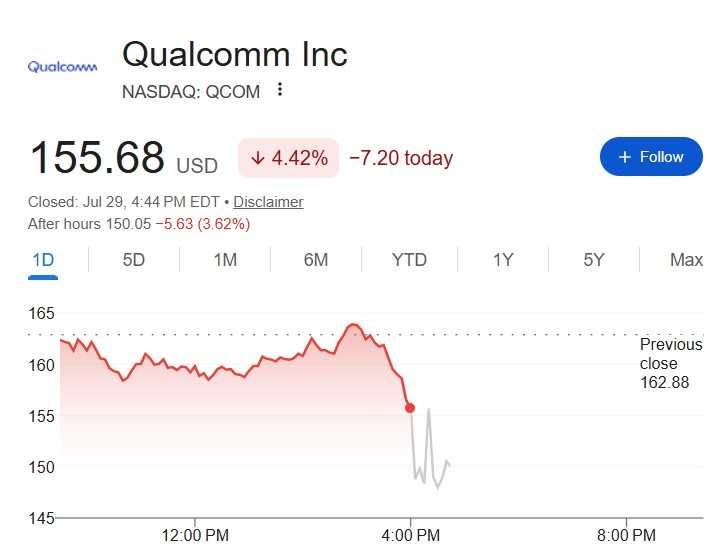
The company subsequently announced it would raise product prices across the board starting September 1 to pass on continuously rising supply chain costs. Qualcomm CEO Cristiano Amon stated plainly:
Costs have gone up, so prices must follow.
He indicated that this round of price hikes is a short-term measure to cope with high supply costs and is expected to gradually improve the company's gross margin over time.
Memory Shortage Impacts Mobile Business, Core Revenue Plummets
The primary trigger for Qualcomm's performance pressure was the sharp increase in global memory chip prices.
According to reports, memory chip costs rose approximately 300% year-over-year this quarter. This significant increase substantially pushed up the manufacturing costs of complete smartphones, suppressing end-user consumer demand.
Mobile chip revenue for the quarter declined 20% year-over-year to $5.1 billion. Amon stated that due to rising memory prices, the price competitiveness of mid-to-low-end smartphones has significantly decreased. Furthermore, even in the high-end Android smartphone market where Qualcomm holds a dominant position, consumers are shifting towards lower-priced flagship models or purchasing previous-generation products.
Amon said:
Consumer preferences within the high-end category are changing, increasingly leaning towards the lower end of the high-end segment, or simply choosing last year's older models. This shift is driven by the rise in memory prices.
At the industry level, according to data from International Data Corporation (IDC), global smartphone shipments in the second quarter of this year fell 6.7% year-over-year, marking the second consecutive quarter of decline, with only Apple and Samsung achieving growth against the trend.
The semiconductor industry as a whole is also deeply entrenched in the dilemma of rising costs. In its financial report, Qualcomm pointed out that widespread increases in input costs have occurred in wafer fabrication, packaging and testing, advanced packaging, memory, and other materials.
Aggressive Price Hike Language, Gross Margin Recovery Expected in Second Half
Facing cost pressures, Qualcomm chose to take the initiative.
The company announced that it would raise prices across all its chip product lines starting September 1, covering various product categories currently sold primarily to smartphone manufacturers. Amon characterized this as a "temporary short-term measure" and emphasized that the company is optimizing its supply chain through various methods.
As previously mentioned by Wallstreetcn, the magnitude of Qualcomm's price increase reaches double-digit percentages. In its earnings statement, Qualcomm stated that this move aims to "reflect higher costs in product pricing" and is expected to drive gross margin improvements over time.
Notably, Qualcomm also warned that Apple is accelerating the switch of modem chips in iPhones to its self-developed solutions, a process happening faster than previously expected.
Qualcomm expects that revenue from Android-based phones will decline approximately 20% year-over-year in fiscal year 2026, resulting in an EPS loss of more than $1.50, constituting a substantial drag on the company's long-term profits.
Automotive and IoT Businesses Become Growth Pillars
Against the backdrop of sluggish mobile business performance, Qualcomm's diversified layout provided important support for its results.
Automotive chip business revenue reached $1.59 billion this quarter, becoming a highlight. The company proposed a goal of achieving $10 billion in automotive business revenue by fiscal year 2029 in June this year, and announced on Wednesday that it had signed a digital cockpit chip supply agreement with BMW.
Internet of Things (IoT) business revenue, targeting industrial low-power applications and devices such as smart glasses, grew 9% year-over-year to $1.83 billion. Additionally, Qualcomm's intellectual property licensing division, QTL, generated revenue of $1.28 billion for the quarter, slightly exceeding market expectations of $1.26 billion.
Amon stated that Qualcomm's non-smartphone business revenue, covering automotive, data centers, and IoT, is expected to grow to $40 billion by fiscal year 2029, with plans to increase the proportion of non-mobile business to 60% of total revenue by fiscal year 2027.
Betting on Data Centers, AI Infrastructure Competition Intensifies
Qualcomm is actively expanding into the AI data center infrastructure market to reduce its reliance on the smartphone business.
Amon reiterated that the company still expects its data center business revenue to reach the $5 billion target next year. In June this year, Qualcomm announced Meta as its first technology hyperscale customer for its AI data center processors.
On Wednesday, Qualcomm also announced the completion of its acquisition of Modular, an AI programming technology software company, and stated that it will officially launch its AI software platform at an industry conference in August this year.
However, Qualcomm's AI transformation path is not smooth. NVIDIA has surged from a company with a market capitalization of approximately $400 billion to a market giant worth over $4.6 trillion today. This market space has attracted numerous chip companies, including Qualcomm and Arm, to compete for layout.
Meanwhile, the heavy investment in AI infrastructure is exacerbating tensions throughout the electronic product supply chain, which in turn pushes up consumer-side costs, leaving smartphone chip suppliers like Qualcomm in a dilemma.