
Apple's Greater China and services business quarterly sales fell short of expectations, with supply shortages dragging down financial forecasts
 Complete. Here is the key summary
Apple's fourth fiscal quarter revenue growth forecast is lower than analysts' expectations, primarily affected by shortages of storage chips and processors, which hindered the iPhone, Mac, and iPad businesses. Although total revenue exceeded expectations, sales in Greater China and service business income fell short of expectations. Additionally, CEO Tim Cook is set to step down, with John Ternus taking over
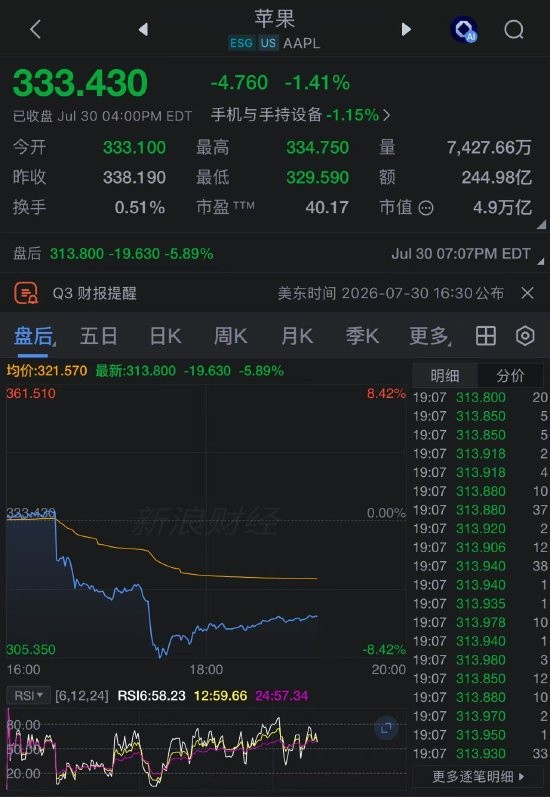
Apple's stock price plummeted in after-hours trading, as component shortages weighed on sales expectations, indicating that the negative impact of supply chain constraints faced by the entire industry is more severe than anticipated.
On Thursday, Apple stated during its earnings call that revenue for the fourth fiscal quarter ending in September is expected to grow by 9% to 11%. Analysts had previously expected an increase of over 12%.
Apple has been plagued by shortages of memory chips and computer processors, which forced the company to raise prices for Mac and iPad in June. The tight supply has led to extended delivery wait times for key computer products such as the Mac mini and Mac Studio.
Chief Financial Officer Kevan Parekh stated during the call that supply constraints will impact iPhone, Mac, and iPad businesses in the quarter ending in September. He mentioned that currency fluctuations are also dragging down growth.
The earnings report also showed that Apple's service business and sales in Greater China grew slower than analysts expected, raising investor concerns about these two key markets.
Despite total revenue exceeding analyst forecasts, Apple's sales in Greater China for the third fiscal quarter were $18.8 billion, significantly lower than the $19.6 billion expected by analysts. Service revenue was $30.7 billion, also below the forecast of $31.4 billion.
To some extent, the last fiscal quarter also marked the farewell performance of CEO Tim Cook. Cook will hand over management to hardware business head John Ternus on September 1. Since taking the helm at Apple in 2011, Cook has diversified the product line and increased the company's annual sales to nearly $500 billion.
 John Ternus
As Apple's largest source of revenue, the iPhone was the highlight of Thursday's performance. The product's quarterly revenue grew by 22% to $54.3 billion, exceeding the market expectation of $53.6 billion. Relevant data indicates that demand for the iPhone 17 series, launched in September last year, remains robust. The company also introduced a new low-cost model, the iPhone 17e, in March this year.
Service revenue, including Apple Music, App Store, iCloud subscriptions, streaming video, and other digital services, grew by 12% last fiscal quarter, which was disappointing.
For the quarter ending June 27, Apple's earnings per share rose to $2.02, higher than the average analyst expectation of $1.89 Mac business revenue was approximately $10.4 billion, a year-on-year increase of 29%, far exceeding the market expectation of $8.62 billion. In March this year, Apple launched several new Mac products, including the MacBook Neo, the MacBook Pro equipped with the M5 chip, and the new MacBook Air.
iPad business revenue was $6.19 billion, below analysts' expectations of $6.89 billion. Apple launched the new iPad Air in March this year and updated the iPad Pro last October, but both products mainly upgraded the chips rather than making significant design changes.
Apple plans to launch several new Macs and iPads from the end of this year to spring next year to boost sales, including the first touchscreen MacBook and a new iPad mini