
AI bulls face the first hard threshold after the surge at the end of July! Kalshi jumps ahead of Wall Street to issue a July non-farm payroll warning
 Complete. Here is the key summary
The prediction market platform Kalshi shows that speculators believe the probability of the U.S. non-farm payrolls adding more than 80,000 jobs in July is only 47%, lower than the Dow Jones consensus expectation of 85,000. The central expectation is concentrated in the range of 70,000 to 80,000, with vigilance towards tail risks below 60,000. Before the data is released, bulls in sectors like semiconductors hope to see a result of "low growth but not stalling."
According to the Zhitong Finance APP, the U.S. Bureau of Labor Statistics is set to release the July non-farm employment statistics report on Friday morning local time. According to consensus expectations from Dow Jones, economists generally anticipate that the number of new jobs added in July will be 85,000. However, bettors on the prediction market platform—globally renowned paid prediction platform Kalshi—believe that the actual non-farm employment data may fall below this level. For the bullish camp in the stock market, especially those bullish on the semiconductor sector, a "low-growth but not stalled" non-farm labor market is what they are very eager to see.
Speculators from prediction market companies like Polymarket and Kalshi seem to believe that the probability of U.S. employers adding more than 80,000 jobs in July is only 47%; they also estimate that the probability of adding more than 70,000 jobs that month is about 60%.
Contracts on the Kalshi prediction platform require traders to predict whether the July employment data will exceed a series of given values. The contracts will be settled in cryptocurrency or stablecoins based on the official data released by the U.S. Bureau of Labor Statistics.
Although the likelihood is low, it is not impossible for the actual data to exceed market consensus expectations. Some speculators still seem to believe that the probability of U.S. employers adding 90,000 jobs in July is 41%, while the probability of the number of new jobs reaching six figures is slightly above one-third.
However, the speculative forces on the prediction platform also seem to believe that the probability of the data being below 60,000 is one-third. This also indicates that the central expectation of prediction market speculators remains close to the 70,000–80,000 range, but they maintain a clear vigilance against the tail risk of being below 60,000.
Last month, bettors on the Kalshi platform unanimously believed that the probability of employers adding more than 125,000 jobs in June was 63%, higher than the market consensus expectation of 115,000. However, the official data released by the U.S. government was far below this level, showing that only 57,000 jobs were added that month.
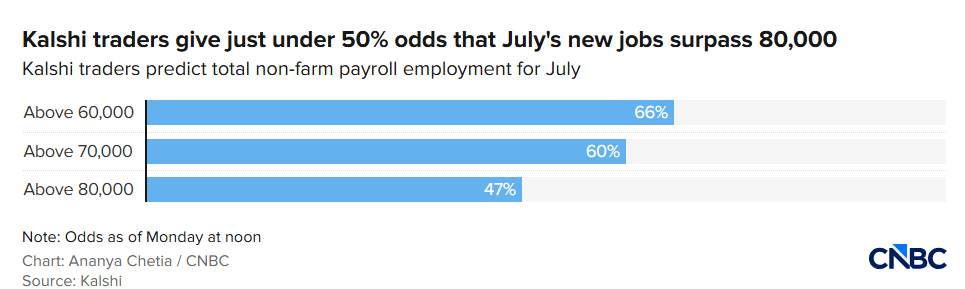
The U.S. Bureau of Labor Statistics will release the July employment report on August 7; a Reuters economist survey report shows that economists expect an average of about 83,000 to 85,000 new non-farm jobs and an unemployment rate of about 4.3%. Other survey reports have median predictions roughly in the range of 82,000 to 90,000, with more optimistic Wall Street institutions like Barclays predicting about 100,000. Compared to the mere 57,000 jobs added in June and an unemployment rate of 4.2%, the consensus expectation essentially bets on a "low growth but not stalled" moderate growth labor market.
A perfectly soft landing non-farm report—where job additions moderate, the unemployment rate changes only slightly, and wage growth continues to cool—can reduce inflation and the pressure for further interest rate hikes by the Federal Reserve, lower real interest rates and valuation discount rates, while not triggering an economic recession, corporate profit downgrades, or cuts in AI capital expenditures. After only 57,000 jobs were added in June, the market gained some breathing room precisely because the cooling labor market weakened recent interest rate hike expectations Non-Farm Payrolls Become the "Lifeline" for Tech Stock Bulls: A Mild Cooling in Employment is the Ideal Fuel for AI-Themed Rebound
For global stock bulls, the most favorable outcome is not that non-farm payrolls are as strong as possible, but rather an increase of about 70,000 to 100,000 jobs, with the unemployment rate stable at 4.2% to 4.3%. This "Goldilocks investment scenario" indicates that U.S. consumption and corporate profits have not slipped into recession, while also not forcing the Federal Reserve to tighten its interest rate path, thereby lowering real interest rates and equity risk premiums. This is particularly beneficial for AI computing infrastructure themes and AI application stocks—namely, semiconductors, electronic components at data centers, and AI application software assets—which are most sensitive to valuation and have longer durations.
If job additions significantly exceed 100,000 and wage growth accelerates again, the market will interpret this as demand still being too hot, leading to a potential rise in the probability of a rate hike in September, as well as an increase in the dollar and U.S. Treasury yields. As of the end of July, the market had priced in about a 64% probability of a rate hike in September, and the 30-year U.S. Treasury yield had once risen to around 5.24%. High-valuation growth stocks would have no room to absorb a second round of interest rate shocks. Conversely, if job additions fall below the critical market threshold of 60,000, accompanied by a rising unemployment rate, declining hours worked, and significant downward revisions to previous values, bonds may initially rise, but the trading logic will quickly shift from "interest rate favorable" to "earnings recession," putting pressure on cyclical stocks, financial stocks, and the global export market.
Therefore, non-farm payrolls serve as a test to determine whether the violent rebound at the end of July was merely a technical correction after forced liquidations or the first hard threshold of a new round of risk appetite. On August 3rd, hopes for negotiations with Iran pushed oil prices down by about 5%, and U.S. Treasury yields fell, with the S&P 500 and Nasdaq rising by 1.48% and 2.13%, respectively. This indicates that the current bulls still rely heavily on the resonance of "cooling oil prices + falling interest rates + strong tech earnings." If non-farm payrolls are too strong, it will raise the interest rate anchor again and compress AI valuations; if too weak, it will shake earnings and credit quality.
The market in August continues to embrace a bullish direction, and what is truly needed is not a single favorable factor, but rather a mild cooling in employment, continued declines in oil prices, and resilient corporate earnings. Only in this way can the leveraged positions and extremely crowded positions from July's forced liquidations and clearances potentially transform into a healthy trend of capital reinvestment. Otherwise, the current rebound may still just be a high volatility recovery from extreme deleveraging