
WuXi AppTec's Triple Resonance: Pipeline, Capacity, and Peptides
 Complete. Here is the key summary
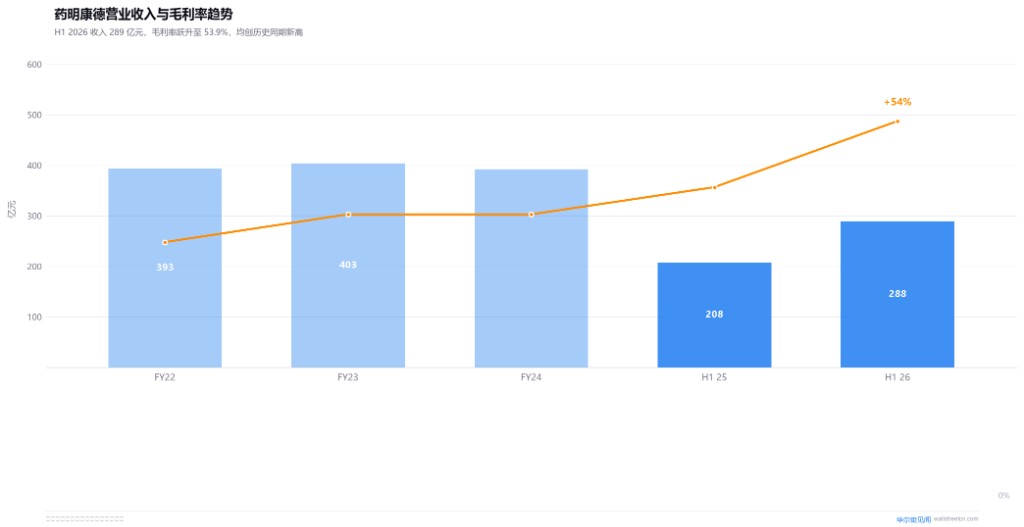
WuXi AppTec hit the daily limit up at the opening on August 4, with its market capitalization increasing by nearly RMB 40 billion in a single day. The interim report shows that due to a RMB 3 billion non-recurring gain from the sale of equity in WuXi XDC in 2025, the growth rate of net profit attributable to shareholders was only 29.4%, while the net profit excluding non-recurring items surged by 89.4% year-on-year. The gross margin jumped from 44.4% to 53.9%, mainly benefiting from the triple resonance effect of increased capacity utilization rate, optimized product structure, and process improvements, indicating strong fundamental operations
On August 4, WuXi AppTec hit the daily limit up at the opening, with its market capitalization swelling by nearly RMB 40 billion in a single day. For a giant with a trillion-yuan valuation to seal the limit so decisively, the answer must lie in the interim report released the previous night.
The question is not whether the performance is good—companies with revenue nearing RMB 29 billion and profits exceeding RMB 10 billion are inherently strong. The real question is: Have the market's biggest concerns over the past two years materialized?
One number provides the answer: Net profit excluding non-recurring items increased by 89.4% year-on-year, while the surface-level growth in net profit attributable to shareholders was only 29.4%. This 60 percentage point gap reflects a misalignment in market perception—you thought it had hit a ceiling, but it is actually accelerating.
Two Versions of WuXi AppTec on the Income Statement
To understand the two versions of WuXi AppTec, we must first look back at the divestment in 2025.
In the first half of 2025, WuXi AppTec disposed of part of its equity interest in its associate, WuXi XDC, recognizing a one-time gain of approximately RMB 3 billion. This gain was included in the net profit attributable to shareholders but did not correspond to any operating cash flow, representing a one-time profit or loss.
By the first half of 2026, this RMB 3 billion one-time gain was no longer present. The net profit attributable to shareholders for the period was RMB 11.08 billion, representing a year-on-year growth of only 29.4%, which appears "flat." However, stripping out the one-time gains and losses, the year-on-year growth in net profit excluding non-recurring items was 89.4%. Removing this noise reveals that the true operating profit nearly doubled.
This difference does not mean growth slowed in 2026; rather, the one-time gain in the first half of 2025 raised the base. Removing this gain shows that true operations achieved near-doubling growth.
Let's look at the gross margin. During the reporting period, the gross margin jumped from 44.4% in the same period last year to 53.9%, a leap of 9.5 percentage points in just half a year. This magnitude is extremely rare and difficult to achieve through a single factor alone.
Breaking it down, there are three drivers: The continuous ramp-up of the capacity utilization rate diluted unit fixed costs; the proportion of late-stage and commercial projects increased, leading to higher average prices per project; and continuous optimization of production processes reduced unit material and energy consumption.
Analysts at China International Capital Corporation (CICC) put it more directly: This expansion in gross margin is the result of a "triple resonance" of scale effects, product structure optimization, and process improvements. This triple resonance is more solid than a single driver, implying that most of the 9.5pp increase is structural and sustainable, not a one-time realization.
The adjusted net profit margin for Q2 alone reached 42.4%, higher than JPMorgan analysts' full-year forecast of approximately 36%. JPMorgan analysts maintained their "Overweight" rating. A single-quarter net margin exceeding analysts' full-year expectations indicates that previous earnings forecasts were generally conservative.
Three Accelerators for the Chemistry Business
The chemistry business is WuXi AppTec's core foundation, and the three core metrics in this interim report all point to acceleration.
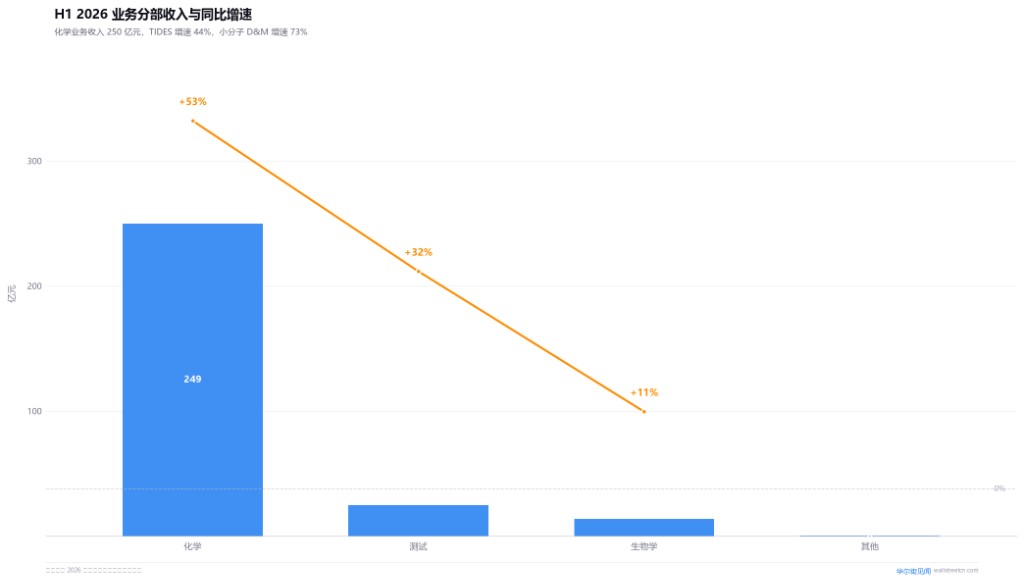
First, consider the revenue scale. In the first half of 2026, revenue from the chemistry business was RMB 24.986 billion, a year-on-year increase of 53.3%, accounting for 86.5% of the company's total revenue. Such a growth rate for a business with a volume nearing RMB 25 billion is very rare.
Next, look at the internal structure. The chemistry business is split into two sub-segments: Small Molecule D&M (Process Development and Manufacturing) revenue was RMB 14.99 billion, up 72.7% year-on-year; TIDES (Oligonucleotides and Peptides) revenue was RMB 7.26 billion, up 44.3% year-on-year. Small Molecule D&M accounts for 60% of the chemistry business, making it the largest segment by volume.
Then there is the pipeline. As of the end of June 2026, the total number of projects in the Small Molecule D&M pipeline reached 3,731, including 95 commercial projects and 94 Phase III clinical projects, with 15 new late-stage projects added in the half-year. Late-stage projects imply higher unit prices, deeper binding, and longer cycles.
These three numbers form a chain: "pipeline shifting to later stages → volume acceleration → structure optimization." As customers advance molecules to late-stage clinical development, these molecules get closer to commercialization, and orders for process development and manufacturing expand accordingly. The late-stage clinical projects undertaken by WuXi AppTec over the past three years are now concentrating into revenue realization.
Increased capacity utilization rate is another hidden clue.
Several new capacity bases built in 2025 entered the "capacity ramp-up phase." Unit costs are typically high in the initial stage of new facility production, but as processes mature and order density increases, the cost per project drops rapidly. The 9.5pp jump in gross margin in the first half of 2026 was partly due to efficiency releases after the completion of capacity ramp-ups.
The third accelerator is process optimization. In the CDMO industry, process details determine gross margins. Minor improvements in peptide synthesis, continuous flow reactions, purification processes, and equipment utilization rates all accumulate into the gross margin. This process is difficult to dissect in public data, but the 53.9% gross margin itself demonstrates that the company has not stopped refining details in every process link.
TIDES: A Moat Not on the Balance Sheet
If one were to find the strongest moat within WuXi AppTec's RMB 500 billion market capitalization, the answer might be TIDES. Although this moat does not appear on the balance sheet.
TIDES is the collective term for the oligonucleotide and peptide CDMO business. In the first half of 2026, TIDES revenue was RMB 7.26 billion, a year-on-year increase of 44.3%. Internally, this is one of the fastest-growing sub-segments by volume. The company also raised its full-year growth guidance for TIDES from approximately 40% to approximately 45%.
Why TIDES? Because it sits in a global track facing capacity shortages.
The core indications for peptide drugs are diabetes and weight loss (GLP-1 class). The global sales boom of Semaglutide and Tirzepatide, two GLP-1 drugs, is just one aspect of this track. Behind them lie new directions such as oral GLP-1s, oral cyclic peptides, and tumor peptides. Regardless of the direction, both process development in the R&D stage and commercial supply in the production stage face the same problem: Limited global capacity to undertake peptide CDMO orders.
WuXi AppTec is one of the few global leaders in peptide CDMO. In the first half of 2026, the number of customers served by TIDES D&M increased by 39% year-on-year, and the number of molecules served increased by 68% year-on-year. These two figures mean that more customers are coming to WuXi, and each customer is assigning more projects to WuXi.
The moat for peptides is hard to replicate. Chemical synthesis capacity can be built with money—more reactors, more production lines—but the core bottlenecks in peptide synthesis lie in process know-how, purification technology, large-scale GMP compliance experience, and practical accumulation from "how many projects have been done." WuXi began laying out this line more than a decade ago and has now formed dual barriers of scale and technology.
The TIDES moat can be seen in three areas: Higher growth rate than the overall chemistry business (44.3% vs. the pure chemical portion of 53.3%), higher order visibility (long-term supply contracts with GLP-1 customers often last 3-5 years), and room for gross margin expansion (increasing proportion of high value-added products).
Therefore, analysts generally regard TIDES as the core variable for WuXi AppTec's medium-to-long-term valuation repair. It is not just a business line, but an independent growth curve.
Business Structure is Undergoing a Qualitative Change, Not Just Quarterly Performance Fluctuations
The calibration signal given by WuXi AppTec this time is: The CRDMO integrated model is entering a compound interest realization period characterized by scale effects, pipeline shifting to later stages, and TIDES explosion. The 89.4% growth in net profit excluding non-recurring items, the 9.5pp jump in gross margin, and the RMB 66.4 billion in backlog orders all point to the same conclusion: The business structure is undergoing a qualitative change, not just quarterly performance fluctuations.
However, a good interim report will not eliminate all hanging swords. The ruling on the 1260H lawsuit will be the next keyword. Before this sword falls, investors cannot fully price in a certainty premium.
Next, watch three observation points: Whether backlog orders in Q3 can continue to grow by more than 25%, verifying that customers have not withdrawn; Whether TIDES can maintain the full-year growth rate of 45%, verifying that this is not a one-quarter trend; When and how the 1260H lawsuit will be ruled.
Optimism among institutional investors has already formed. CICC analysts raised the A-share target price by 28.5% to RMB 167, while JPMorgan analysts set the H-share target price at HKD 184 and maintained their "Overweight" rating. However, there is always a Pacific Ocean of expectation gaps between institutional views and pricing power.
Risk Warning and Disclaimer
The market carries risks; investment requires caution. This article does not constitute personal investment advice, nor does it take into account the specific investment objectives, financial status, or needs of individual users. Users should consider whether any opinions, views, or conclusions in this article align with their specific circumstances. Investment decisions made based on this content are the sole responsibility of the investor.