
Why Is Healthcare the Best Non-AI Sector?
 Complete. Here is the key summary
HSBC Qianhai Securities points out that China's healthcare sector has become a capital safe haven during AI market volatility, driven by its global growth prospects and attractive valuations. Driven by the triple logic of AI capital rotation, improving earnings expectations, and allocation demand for non-AI sectors, H-share and A-share healthcare indices have rebounded significantly. Institutions maintain buy ratings on companies such as WuXi Biologics, favoring the pharmaceutical outsourcing and biotechnology directions
China's healthcare sector is becoming a core safe haven for global capital during fluctuations in the AI-themed market rally. Since bottoming out on June 26, 2026, the H-share and A-share healthcare indices have rebounded by 16% and 11% respectively, significantly outperforming the broader market, as an innovation-driven globalization narrative continues to drive capital inflows into this sector.
According to Zhuifeng Trading Desk, over 30 offline roadshows held by HSBC Qianhai Securities in Singapore, Hong Kong, and Shanghai showed that the investor structure has expanded from professional healthcare investors to include general industry investors and technology fund managers, indicating that the appeal of the healthcare sector is penetrating across different investor circles. The report stated:
Amid volatility in the AI-themed market rally, focusing on Chinese healthcare companies (especially those with global growth prospects) is becoming a market consensus.
Investors generally believe that this rebound will last at least until July 31 or September 1, when interim results are released, based on the fundamental logic that the market is "catching up" on the strong fundamentals already demonstrated in the first half of the year.
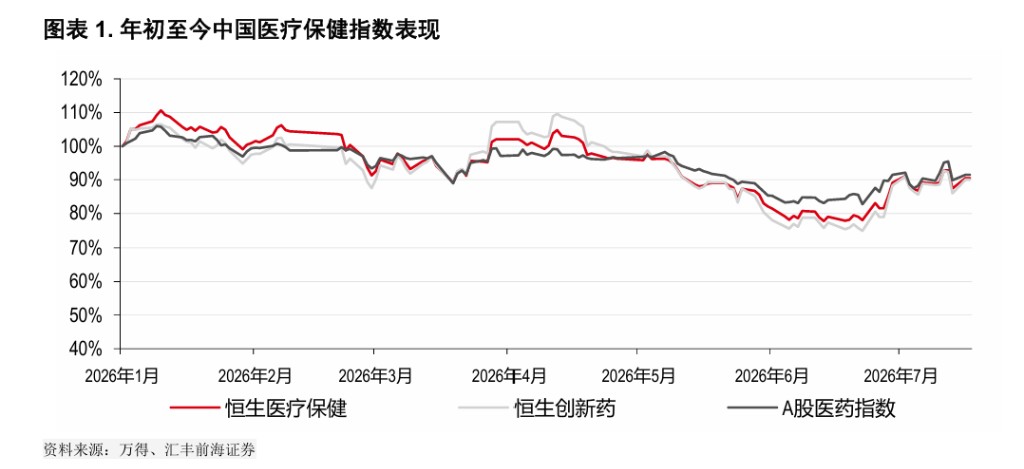
HSBC Qianhai Securities maintains buy ratings on WUXI BIO, Pharmaron, Keymed Biosciences, and Innovent Biologics, believing that the healthcare innovation industry offers both short-term catalysts and long-term potential, with global business expansion and strong clinical data continuing to drive growth.
What Is Driving the Rebound: Resonance of Triple Capital Logic
The rapid rebound in the healthcare sector was not caused by a single factor.
According to feedback from HSBC Qianhai Securities' roadshows, investors attribute this rise to the superposition of three logical factors:
First, AI-related funds actively reduced positions, rotating capital into sectors with more attractive valuations; second, based on favorable earnings expectations for the first half of 2026, capital flowed from AI, technology, and consumer sectors into healthcare; third, the market rotated toward non-AI sectors, positioning the healthcare sector—with its innovation-driven global prospects—as an active target.
As a result, the H-share healthcare index rebounded 7 percentage points more than the Hang Seng Index over the same period, while the A-share healthcare index outperformed the CSI 300 Index by a significant 19 percentage points.
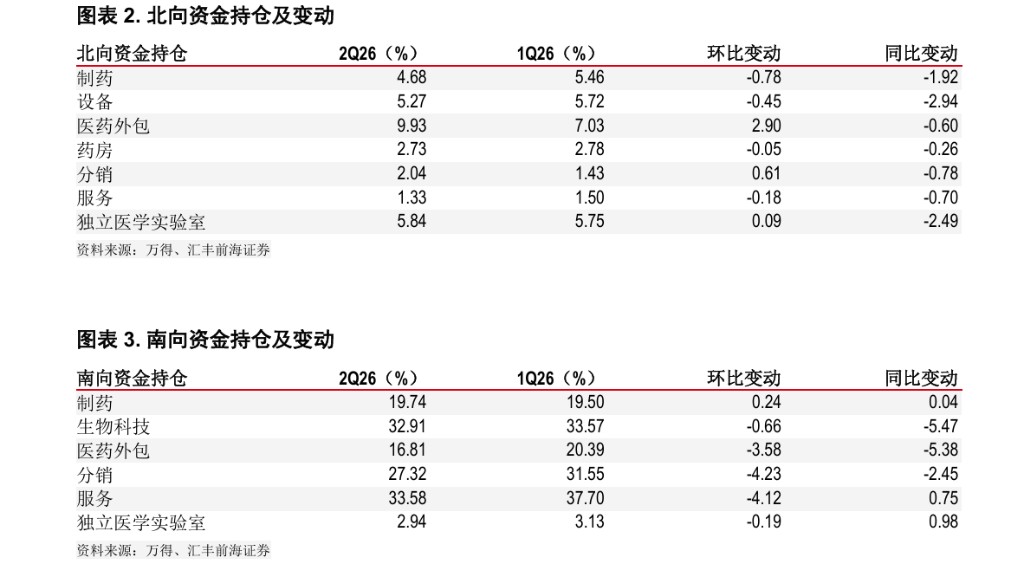
What Do Institutions Favor Most: Outsourcing and Biotechnology Lead the Way
In terms of sub-sector allocation, global investors most favor pharmaceutical outsourcing and the biotechnology & pharmaceuticals directions.
In pharmaceutical outsourcing, investors have heavily positioned in WuXi AppTec, mainly due to high market expectations for its performance in the first half of 2026; WUXI BIO and Pharmaron are also viewed favorably, with the core logic being their prospects for accelerated growth from 2026 to 2028 and the potential for margin expansion.
WuXi AppTec's first-half performance greatly exceeded expectations, achieving revenue of RMB 28.898 billion (+38.9%) during the reporting period, with net profit attributable to shareholders exceeding the RMB 10 billion mark for the first time in a half-year period, reaching RMB 11.080 billion (+33.7%), and adjusted net profit of RMB 11.570 billion (+83.2%). More notably, the company raised its full-year revenue guidance from 18%-22% to 35%-39% in one go, and increased capital expenditure from RMB 6.5-7.5 billion to RMB 7.5-8.5 billion—a first in the company's history.
In biotechnology and pharmaceuticals, both general industry investors and professional healthcare investors remain positive about Innovent Biologics and Kelun Biopharm, primarily based on their strong domestic business growth and the visibility of overseas BD (business development) prospects. Additionally, CSPC Pharmaceutical Group and Hansoh Pharmaceutical were widely discussed in roadshows due to their business development momentum and expectations for valuation sum-of-the-parts analysis.
How Far Can the Rebound Go?
Despite the significant improvement in sentiment, investors still have three core controversies regarding this sector.
First, policy uncertainty remains, including the unclear pace of progress in centralized procurement of biosimilars for public hospitals, centralized procurement of medical devices, and reforms in medical service pricing. Second, if the AI-themed market rally returns, related funds may flow out of the healthcare sector again. Third is the risk of external policy-related factors.
Furthermore, the market has lowered growth expectations for pharmaceutical companies, medical device companies, and hospitals due to the ongoing anti-corruption campaign in healthcare.
HSBC Qianhai Securities pointed out that catalysts worth watching for in China's biotechnology sector include: the commercialization progress of relevant companies in the US market, data readouts from the ESMO annual meeting, and the release of Harmoni 3 data.
Risk Warning and Disclaimer
The market involves risks, and investment should be approached with caution. This article does not constitute personal investment advice, nor does it take into account the specific investment objectives, financial status, or needs of individual users. Users should consider whether any opinions, views, or conclusions in this article align with their specific circumstances. Investment decisions made based on this content are the sole responsibility of the investor.