
SpaceX Earnings Soar, Yet Stock Plummets! Goldman Sachs Backs AI Business for Disrupting Valuation Logic; Citi Sees Long-Term Target of $900
 Complete. Here is the key summary
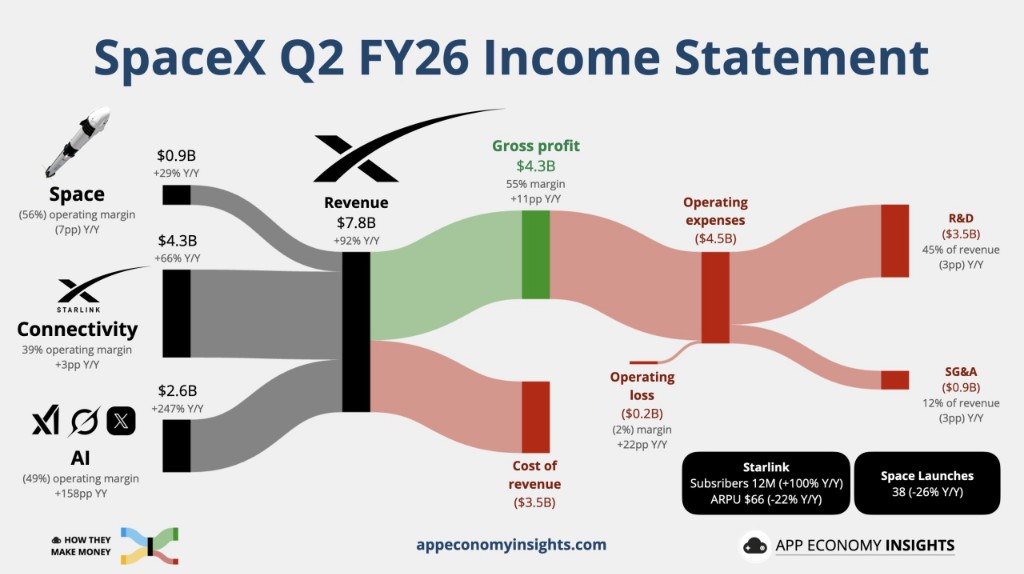
SpaceX released its Q2 2026 financial report, with revenue of $7.814 billion exceeding expectations and GAAP operating profit significantly surpassing forecasts. Goldman Sachs raised its target price to $220, while Citi reiterated its long-term view of over $900. The AI business emerged as the highlight, generating $2.6 billion in revenue and achieving positive EBITDA, thereby disrupting previous valuation logic. Management advanced the annual revenue target of $1 trillion to 2030 or even 2029. Despite strong performance, SpaceX's after-hours stock price fell by 7.46%
SpaceX delivered its first post-IPO earnings report, with all three major business segments exceeding expectations, prompting Wall Street analysts to collectively raise their valuation forecasts. The investment thesis for this space technology giant is undergoing a systematic revaluation in the capital markets.
SpaceX's total revenue for the second quarter of 2026 reached $7.814 billion, approximately 17% higher than Goldman Sachs' forecast and about 15% above the market consensus. GAAP operating profit also exceeded Goldman Sachs' and market expectations by approximately 92% and 91%, respectively.
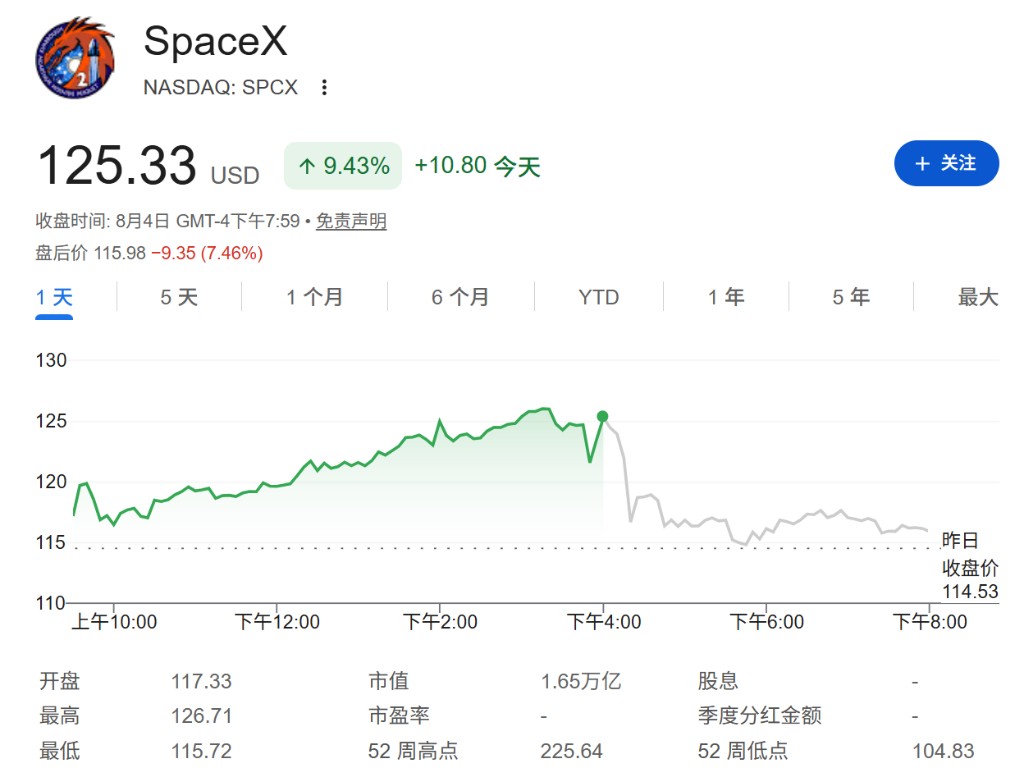
According to Zhuifeng Trading Desk, Goldman Sachs promptly raised SpaceX's 12-month target price from $205 to $220, maintaining a Buy rating. This implies an upside potential of approximately 76% relative to the current stock price of $125.33. The firm noted that SpaceX's stock price has fallen about 42% from its post-IPO closing peak, making the current risk-reward ratio attractive. Citi maintained its Buy rating and $200 target price, reiterating its previously stated long-term view of a price above $900. As of press time, SpaceX's after-hours stock price was down 7.46%.
During the earnings call, management revealed that the company now sees a path to achieving an Annualized Run Rate (ARR) of $100 billion by December. Consequently, they have significantly advanced their previously set annual revenue target of $1 trillion from 2031 to 2030, or "possibly as early as 2029," far exceeding current market expectations.
AI Business Becomes Biggest Surprise, Disrupting Previous Valuation Framework
The AI segment was the largest source of positive surprises this quarter. According to a Citi report, revenue from this business amounted to $2.6 billion in the second quarter, exceeding Citi's expectation by about 24% and the market consensus by about 27%. Adjusted EBITDA reached $1.146 billion, more than 100 times higher than Citi's expectation of approximately $10 million, and representing a directional reversal from the market consensus expectation of a negative $300 million.
Goldman Sachs analysts Eric Sheridan, Alex Vegliante, and Julia Fein-Ashley pointed out in their report that the AI business's outperformance was primarily driven by cloud service agreement revenue. Management stated that the supply-demand gap in AI computing power has resulted in each new cloud service agreement having a better economic model than the previous one. The payback period for AI capital expenditures is currently less than one year, a metric that has led the market to reassess SpaceX's capital allocation logic.
Regarding scale planning, management significantly raised the ground-based computing power target for the end of 2027 from Citi's previous expectation of 4.2GW to 5–10GW. They also indicated that corresponding plans have been implemented for computing power layout projects totaling approximately 20GW, noting that supply chain constraints are the current primary bottleneck rather than insufficient demand. Based on this, Goldman Sachs substantially raised its AI business revenue forecasts for 2026 to 2028, increasing the 2027 AI revenue forecast from $34.467 billion to $70.336 billion, a rise of over 104%.
Citing its previously published initiation coverage report, Citi noted in its analysis that today's AI business outperformance is likely to become a sustained driver of beating expectations in future quarters. Current progress further solidifies the foundation for its long-term target price of over $900.
Starlink Continues Expansion, Ground Network Layout Emerges
The Connectivity business continued its strong momentum. According to Goldman Sachs data, revenue from the connectivity segment in the second quarter was $4.291 billion, exceeding Goldman Sachs' forecast by 8.6%. Adjusted EBITDA was $2.597 billion, surpassing Goldman Sachs' prediction by 12.3%. The number of consumer Starlink broadband users reached 12 million, slightly higher than Goldman Sachs' forecast of 11.8 million.
Management expressed optimism about the backlog of orders from corporate and government clients, pointing out that Starlink penetration in the aviation industry is currently still below 10%, indicating significant growth potential. Goldman Sachs expects that the cash flow generated by the connectivity business in the medium term will become an important source of funding for the capital needs of deep space exploration and the AI business.
Citi Research disclosed a new strategic move: SpaceX revealed that the spectrum purchased from EchoStar will include ground network components. Starlink plans to build a ground network, providing connectivity for mobile bands through small cells and femto cells, with the goal of offering bandwidth superior to existing carriers. Citi believes this plan positions SpaceX as a potential fourth major competitor in the US mobile market, but also notes that large-scale implementation would be difficult without nationwide MVNO cooperation agreements.
Notably, Starlink ARPU was lower than Goldman Sachs' forecast but remained stable quarter-over-quarter. Management stated that as the company advances its localized market strategy, hybrid ARPU may decline over time, which is consistent with Goldman Sachs' previous expectations.
Starship Progress Accelerates, Launch Milestone Approaches
The Space segment generated revenue of $962 million in the second quarter, exceeding Goldman Sachs' forecast by 17.2%. Adjusted EBITDA was -$205 million, with the loss narrowing significantly, exceeding Goldman Sachs' forecast by 57.1%.
Management provided incremental information on Starship progress. According to Citi Research, the 14th flight test of Starship is expected to launch V3 version Starlink satellites into operational orbit, with the possibility of achieving the first "chopstick arm" capture of the spacecraft's second stage. Citi believes that if this milestone is successfully achieved, it will be an important value realization node driving its long-term $900 target price. Management also confirmed that even if the 14th flight fails to achieve this, completing the synchronous capture of both stages by the end of the year remains a established goal. Furthermore, management stated that the Starship heat shield issue has been resolved, and once verified, there are no other technical barriers to achieving full rapid reusability.
Goldman Sachs pointed out that SpaceX has established dominance in the commercial space launch sector, continuously lowering the cost per kilogram to orbit through vertical integration, a feat difficult for competitors to replicate. Goldman Sachs expects the company to build five launch pads by the end of 2027, which could lead to an upward revision of launch frequency assumptions within the next 12 to 18 months.
Significant Forecast Upgrades, High Capital Expenditure Remains Primary Concern
This earnings report prompted Goldman Sachs to make substantial revisions to its earnings forecasts for SpaceX. The Annual Revenue Forecast for the full year 2026 was raised from the previous $38.244 billion to $47.635 billion. The GAAP EBIT forecast jumped from $1.015 billion to $10.063 billion, and the full-year diluted earnings per share forecast was revised from a loss of $0.09 to a profit of $1.00. Looking ahead to 2027, Goldman Sachs expects revenue to further expand to $107.432 billion, an increase of approximately 55% from the previous estimate.
Goldman Sachs used a Sum-of-the-Parts (SOTP) valuation method, discounting the performance forecasts of each segment for 2029, to calculate a base target price of $220, corresponding to an upside potential of about 90%; the optimistic scenario target price is $285. Citi derived its $200 target price based on the average of three valuation methods, while its long-term vision target of over $900 is built upon the full reusability of Starship and the scaled implementation of orbital AI computing.
Notably, Goldman Sachs expects capital expenditures to remain high. Management stated that the quarterly capital expenditure level in the second half of 2026 will be comparable to that of the second quarter. Consequently, Goldman Sachs raised its full-year 2026 capital expenditure forecast to $64.589 billion; the 2027 capital expenditure forecast was further increased to $189.115 billion, with free cash flow expected to remain negative for the next few years. Both institutions pointed out that given the high-return nature of AI capital expenditures, continuous cash burn does not necessarily constitute a major risk. However, concentrated governance, related-party transactions involving the founder, and expectations of large-scale equity dilution remain potential risk factors that investors need to monitor closely.
The above exciting content comes from Zhuifeng Trading Desk.
For more detailed interpretations, including real-time analysis and frontline research, please join [**Zhuifeng Trading Desk ▪ Annual Membership**]

Risk Warning and Disclaimer
The market involves risks, and investment requires caution. This article does not constitute personal investment advice, nor does it take into account the specific investment objectives, financial status, or needs of individual users. Users should consider whether any opinions, views, or conclusions in this article align with their specific circumstances. Investors bear full responsibility for decisions made based on this content.