
Wedbush: MediaTek EMIB yield comment "fully confirms" Google's TPU transfer order to Intel packaging
 Complete. Here is the key summary
MediaTek confirmed that Intel's EMIB packaging yield has reached a "very good" level, eliminating the need to reserve TSMC CoWoS capacity as a backup. Wedbush analysts pointed out that this move further confirms that Google TPU orders may shift to Intel, and the cost of the EMIB-T solution is over 40% lower than CoWoS, with mass production expected in 2026
According to Zhitong Finance APP, Intel's (INTC.US) advanced packaging technology is reaching a critical turning point. MediaTek clearly stated at last week's earnings call that the yield rate of Intel's EMIB (Embedded Multi-Die Interconnect Bridge) advanced packaging technology "has reached a very good level." This statement quickly attracted significant attention from Wall Street—Wedbush analysts pointed out that MediaTek's comments "further validate Intel's progress in the packaging field" and may indicate that Google's (GOOGL.US) TPU orders are imminent.
MediaTek "Official Announcement": Yield Rate Meets Standards, Second-Generation ASIC Scheduled for Mass Production in 2028
MediaTek CEO Cai Lixing provided the clearest positive evaluation of Intel's EMIB-T packaging technology to date during last week's earnings call. He stated that back-end packaging technology is a key link in the entire complex ASIC, and MediaTek's collaboration with suppliers has delved into operational details such as substrate yield improvement, capacity supply, and production cycle time, managing each aspect.
Cai Lixing admitted that EMIB has made good progress in yield improvement and technological maturity, sufficient to meet the timeline for mass production in 2028. MediaTek's CFO Gu Dawei, when asked whether it was necessary to reserve TSMC's CoWoS capacity as a backup for the second-generation project, directly stated that based on all the positive data and results obtained from the second project, MediaTek is confident in achieving the mass production task on schedule, and the current EMIB route no longer requires backup.
According to supply chain information, the yield rate of Intel's EMIB-T packaging back-end production has surpassed 90%, reaching the mass production threshold, with formal mass production expected in 2026. In terms of cost, EMIB-T replaces the expensive large-area silicon interposer with a small-area silicon bridge, reducing packaging costs by more than 40% compared to TSMC's CoWoS solution.
Wedbush: MediaTek's Comments "Fully Confirm" Speculation on Google's TPU Order Shift
Wedbush analyst Matt Bryson pointed out in a recent report that MediaTek's statement regarding EMIB yield has multiple implications.
First, the speculation that Google's TPU will adopt EMIB has been "fully confirmed." Previously, the market had rumored that Google's next-generation TPU would abandon TSMC's CoWoS and switch to Intel's EMIB-T packaging. As MediaTek is a core ASIC design partner for Google's TPU, its positive evaluation of EMIB yield directly validates the feasibility of this technological path.
Second, the collaboration between MediaTek and Google is warming up. Bryson noted that MediaTek's management raised its 2027 AI ASIC market share target from 10%-15% to 15%-20% during last week's earnings call. Based on a serviceable market (SAM) of $80 billion in 2027, this corresponds to potential revenue of $12 billion to $16 billion. The first AI ASIC is expected to achieve mass production in the fourth quarter of 2026, contributing $2 billion in revenue.
Intel's Packaging Business Achieves "Dual Breakthrough"
MediaTek's endorsement is not an isolated event. Intel is simultaneously experiencing dual breakthroughs in technology and business in the packaging field: On the technical level, EMIB-T is Intel's next-generation 2.5D advanced packaging technology, positioned as a low-cost alternative to TSMC's CoWoS. It achieves vertical power delivery through silicon vias, eliminating expensive intermediary layers, significantly reducing costs and improving wafer utilization. Intel claims that by 2026, it can reach 8 to 10 times the size of the photomask composite.
On the commercial level, Intel's foundry business (IFS) just announced last month that cybersecurity giant Fortinet (FTNT.US) has become its first publicly named external foundry customer. If Google's TPU packaging order materializes, it will become IFS's most significant external customer collaboration to date.
JP Morgan believes that the collaboration between Intel and Google should be limited to packaging services rather than wafer foundry—TPU will still be manufactured by TSMC, with Intel only responsible for packaging. Even so, this is still a significant breakthrough for Intel—advanced packaging is one of the fastest-growing segments in AI chip manufacturing, and TSMC's CoWoS capacity has long been in short supply.
MediaTek's AI ASIC Blueprint: From $2 Billion to $16 Billion
MediaTek's AI ASIC business is showing explosive growth:
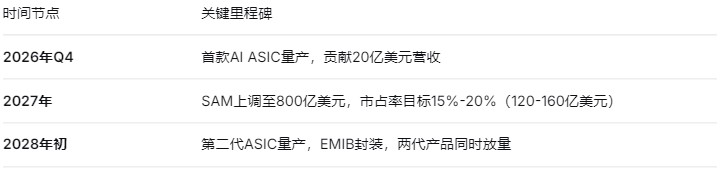
MediaTek is simultaneously adopting a dual packaging strategy of TSMC's CoWoS and Intel's EMIB-T to meet the large AI chip design needs of different customers. Cai Lixing emphasized that the "performance per TCO" and "performance per watt" of the second-generation ASIC will be significantly improved. Citibank is even more optimistic, estimating that its related revenue could reach $18 billion by 2027.
Conclusion
MediaTek's positive evaluation of EMIB yield has provided Intel's technological roadmap in advanced packaging with the highest level of endorsement from a core partner. Wedbush believes this "fully confirms" the speculation that Google's TPU will adopt Intel's EMIB.
For Intel, if Google's TPU packaging order is officially realized, it will be a significant victory for its IDM 2.0 transformation strategy—proving that it can not only compete for external customers (Fortinet) in wafer manufacturing but also compete directly with TSMC in the fastest-growing advanced packaging segment. For MediaTek, the revenue growth curve of AI ASIC from $2 billion to $16 billion is reshaping it from the "king of mobile chips" to an "important player in AI chips."