
Streaming and Parks Drive Dual Engines: Disney Q3 Operating Profit Hits Record High, Net Profit Nearly Halved Due to Impairment and High Base | Earnings Insights
 Complete. Here is the key summary
Disney's revenue for Q3 of fiscal year 2026 reached $25.25 billion, a 7% year-over-year increase that exceeded expectations; operating profit across its three segments totaled $5.56 billion, setting a historical record. The Entertainment segment saw a 64% surge in operating profit driven by improved streaming profitability and cost reductions. Affected by the impairment of A+E Global Media and a high base effect, GAAP net profit declined sharply, but adjusted EPS reached $2.06, beating expectations. Disney's US shares rose over 3% in pre-market trading following the earnings release
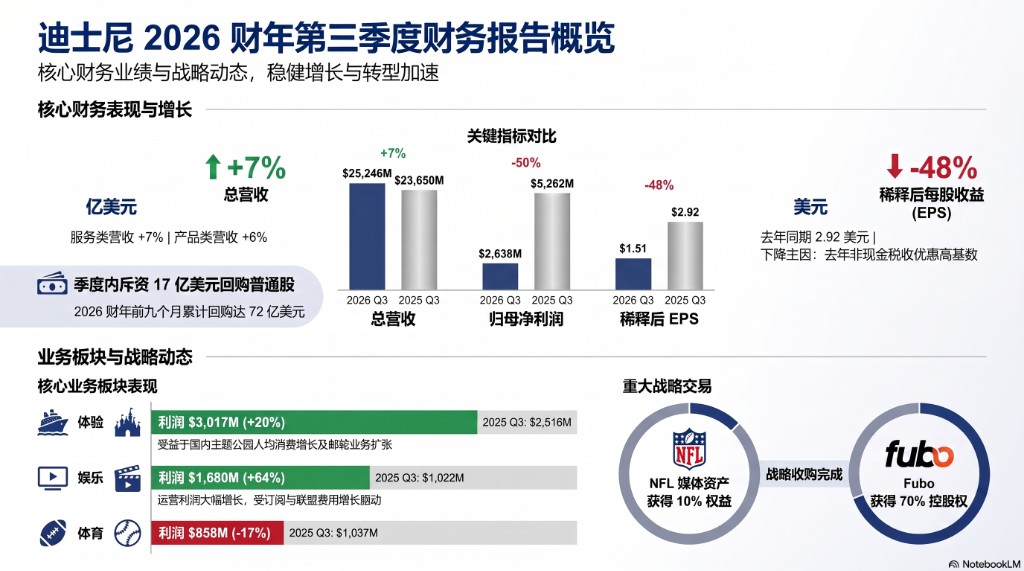
Disney delivered an earnings report where both revenue and core profitability exceeded expectations. In the third quarter of fiscal year 2026, ended June 27, 2026, the company achieved revenue of $25.25 billion, a 7% year-over-year increase, surpassing market expectations; combined operating profit from its three business segments totaled $5.56 billion, up 21% year-over-year, hitting a record high and exceeding analysts' expectations of $5.24 billion.
Among these, the Entertainment segment enjoyed strong growth benefited by improved streaming profitability, while the Experiences segment maintained resilience driven by expansion in theme parks and cruises, becoming the largest contributor to profit. However, due to an $812 million impairment charge on its investment in A+E Global Media and the high base effect from Hulu's tax adjustment in the same period last year, Disney's GAAP net profit dropped significantly year-over-year.
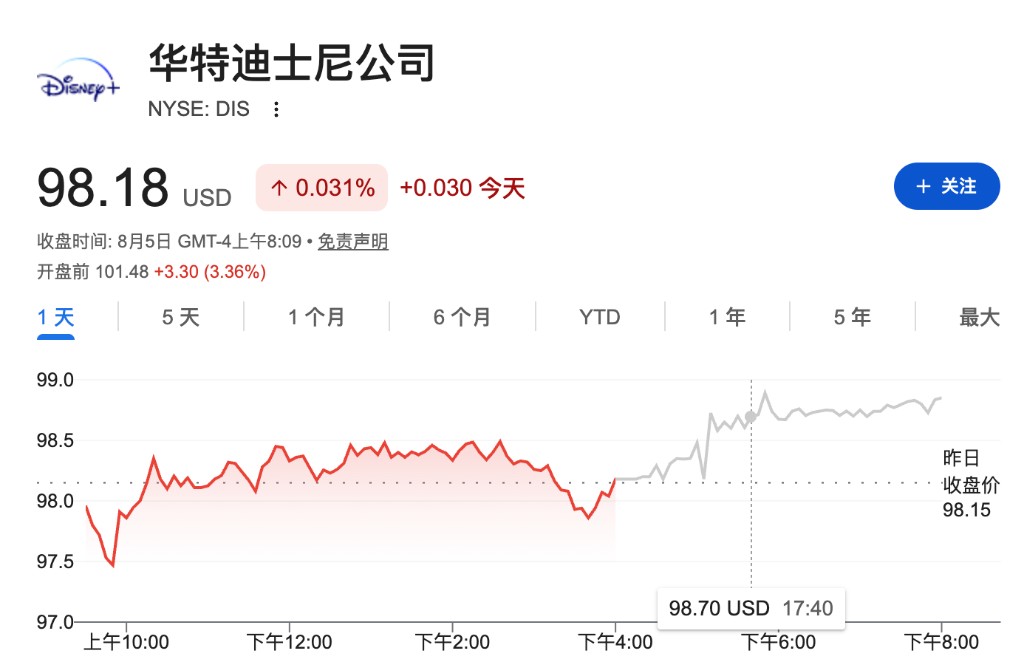
Excluding one-off factors, the company's adjusted earnings per share (EPS) reached $2.06, higher than the market expectation of $1.86, indicating that core profitability continues to improve. Following the earnings release, Disney's US shares rose more than 3% in pre-market trading.
Streaming Profitability Improves, Entertainment Segment Profit Surges 64%
In the third quarter, Disney's Entertainment segment revenue was $11.35 billion, up 6% year-over-year; operating profit reached $1.68 billion, skyrocketing 64% year-over-year, becoming the highlight of the quarter.
The core growth came from the streaming business. Subscription and affiliation fees revenue reached $7.55 billion, a 12% year-over-year increase, with the FuboTV transaction contributing approximately 4 percentage points, subscriber growth contributing about 3 percentage points, and higher pricing contributing roughly 3 percentage points.
Disney stated that the margin of its online video business has achieved double-digit growth, with streaming profitability continuously improving. Meanwhile, the company improved margins by cutting marketing and administrative expenses, with sales and general administrative expenses decreasing 8% year-over-year to $2.3 billion in the quarter.
The content sales business faced pressure, with revenue declining 6% year-over-year to $1.6 billion, mainly affected by declines in television on-demand and home entertainment distribution revenue. Advertising revenue remained basically flat, down 1% year-over-year, reflecting that the US streaming advertising market still faces certain pressures.
Performance on the content side was mixed. In the film business, The Devil Wears Prada 2 and Toy Story 5 performed brilliantly, but Star Wars: The Mandalorian and Grogu underperformed at the box office. Disney also cautioned that the subsequent live-action version of Moana might perform weaker than expected, potentially impacting future quarterly results.
Theme Park and Cruise Expansion, Experiences Segment Continues to Lead Growth
The Experiences business remains Disney's most stable growth engine.
In the third quarter, the segment's revenue was $9.97 billion, up 10% year-over-year; operating profit was $3.02 billion, up 20% year-over-year, contributing more than half of the group's operating profit.
Among them, US theme parks performed particularly strongly, with domestic Parks & Experiences operating profit reaching $2.09 billion, a 27% year-over-year increase. Disney stated that visitor numbers at US parks increased 3% year-over-year, hotel occupancy rates rose from 86% in the same period last year to 91%, and per-capita spending by visitors continued to grow.
The cruise business became an important driver of growth. With the Disney Destiny entering operation in November 2025 and the Disney Adventure making its maiden voyage in March 2026, the entry of new ships into service significantly increased passenger days, driving resort and travel revenue up 17% year-over-year to $2.77 billion.
In contrast, international park operations were affected by cost pressures, with operating profit declining 13% year-over-year to $369 million.
Disney management stated that Walt Disney World in Orlando performed exceptionally well this quarter, with current bookings remaining strong, and expects visitor growth to continue in future quarters.
Sports Business Under Pressure, A+E Impairment Leads to Sharp Decline in Net Profit
The Sports business was the only segment with declining profit this quarter.
The segment's revenue was $4.5 billion, up 4% year-over-year, but operating profit fell 17% to $858 million. The main reasons were increased sports rights costs, including changes in the recognition pace of rights fees due to the NBA renewal, and higher costs for new sports rights contracts.
Additionally, the UFC broadcasting rights expired in December 2025, leading to a decrease in related pay-content revenue.
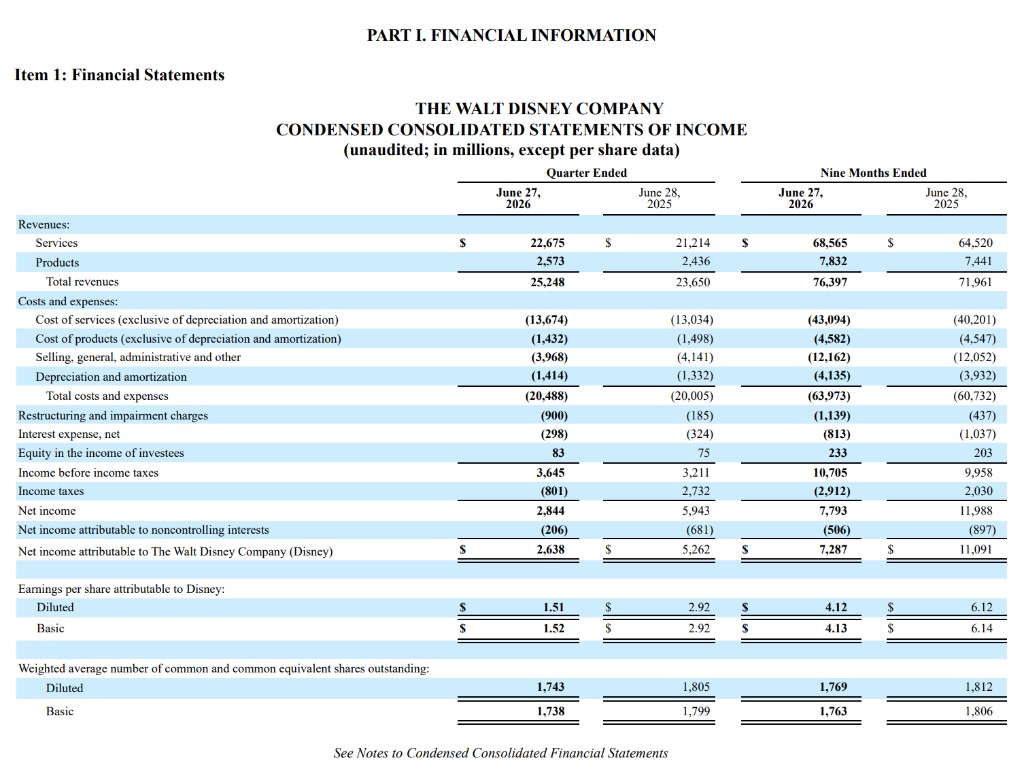
Regarding net profit, Disney's net income attributable to shareholders in the third quarter was $2.64 billion, with diluted earnings per share of $1.51, a 48% year-over-year decline.
The main reasons stemmed from two non-operating factors:
On one hand, the company recorded an $812 million impairment loss on its equity stake in the A+E Global Media joint venture. Disney subsequently announced that it would sell its 50% stake in A+E to partner Hearst Corporation for $1.2 billion in cash and plans to use the proceeds for stock repurchases.
On the other hand, in the same period last year, the company recognized a $3.3 billion non-cash tax benefit due to the tax classification adjustment of Hulu, resulting in an abnormally high net profit base for the third quarter of fiscal year 2025.
Increasing Repurchases and Investments, Disney Enters Deepened Transformation Phase
In terms of capital allocation, Disney continues to strengthen shareholder returns. By the first nine months of the fiscal year, the company had spent $7.25 billion on stock repurchases and reaffirmed its goal of repurchasing at least $9 billion for the full year. The approximately $1.2 billion obtained from the sale of the A+E stake will also be further used for stock repurchases.
At the same time, the company is continuing to advance investments in content and experiences. Capital expenditures for the first nine months reached $6.78 billion, an 11% year-over-year increase. Full-year capital expenditure is expected to be around $9 billion, higher than the $8 billion in the same period last year, mainly used for theme park expansions, new attraction construction, and resort asset upgrades.
In terms of strategic M&A, Disney previously completed the merger with FuboTV and the acquisition of NFL media assets. The Fubo deal helped the company expand the scale of its live TV business, while the NFL assets further enhanced ESPN's competitiveness in the sports streaming sector.
Looking ahead to the fourth fiscal quarter, Disney expects combined operating profit from various business segments to be approximately $4.9 billion, broadly in line with market expectations. The company stated that it is still in a cost optimization cycle and will continue to improve profitability by reducing administrative expenses and enhancing operational efficiency.
As streaming profitability gets on track, theme parks maintain growth, and large-scale repurchases continue to advance, Disney is transforming from a traditional entertainment giant into a more diversified content and experiences platform.
Risk Warning and Disclaimer
The market carries risks; investment requires caution. This article does not constitute personal investment advice, nor does it take into account the specific investment objectives, financial status, or needs of individual users. Users should consider whether any opinions, views, or conclusions in this article align with their specific circumstances. Investment based on this information is at your own risk.