
Google continues to expand its AI landscape, but core talent is constantly being lost
 Complete. Here is the key summary
Google Cloud's revenue surged 82% in the second quarter, shifting the company's focus towards commercial returns. Meanwhile, the departure of core AI talent Jeff Dean and the reassignment of Demis Hassabis have raised concerns about Google's ability to retain top talent and balance cutting-edge research with commercial interests
Key Points
Google Cloud's business is experiencing rapid growth, with commercial returns becoming a priority, testing the company's commitment to investing in cutting-edge artificial intelligence research.
Jeff Dean's departure and Demis Hassabis no longer being responsible for the daily operations of DeepMind have led to increasing doubts about Google's ability to retain top talent and maintain its leadership in the AI frontier.
Google Cloud's revenue surged 82% in the second quarter, further supporting the company's shift in focus towards computing infrastructure, efficient models, and enterprise-level AI services.
 On May 7, 2024, at Google DeepMind headquarters in London, co-founder Demis Hassabis was interviewed by Bloomberg.
From different perspectives, people have vastly different evaluations of Google: some believe it holds the most enviable advantages in the field of artificial intelligence; others point out that a large number of top talents continue to leave for leading AI laboratories and frontline startups.
In the past two weeks, this contradiction has been vividly displayed. First, Google announced an 82% surge in cloud department revenue; shortly after, on Wednesday, a major restructuring of Google's AI organization was announced — Chief Scientist Jeff Dean, who had served the company for 27 years, announced his departure.
The classic paper on Transformer, which laid the foundation for the generative AI wave, was born at Google in 2017. A series of recent events highlight the core dilemma faced by this tech giant with a market value exceeding $4 trillion: where should funds be invested? Developing cutting-edge large models requires substantial upfront investment in computing power and research costs, with future returns fraught with uncertainty; in contrast, the cloud business operates with outstanding efficiency, significantly outpacing similar businesses at Amazon and Microsoft.
Alphabet CEO Sundar Pichai stated in last month's earnings call that 90 of the Fortune 100 companies are already using the Gemini enterprise version, confirming Google's strong capability to sell AI services to cloud customers. Tomas Tunguz, founder of venture capital firm Theory Ventures, believes that it is becoming increasingly clear that meeting the needs of the vast majority of enterprises does not require top-tier flagship large models.
"I believe AI development has reached this point, especially for a large number of white-collar work scenarios, where moderately performing models are sufficient. The next generation of cutting-edge models may only provide value in specific fields that require extremely high computing power."
Google's full-stack AI layout is a significant reason for its stock price rising 16% this year; by 2025, the stock's increase could reach 65%, outperforming all large tech peers.
However, the road ahead has been tumultuous recently. After the latest earnings report was released, the market expressed concerns about the scale of capital expenditures, causing Alphabet's stock price to drop; following the announcement of Dean's departure and Hassabis stepping down as CEO of Google DeepMind on Wednesday, the stock price fell again, with Hassabis transitioning to chairman of the department Despite Wall Street's overall optimistic attitude, not everyone at Google is pleased with the current direction.
Several unnamed insiders have revealed that some researchers are dissatisfied: the computing resources needed to advance cutting-edge projects are limited, while Google Cloud sells its self-developed TPU chips to external clients, including Anthropic. TPU, or Tensor Processing Unit, is Google's self-developed AI chip, competing with NVIDIA's GPUs.
Google's cumbersome hierarchical management system has long troubled researchers, as turning research results into products requires multiple layers of approval. In contrast, emerging companies like OpenAI and Anthropic, as well as startups, are more attractive, especially to AI researchers and engineers who love laboratory research rather than focusing on financial statements.
Dean will leave with well-known Google researchers Sanjay Ghemawat, Oriol Vinyals, and Guoke Li to establish a new company called Discovery Loop. Dean stated on the X platform that this startup, backed by Google, will be set up as a public benefit corporation, with the mission of automating machine learning, science, and engineering to accelerate various scientific discoveries and technological advancements.
Following them, more renowned researchers have left, including Noam Shazeer, the author of the landmark 2017 paper "Attention Is All You Need," which is the cornerstone of generative AI. All eight authors of this paper have now left Google. Shazeer joined OpenAI in June; less than two years ago, Google spent nearly $3 billion to lure him back through acquisition. Shortly after his departure, Nobel laureate John Jumper also left DeepMind to join Anthropic.
"Wanting to be witnesses of history"
D.A. Davidson analyst Gil Luria stated that there is a clear trend behind the mass exodus of top talent. "These researchers are not keen on the commercialization of AI. They want to witness significant historical breakthroughs firsthand, so they view Anthropic, OpenAI, or other startups as platforms to achieve this goal." (The analyst maintains a buy rating on Alphabet.)
Dean is one of the few senior executives at Google who dared to publicly criticize the Trump administration. Earlier this year, he openly opposed the U.S. Department of Defense's decision to classify Anthropic as a supply chain risk company, warning that this move could harm the entire U.S. AI industry.
More importantly, from a technical perspective, the computing infrastructure and neural network systems he led the construction of have established Google's position as an early leader in modern AI.
Demis Hassabis co-founded DeepMind in 2010 and sold the company to Google four years later. After this adjustment, he will serve as the chairman of the department while also taking on the newly established role of chief scientist at Alphabet, focusing on long-term research and the societal impacts of artificial general intelligence (AGI). He also plans to devote more energy to operating Isomorphic Labs, an AI drug development company spun off from DeepMind DeepMind's technical director and Alphabet's chief AI architect, Koray Kavukcuoglu, will take over the daily management of the department and the development of the next-generation Gemini model. A person close to the DeepMind team revealed that over the past year, Kavukcuoglu has gradually taken on a significant amount of work from Demis Hassabis, leading model development and overseeing major Gemini release events; meanwhile, Hassabis has been spending less time in the lab and focusing more on regulatory policies and long-term research on the impacts of cutting-edge AI.
One of the biggest points of contention within Google is the allocation of computing resources.
Google's investment in global data centers, chips, and supporting infrastructure ranks among the top in the industry, yet computing power remains scarce. Every TPU, whether used for model training, supporting Google's own products, or fulfilling cloud customer contracts, means the company has to make trade-offs among multiple competing demands.
Insiders say that when Google makes large-scale commitments of computing resources to competing labs like Anthropic, dissatisfaction with internal resource allocation becomes particularly pronounced—models launched by Anthropic directly compete with Gemini.
Sources indicate that Google plans its computing needs in advance, covering multiple business lines including research and model training, supporting search and its own products like Gemini, and servicing cloud customers, with related plans made several years in advance; however, if product growth exceeds expectations or strategic priorities shift, short-term computing quotas may also change dynamically.
Sundar Pichai mentioned in the last two earnings call meetings that even as cloud customer demand continues to rise, Google still ensures the supply of computing power to DeepMind. When asked in July about the TPU allocation plan, he stated that Google's "top priority" is to secure the computing power needed to compete in the frontier of general artificial intelligence, calling the related research "the foundation of all businesses."
Pichai also stated that the company would balance the computing power needed for cutting-edge research, consumer products, and AI model operations, and is continuously deploying TPUs to third-party data centers to take on external computing orders.
Google shareholder and Niles Investment Management founder Dan Niles stated that the allocation of computing resources naturally tends to spark internal conflicts. "Google's business landscape is vast, and it must decide who to tilt computing resources towards; in such a situation, there will always be someone feeling their interests are compromised."
Promoting DeepMind and Google Cloud's Deep Collaboration
At the World Economic Forum in Davos this January, Hassabis and Google Cloud CEO Thomas Kurian discussed enterprise-level AI products and application scenarios on stage together.
Insiders say this scene is quite rare. Historically, the two departments have operated independently, and Hassabis has rarely participated in the company's commercialization efforts. This joint appearance sends a signal: Hassabis is beginning to pay more attention to AI enterprise application scenarios, especially in areas like code generation and intelligent customer service; it also reflects Google's overall strategy—to counter OpenAI and Anthropic by bridging research teams and commercialization efforts In the months that followed, Google's large model development faced continuous obstacles, marked by the delayed release of its latest flagship model, Gemini 3.5 Pro. In contrast, Google Cloud, led by Thomas Kurian, experienced its strongest growth period in history.
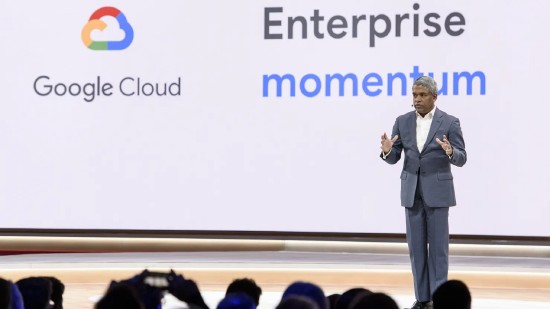
Kurian, a former executive at Oracle, took over Google Cloud in 2019. He established a mature enterprise sales system in this company, which excels in consumer internet business. Google Cloud develops its own AI chips and operates a global data center network, selling large models, databases, security software, and intelligent agent development tools.
This strategy provides Google with multiple monetization paths for AI: it can sell computing infrastructure to labs like OpenAI and Anthropic, deliver the Gemini model to enterprises, and embed AI capabilities into its own products like Search, YouTube, and Workspace.
As the generative AI boom approaches its fourth year, a key question has emerged: does Google really need to develop its own top-tier global models, or should it let other companies bear the high R&D costs?
At the Google Developer Conference in May, Kurian stated in an interview that Google's goal is to continuously push the boundaries of technology while optimizing operational efficiency. The Flash model launched by the company has cutting-edge performance, with speed and energy efficiency four times that of similar models, enabling Google to scale advanced AI capabilities for enterprise services and consumer products.
Similar to the views of Tong Guzi, Niles also believes that the vast majority of commercial scenarios do not require the strongest large models. "Existing models are sufficient to meet 90% of business needs. Many tasks do not require a 'Ferrari'; an ordinary 'family sedan' can satisfy 90% of usage scenarios."
However, for scientists and researchers dedicated to achieving the next Transformer-level technological breakthrough, "good enough" is never enough