
From the Yen's Collapse to the Fed's Silence: The Strategic Value of Gold Is Emerging
 Complete. Here is the key summary
The sharp plunge in the yen and the Federal Reserve's admission that long-term interest rates are increasingly determined by market forces reflect the waning control global central banks have over bond markets. Against a backdrop of soaring debt and continuous monetary expansion, traditional stock-bond asset allocation faces challenges. As an asset hedging against fiat currency depreciation, gold's long-term allocation value may further increase
The yen has fallen to a 40-year low, and an inadvertent remark by the Federal Reserve Chair at a press conference is revealing an unsettling reality to the market: Major global central banks are gradually losing control of the bond market, and the ultimate beneficiary of this process may be none other than gold.
The Bank of Japan's rate hikes and the unwinding of carry trades are triggering dual selling pressure on the U.S. stock and Treasury markets. Meanwhile, Fed Chair Walsh admitted at the press conference following the July FOMC meeting that the rise in long-term interest rates was not actively driven by the Fed, but rather the result of market pricing—indicating that the Fed's influence on the bond market is marginally weakening. The Dow Jones Industrial Average subsequently plummeted by over 1,000 points in a single day, while long-term U.S. Treasury yields surged.
In the view of analyst Matthew Piepenburg, these two events point to the same conclusion: The fiat currency system, represented by the U.S. dollar, is eroding purchasing power at a visible pace, and the strategic value of gold as an anti-fiat asset is at a new historical starting point.
The Yen's Collapse: A Reckoning for Four Decades of Accumulated Issues
The yen's recent drop to its lowest level against the U.S. dollar in four decades is not an incidental exchange rate fluctuation, but the inevitable result of decades of extreme monetary easing.
Japan has long maintained zero or even negative interest rate policies, with debt-to-GDP ratios soaring and excessive money issuance becoming an insurmountable burden. Facing the yen's continuous depreciation, the Japanese Ministry of Finance intervened using approximately $73 billion in foreign exchange reserves, sourced largely from massive sales of U.S. Treasuries. However, this move had little effect. The Bank of Japan subsequently raised its benchmark interest rate to 1% in June—the highest level since the 1990s—but against the backdrop of decades of ultra-low interest rates, this increase remains a drop in the bucket.
The more profound impact lies in the end of the yen carry trade. For a long time, global hedge funds and large institutions borrowed yen at near-zero cost, converted it into U.S. dollars, and heavily purchased U.S. stocks, particularly Nasdaq tech stocks, thereby forming massive leveraged positions. This trading model experienced its first significant volatility in August 2024, and now, with the Bank of Japan's policy shift, the pressure to unwind carry trades is being fully released.
Selling Spreads: The Return of Simultaneous Stock and Bond Declines
The unwinding of carry trades is triggering a chain reaction. Japanese corporations and financial institutions are choosing to cash out their dollar-denominated assets and repatriate funds while the yen is at historic lows to capture exchange rate differentials. This means that large amounts of U.S. stocks and U.S. Treasuries are being sold off simultaneously.
The Nasdaq Composite recorded its worst monthly performance in decades in July, with tech stocks bearing the brunt. Meanwhile, the U.S. Treasury market is also facing sustained selling pressure from Japan. Piepenburg points out that this scene is identical to March 2020, fiscal year 2022, and "Liberation Day" in 2025—stocks and bonds are once again falling in tandem, rather than hedging each other.
This poses a fundamental challenge to the traditional 60/40 stock-bond portfolio. Against the backdrop of unprecedented expansion in sovereign debt, government bonds can no longer serve as safe-haven assets. The U.S. public debt currently stands at approximately $40 trillion, with daily interest expenses alone reaching $3 billion. Over the next 12 months, more than $8 trillion in debt faces refinancing pressure and must be rolled over at higher interest rates.
Walsh's "Inadvertent Remark": An Implicit Admission of the Fed's Loss of Control
The July FOMC meeting kept the federal funds rate target range unchanged at 3.5% to 3.75%, with 9 votes in favor and 3 against. This outcome itself was not surprising—given the current debt scale, raising rates would only further increase the fiscal interest burden, creating a policy paradox where "the more rates are hiked, the higher inflation becomes."
What truly triggered a violent market reaction was a statement made by Walsh at the press conference.
When asked why he did not vote for a rate hike, he replied: "Rates today are higher than they were 42 days ago. The market has made its own judgments, partly because we have stepped back and no longer attempt to influence those judgments. Market expectations for nominal interest rates across the entire U.S. Treasury yield curve have shifted upward... The effectiveness of monetary policy depends not only on what we say, but even not only on what we do."
Piepenburg interprets this statement as a significant implicit admission: the rise in long-term interest rates has escaped the Fed's direct control, the market is pricing U.S. Treasuries independently, and adding a premium reflecting credit risk. In other words, pricing power in the bond market is shifting from central banks to the market.
The Only "Way Out" of the Debt Crisis Is a Deeper Trap
Faced with the risk of losing control of the bond market, the Fed theoretically still has one card to play: directly purchasing Treasuries through large-scale quantitative easing to artificially suppress rising yields.
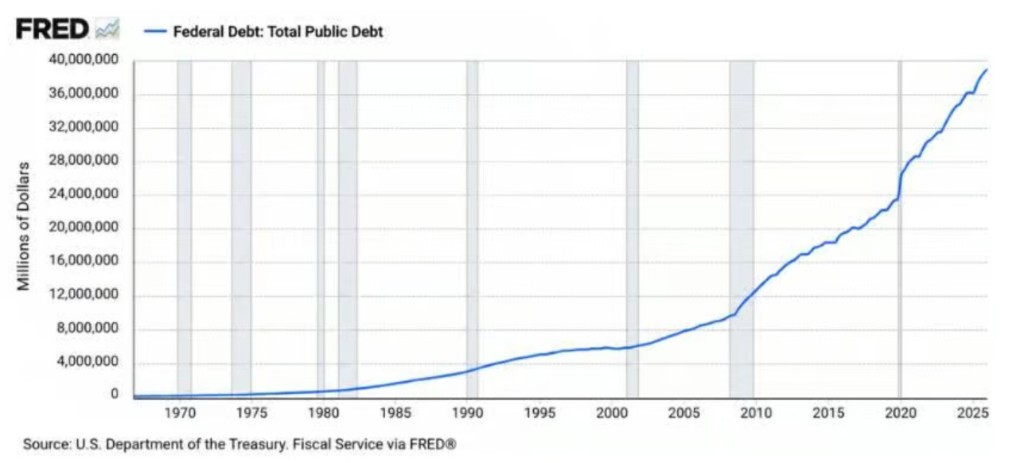
However, this "solution" is itself the problem. Large-scale money printing to buy bonds means further currency depreciation, and the purchasing power of the U.S. dollar will be diluted at an accelerated pace. Piepenburg points out that using currency depreciation to sustain debt is an old path repeatedly taken by major powers 陷入 debt crises, without exception leading to decline.
The parabolic growth of the U.S. M2 money supply has confirmed this trend at the data level. In a fiscally dominant landscape, any nominal anti-inflation policy is ultimately destined to serve the purpose of financing debt.
Real Money in the Cracks of the Fiat System
In Piepenburg's view, all of the above—the yen's collapse, the sell-off in U.S. Treasuries, the Fed's silence, and continuous excessive money issuance—together constitute the macroeconomic foundation for the emergence of gold's strategic value.
As the purchasing power of fiat currencies dissipates at a quantifiable rate, the relative appeal of gold, as a store of value not reliant on any sovereign credit, rises accordingly. He also notes that there was a deliberate suppression of precious metal prices in early 2026, which provided a window for large institutional investors to accumulate physical gold at low levels, while retail investors' attention was drawn to the fluctuations of tech stocks.
In his view, if wealth is measured in paper currency, investors are experiencing an implicit wealth transfer in the form of inflation; and the true signals from the bond market—rather than the public statements of central banks—are the key coordinates for understanding the direction of this transfer.