
OpenAI's Largest Pre-training Model "Doug" Exposed
 I'm LongbridgeAI, I can summarize articles.
According to leaks, OpenAI is advancing a new generation of large pre-trained models under the codename "Doug." This will be its largest pre-training project to date and is distinct from GPT-6. GPT-6 may be Astra, whose release was previously paused. Doug is expected to launch by November at the latest. If true, this marks OpenAI's restart of large-scale foundation model upgrades after nearly two years of relying on post-training and reinforcement learning
On August 9, ChrisGPT, an X user who has long tracked OpenAI's model developments, leaked that OpenAI is advancing a new round of large pre-trained models under the codename "Doug."
According to him, Doug will be OpenAI's largest pre-training project to date, and it is not the same model as GPT-6.
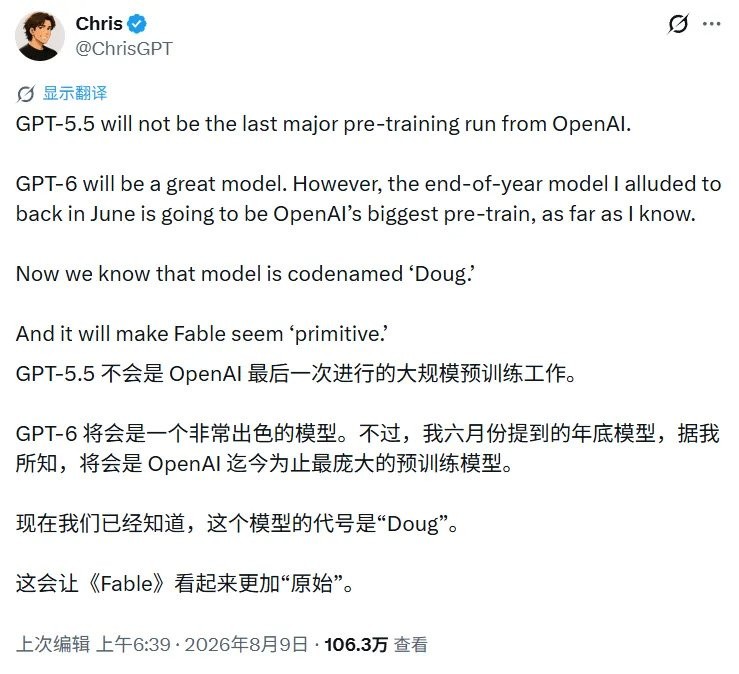
In subsequent replies, ChrisGPT further stated that GPT-6 is likely Astra, OpenAI's most powerful model, whose release was urgently paused due to security concerns yesterday.
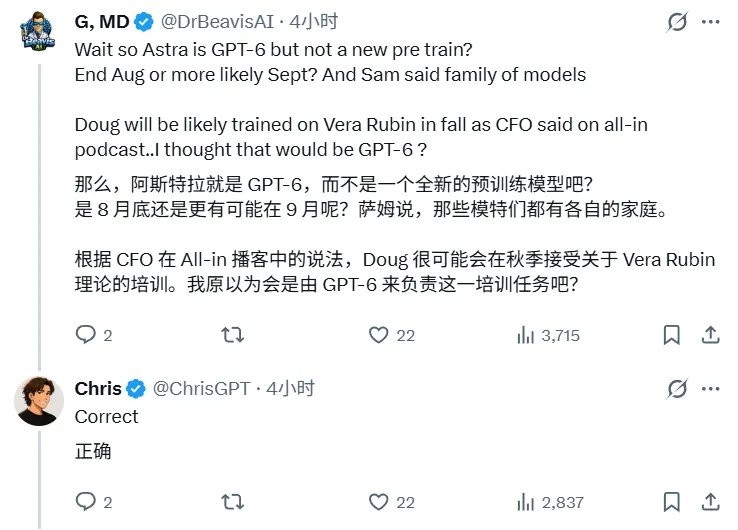
As for Doug, he expects it to be launched by November at the latest.

ChrisGPT was not the first source to publicly mention Doug.
On August 7, SemiAnalysis, a research institution specializing in the semiconductor and AI industries, published a research memo previously sent to institutional clients in an article discussing Gemini and Google Cloud. The memo was dated July 9.
- Article URL: https://newsletter.semianalysis.com/p/gemini-is-cooked-but-gcp-is-cooking A key sentence in the memo stated: OpenAI has overcome issues in pre-training, and a much larger model codenamed Doug is being actively advanced.
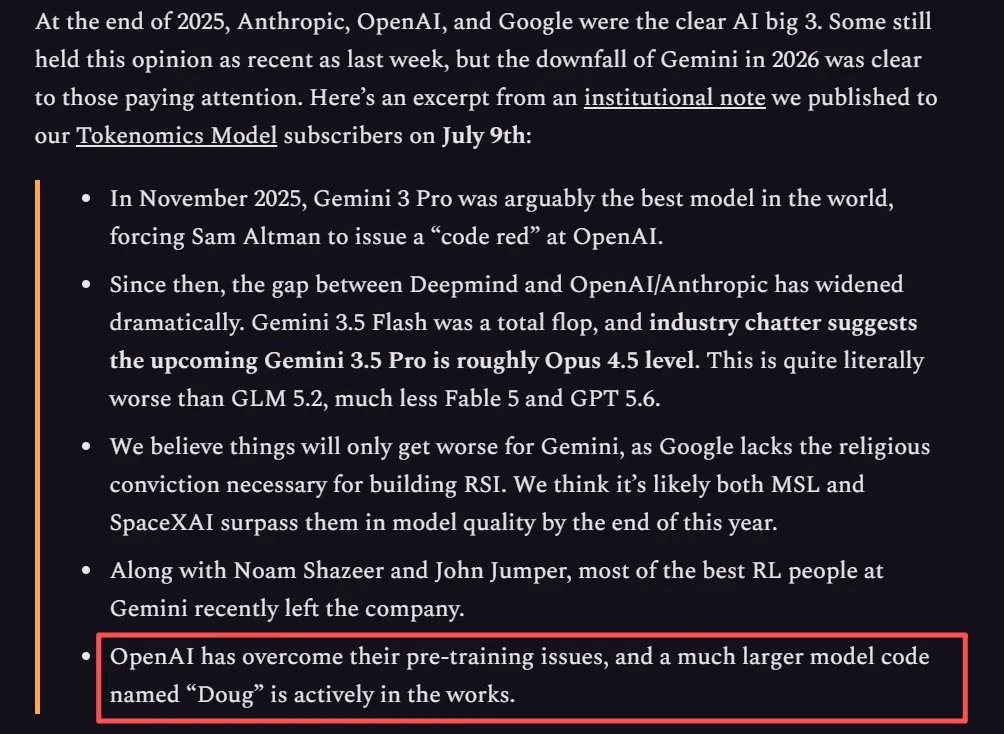
If these reports are accurate, Doug could signify that OpenAI is restarting a large-scale foundation model upgrade after nearly two years of primarily relying on post-training, reinforcement learning, and inference-time compute to drive capability growth.
The story begins with GPT-4o.
OpenAI Shifted More Growth to RL
On May 13, 2024, OpenAI released GPT-4o, branding it as its new flagship model.
In the nearly two years since, although OpenAI trained and released new pre-trained models such as GPT-4.5, it never completed a full-scale pre-training cycle capable of being widely deployed as the next-generation mainstream frontier model.
Meanwhile, the growth in OpenAI's model capabilities began to stem increasingly from another approach.
On September 12, 2024, OpenAI released o1-preview.
Compared to the past reliance on larger-scale pre-training to drive capability growth, o1 demonstrated an alternative scaling method: enabling the model to learn to invest more computation in reasoning through large-scale reinforcement learning. Since then, post-training, RL, and inference-time compute have become increasingly important in OpenAI's model architecture.
In April 2025, o3 was officially released. OpenAI again emphasized that the reasoning capabilities of the o-series stem from large-scale reinforcement learning.
In August 2025, GPT-5 was released. It is no longer just a single model but a unified architecture consisting of fast models, deep reasoning models, and a routing system.
SemiAnalysis believes that behind o1, o3, and even the GPT-5 series, there was no new base model generational leap comparable to GPT-4o. These models were actually still built upon the foundation model architecture of the GPT-4o era.
OpenAI has never confirmed this training lineage, but if SemiAnalysis's information holds, the strategy of the past nearly two years becomes clear: without a generational leap in the base model, capability growth was mainly driven by increasingly powerful post-training and RL.
Model scaling has gradually expanded from primarily relying on pre-training in the past to three dimensions: pre-training, RL, and inference-time compute.
The issue is that if the foundation model does not undergo a comparable generational upgrade for a long time, continuing to scale solely through post-training and inference computation will inevitably face diminishing marginal returns.
The emergence of Gemini 3 rapidly transformed this potential training route issue into immediate competitive pressure.
Garlic: Pre-training Starts Running Again
On November 18, 2025, Google released Gemini 3.
Ten days later, SemiAnalysis presented a widely discussed judgment in its TPUv7 analysis: Since GPT-4o, OpenAI has not completed a successful full-scale pre-training cycle capable of being widely deployed as a new frontier model.
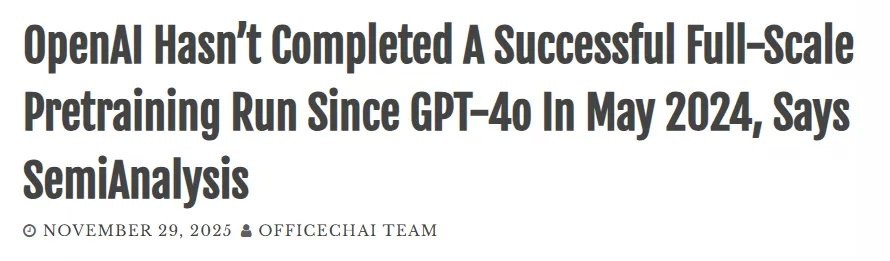
After Google launched Gemini 3, this difference shifted from a training route issue to direct competitive pressure.
On December 1, multiple media outlets reported that Sam Altman announced a "Code Red" within OpenAI, requiring the team to prioritize improving ChatGPT and reallocating some resources.
A day later, more critical training information emerged.
On December 2, 2025, The Information reported that OpenAI is developing a new pre-trained model codenamed "Garlic." Citing internal sources, the report stated that Garlic performed well in coding and reasoning evaluations and utilized a series of bug fixes discovered by OpenAI during previous training processes.
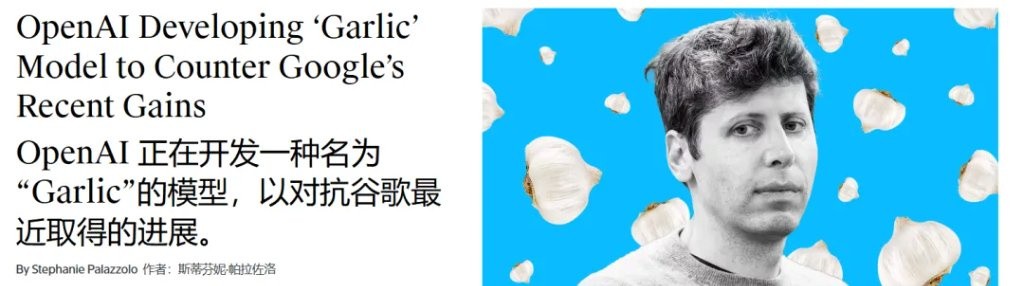
More importantly, OpenAI's Chief Research Officer Mark Chen reportedly told the team that the company had resolved some key issues in previous pre-training. The report also mentioned that these training improvements allow smaller models to accommodate knowledge that previously required larger models.
In the same report, another statement later proved particularly significant: OpenAI has begun developing an "even bigger and better model" based on the lessons learned from Garlic.
The story of Doug actually begins here.
On January 6, 2026, SemiAnalysis discussed OpenAI's model roadmap again. This time, they directly stated: OpenAI has resolved issues in pre-training.
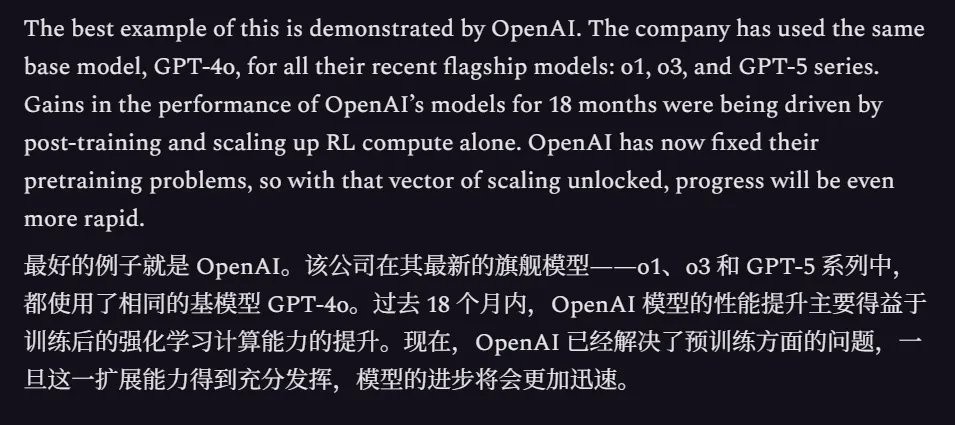
In other words, according to the information held by SemiAnalysis, the problems that previously hindered OpenAI's full-scale pre-training have been resolved.
Garlic likely served to validate whether these fixes were effective, while Doug may be the result of scaling these training methods to a much larger magnitude.
OpenAI May Be Preparing to Restart Base Scaling
If the above information is accurate, OpenAI may be continuously advancing at least two important model projects: Astra, which has entered the advanced evaluation stage, and Doug, which is reportedly larger in scale.
Doug points to another matter: restarting the scaling of the base model itself.
Over the past two years, OpenAI has proven that the old base can continue to be pushed upward through RL, reasoning, and inference-time compute.
Doug aims to answer another question: Once the base model itself completes a significant leap, where can this post-training system, already pushed to its limits, take capabilities next?
This may be the true starting point for OpenAI's next round of model competition.
Synced
Risk Warning and Disclaimer
The market involves risks; investment should be approached with caution. This article does not constitute personal investment advice, nor does it consider the specific investment objectives, financial status, or needs of individual users. Users should consider whether any opinions, views, or conclusions in this article align with their specific circumstances. Investors bear full responsibility for their own decisions.