
South Korean stocks open high then retreat; KOSPI index rises over 2% at one point; stalemate in Hormuz negotiations pushes up oil prices
 I'm LongbridgeAI, I can summarize articles.
On Monday, the MSCI Asia Index rose 0.8%. South Korean stocks opened higher but later gave up gains, with the KOSPI rising more than 2% intraday and the KOSDAQ triggering a circuit breaker. Meanwhile, Iran explicitly denied direct negotiations with the US, leaving the Hormuz deadlock difficult to resolve. Brent crude continued its rally, staying above $84, as geopolitical risks remain elevated in the market
South Korean stocks opened higher on Monday before narrowing their gains, with chip stocks becoming the market's focus; meanwhile, negotiations between Iran and the US regarding the reopening of the Strait of Hormuz hit a stalemate, and oil prices continued their upward trend.
The MSCI Asia Index rose 0.8%, following the US stock market's rally last Friday. SK Hynix previously announced an expansion plan worth over 54 trillion won, boosting the Korea Composite Stock Price Index (KOSPI) to rise more than 2% intraday, but gains subsequently narrowed. The Korea Securities Dealers Automated Quotations (KOSDAQ) triggered the SIDECAR mechanism, suspending programmatic buying. Meanwhile, Brent crude rose more than 1%, trading above $84, having accumulated a gain of over 5% in the previous three trading sessions.
According to CCTV News on August 10, US President Trump stated in an interview on the 9th that he is currently "handling the Iran issue quietly." Meanwhile, according to Xinhua News Agency on the same day, Iranian Foreign Minister Araghchi explicitly denied any direct negotiations between the two sides, stating that "there are currently no negotiations between Iran and the US," and that "information exchange is conducted through intermediaries." In addition, US consumer price data for July will be released this week, and the market will closely monitor its impact on the Federal Reserve's interest rate path.
South Korean stocks open high then retreat; KOSDAQ triggers circuit breaker mechanism
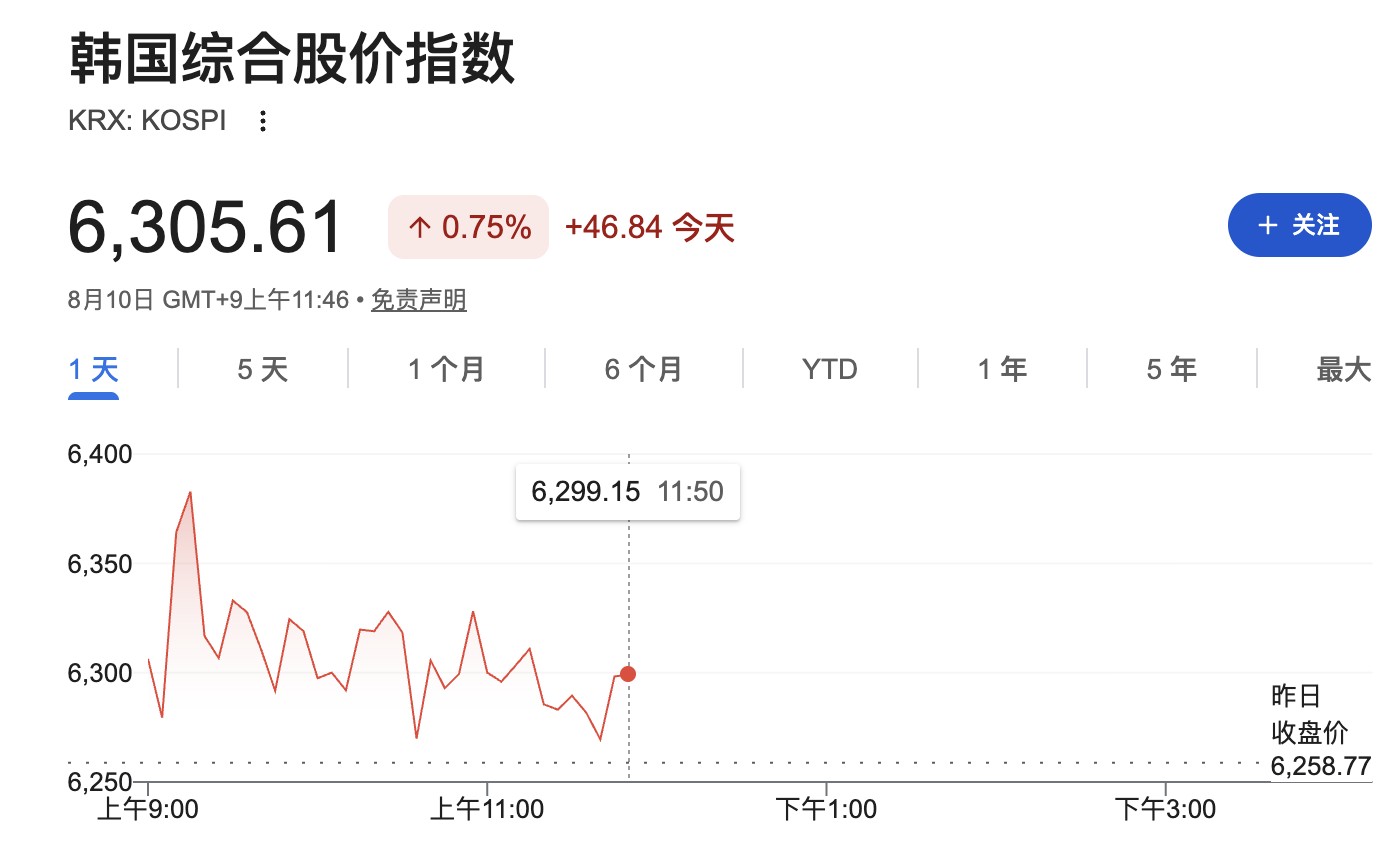
The KOSPI index opened up 0.8% at 6,306.33 points, rising more than 2% intraday before narrowing gains to approximately 0.75%. In the previous trading session, the KOSPI fell 0.6%, with Monday's rebound mainly driven by the chip sector.
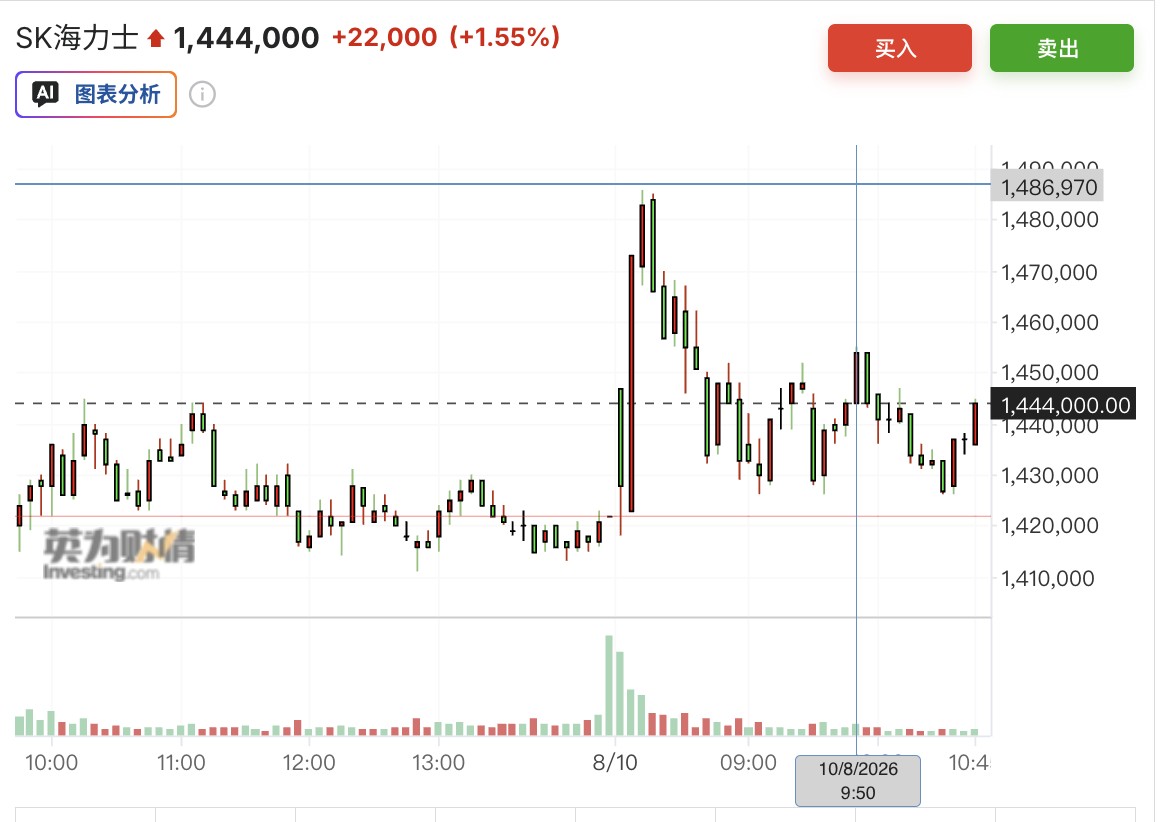
SK Hynix surged 1.5%. The company previously announced an investment plan totaling approximately 54 trillion won, with 35.2 trillion won allocated to the Yongin "Y2" wafer fab and 19.1 trillion won to the Cheongju "M17" wafer fab, to cope with growing memory demand in the AI era. Samsung Electronics rose about 2.3%.
The Korea Exchange activated the KOSDAQ SIDECAR mechanism on the day, suspending programmatic buying in the KOSDAQ. The Japanese market also strengthened synchronously, with the Nikkei 225 Index rising about 2% by the early close, and the TOPIX Index rising 0.8%. Semiconductor-related stocks such as Advantest and Tokyo Electron led the gains.
The aforementioned rise followed the US stock market performance last Friday. US non-farm payroll data for July unexpectedly weakened, driving the S&P 500 Index to a record high. The market interpreted the weak employment data as a signal that the Federal Reserve does not need to raise interest rates urgently.
Hormuz negotiations hit stalemate; oil prices continue upward trend
Brent crude oil futures rose more than 1% at one point on Monday, currently trading at $84.16 per barrel; WTI crude rose about 0.84%, trading at $78.64 per barrel. In the previous three trading sessions, Brent has accumulated a gain of over 5%.

Weekend negotiations between Iran and Oman failed to reach an agreement on reopening the Strait of Hormuz. Iranian Foreign Minister Abbas Araghchi explicitly stated that Tehran is not currently engaged in direct negotiations with the US. According to media reports, Mohammad Bagher Zolghadr, head of Iran's Supreme National Security Council, stated that the Strait of Hormuz will remain closed until the US meets six conditions, including ending war and aggressive actions against Iran and its allies, and providing compensation to Iran.
The US side insists that any reopening arrangement must guarantee unrestricted freedom of navigation, without additional approval, fees, or control conditions imposed by Iran. According to Citigroup, Houthi forces in Yemen continue to launch attacks on Saudi-related vessels near the Red Sea and the Bab el-Mandeb Strait, keeping risks outside of Hormuz equally high.
Westpac pointed out in a report, "Entering the sixth month of the Iran war, uncertainty remains high. The Strait of Hormuz is effectively still closed, and the involvement of Houthi forces in Yemen further disrupts alternative shipping routes in the Red Sea."
Trump's tone becomes more restrained; market sentiment remains relatively stable
According to media reports, Trump stated in an interview on Sunday that the US can wait for Tehran to soften its stance due to economic pressure, rather than taking military escalation actions. In the preceding weeks, Trump had repeatedly threatened to launch large-scale air strikes on Iran, but subsequently held back, citing the desire to leave room for negotiations.
My Bui, an economist at AMP Ltd., wrote in a client report that given Trump's approval ratings have fallen to new lows, investors should not be overly bearish, as he is likely to retreat from threats again. "Currently, the market remains normal, with stocks supported by robust fundamentals, strong economic growth, and productivity improvements."
Bloomberg strategist Mark Cranfield pointed out that oil prices strengthened on Monday, but traders remain skeptical about whether the rise can be sustained. "Net long oil positions in July only saw a mild rebound and have been reduced across various crude contracts."
In other markets, US Treasuries slightly gave back last Friday's gains on Monday, with the 10-year US Treasury yield rising 1 basis point to 4.66%, and the 2-year yield rising 2 basis points to 4.21%. Gold fell about 0.5%, trading near $4,320 per ounce, after accumulating a gain of over 7% last week, marking the largest weekly gain since January.
Continuously updating