
Meta Open-Sources Its Most Powerful AI Model; Zuckerberg Challenges OpenAI and Anthropic
 I'm LongbridgeAI, I can summarize articles.
Meta announced the open-sourcing of its most powerful AI model, Muse Spark 1.2, and launched the Muse Glimmer series designed for consumer-grade devices. CEO Mark Zuckerberg emphasized that the open-source strategy can fill market gaps and counter closed ecosystems like those of OpenAI and Anthropic, while calling on U.S. policymakers to lower competitive barriers for open-source models
Meta announced the release of the weights for its most powerful AI model and introduced a new series of models designed for consumer devices. This move aims to challenge leading labs such as OpenAI and Anthropic, while demonstrating to investors that its massive AI investments are yielding results.
On Monday, August 10, Meta CEO Mark Zuckerberg announced in an Instagram video that the company will open-source its latest AI model, Muse Spark 1.2, allowing the public to download and use it, and simultaneously launch the Muse Glimmer series of open-source models designed for laptops.
Zuckerberg’s high-profile announcement was intended to demonstrate to the market that the Meta Superintelligence Lab, established last year, has made substantial progress, thereby endorsing the company’s capital expenditure, which is expected to reach as high as $145 billion this year.
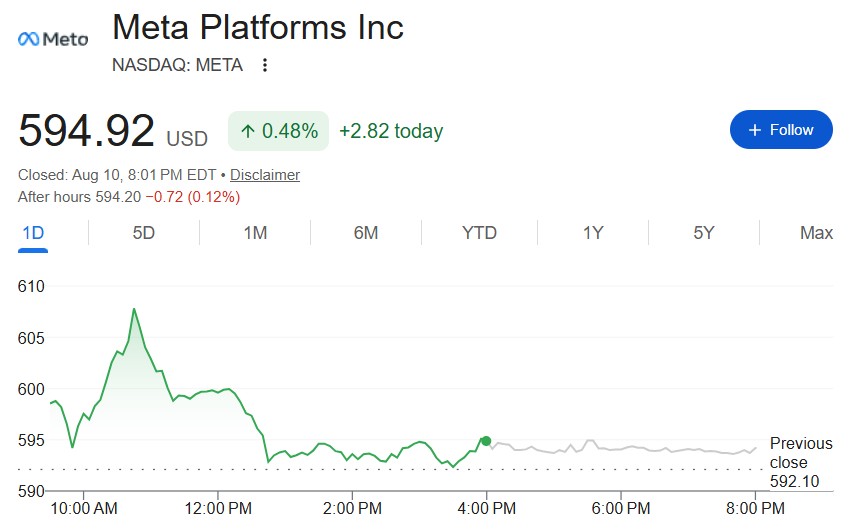
Following the news, Meta’s stock price rose by 2.6% at one point on Monday. Prior to this, the stock had fallen approximately 10% year-to-date amid continued investor scrutiny of the company’s spending plans and AI competitiveness.
Betting on Open Source: A Differentiated Strategy Against Closed Giants
Meta’s bet on open source follows a clear strategic logic.
In a 6,500-word AI paper published on the same day, Zuckerberg positioned Meta’s open-source route as a significant force against closed AI ecosystems and called on Washington to support U.S. open-source efforts.
Zuckerberg also issued a clear call regarding U.S. AI policy. He wrote:
Foreign labs currently hold several advantages because U.S. labs must comply with more additional restrictions on training data. If the U.S. wants its open-source models to remain leading in the long term, U.S. policy must reduce these additional hurdles.
He also stated:
I do not believe restricting access to foreign open-source models is an effective solution. Our goal should be to make U.S. open-source models the best choice globally, which requires removing various obstacles that make it more difficult for U.S. open-source models to compete.
Neil Shah, co-founder of Counterpoint Research, commented:
If Western tech giants only build walled gardens, developers and enterprises will naturally turn to open-weight models. Most of Meta’s U.S. competitors adopt proprietary models, while there is strong market demand for non-closed open-source models. Meta is well-positioned to fill this gap.
Muse Glimmer focuses on on-device execution, forming a distinct contrast to the current mainstream cloud-based AI processing model. Neil Shah pointed out:
Deploying small agent models like Muse Glimmer directly on PC and mobile hardware can bypass cloud computing costs, creating a competitive advantage against companies like Google and Microsoft on the end-user side.
Implicitly Targeting OpenAI and Anthropic
While outlining his open-source vision, Zuckerberg warned about the concentration of AI power, with wording widely interpreted as an implicit criticism of OpenAI and Anthropic.
He wrote:
The idea that AI is so dangerous that the only safe path is extreme centralization of power is fundamentally flawed. It is surprising that the discourse of many AI developers is filled with apocalyptic tones. I cannot understand why someone who believes AI will eliminate most jobs and human value would be eager to build such a future.
Anthropic CEO Dario Amodei and OpenAI CEO Sam Altman have previously warned about the impact of AI on employment, though Altman has recently softened some of these statements.
Zuckerberg proposed a distinctly different vision:
We should distribute superintelligence broadly rather than centralizing it, empowering everyone to harness it. Everyone will have a super-powered personal agent that deeply understands themselves, their goals, and everything they care about.