
BofA: Tonight's CPI "Downside Surprise" Has Greater Impact; A Lower-Than-Expected Core CPI Could Rule Out a September Rate Hike
 I'm LongbridgeAI, I can summarize articles.
In its CPI preview report, Bank of America pointed out that the market's reaction to an inflation "downside surprise" will be significantly greater than to an "upside surprise." If the month-on-month core CPI comes in 0.1% lower than expected, a September rate hike will be largely ruled out, exerting dual pressure on US Treasury yields and the US dollar. Conversely, while a 0.3% beat would bring a September hike back into view, the outcome is not locked in due to uncertainties surrounding Warsh's stance and the need to validate August data
Tonight's US July CPI data will serve as a key litmus test for whether the Federal Reserve raises interest rates in September.
According to Zhuifeng Trading Desk, on August 11, Bank of America Merrill Lynch interest rate strategists, including Meghan Swiber, released a research report providing a forward-looking analysis of the US July CPI data. The baseline forecast is a +0.1% month-on-month increase (+3.4% year-on-year) for headline CPI, and a +0.2% month-on-month increase (+2.5% year-on-year) for core CPI—both consistent with market consensus. BofA maintains its baseline forecast of three rate hikes this year.
However, analysts stated that US Treasury yields and the US dollar are more sensitive to inflation "downside surprises" than to "upside surprises" of the same magnitude. Since June's CPI already softened more than expected, another miss in July would directly undermine the basis for a Federal Reserve rate hike in September.
Baseline Scenario: Inflation Returns to Trend
BofA characterized June's unexpected decline in inflation as a "one-off event," expecting July's data to revert to recent trends.
The analysts' baseline forecast is:
-
Headline CPI: +0.1% month-on-month, +3.4% year-on-year. Despite renewed tensions in the Middle East causing energy price volatility, the average price at gas stations in July was actually lower than in June, and food inflation is expected to maintain its trend of +0.2%.
-
Core CPI: +0.20% month-on-month, +2.5% year-on-year, which would be the lowest reading since January this year. Core goods inflation remains mild, while core services (including housing and non-housing services) are expected to rebound to trend levels, with a month-on-month increase of approximately +0.3%.
-
Balanced Risks: Volatile components such as airfares, used cars, and lodging away from home may strengthen more than expected; however, the downward trend in motor vehicle insurance may also continue.
Under this forecast, a September rate hike is not a foregone conclusion; the key still lies in the subsequent trajectory of core PCE data.
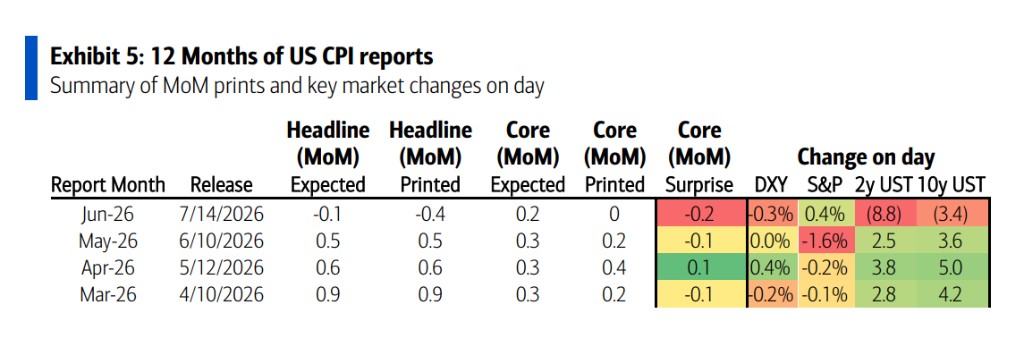
Key Judgment: The Impact of an Inflation Downside Surprise Is Greater
The analysts wrote, "We expect US interest rates and the US dollar to react more strongly to a downside surprise than to an upside surprise of equal magnitude."
The bank predicts:
- If the data is stronger (core CPI +0.3% month-on-month): A September rate hike returns to the agenda, but it is not "locked in"—because August data will be released before the September FOMC meeting, and Warsh's attitude appears markedly cautious, leaving the final decision subject to change.
- If the data is softer (core CPI +0.1% month-on-month): A September rate hike is largely ruled out, simultaneously posing a significant challenge to the market's pricing of approximately 30bp in rate hikes for the remainder of the year.
In other words, stronger data merely "opens a door," while softer data "closes a door."
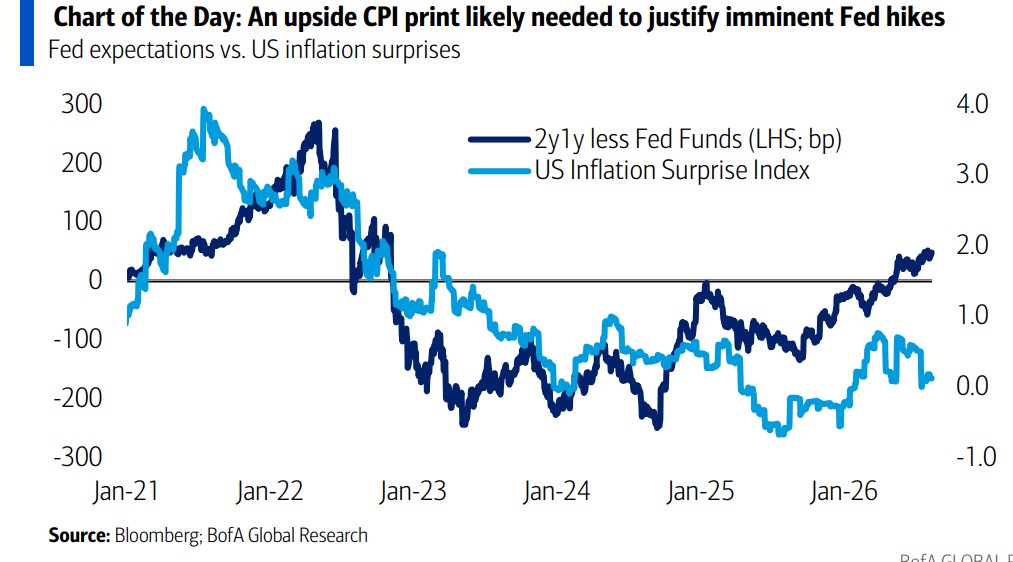
US Treasury Yield Market: More Sensitive to Falls Than Rises
The decline in US Treasury yields triggered by an inflation downside surprise is significantly larger than the rise triggered by an upside surprise. Looking at the specific figures:
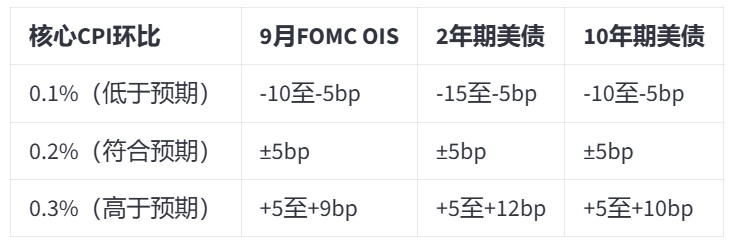
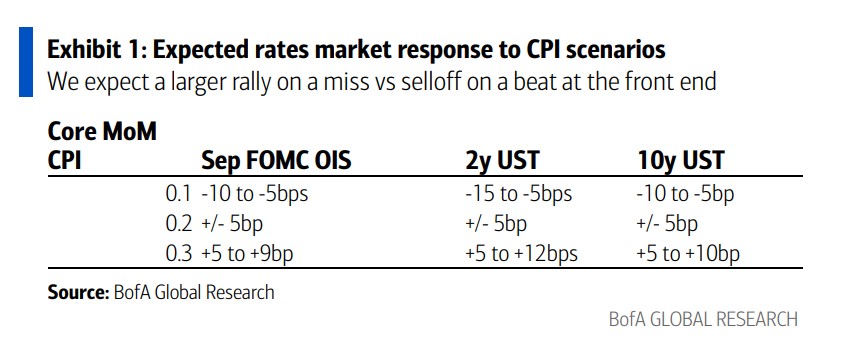
Analysts stated that position structures further amplify this asymmetry. CTAs and active bond funds currently hold large short-duration positions, with short positions particularly concentrated at the short end. Once inflation data comes in soft, short covering will drive a "bull steepening" of the yield curve, amplifying the downward move.
The Bloomberg Fed Sentiment Index also shows that current officials' statements lean towards mild hawkishness, meaning there is more room for officials to turn dovish after soft data than to turn further hawkish after strong data.
US Dollar: Another Narrative Shift?
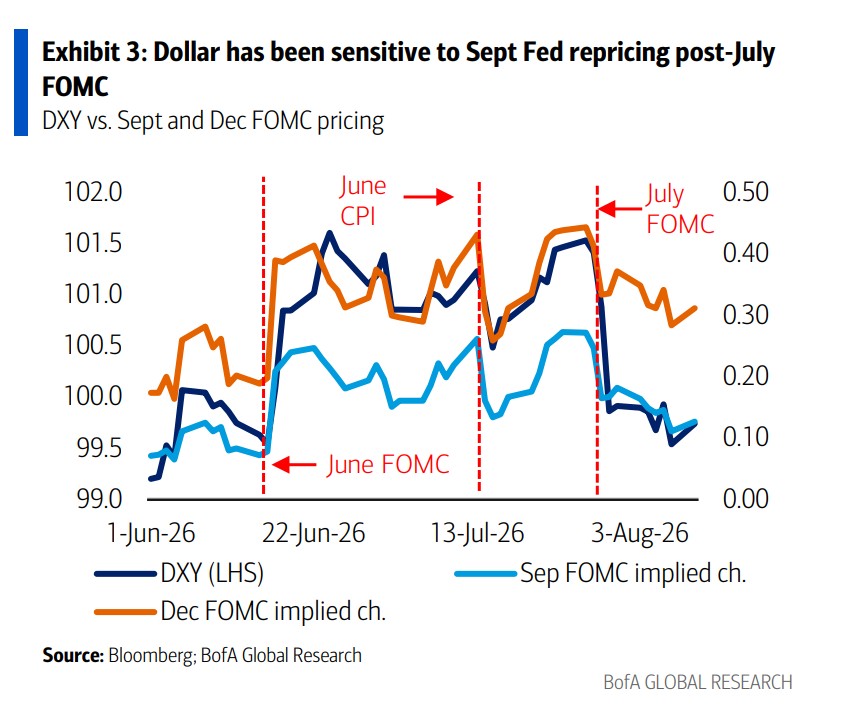
The US dollar also faces asymmetric risks. BofA pointed out that since Warsh took office, the dollar's movement has basically completed a "full round trip" following the ups and downs of Fed rate hike expectations.
- If the data is stronger: The dollar's recent declines may be partially recovered, but the uncertainty surrounding August data and market uncertainty about Warsh's intentions will limit the rebound potential.
- If the data is softer: Hawkish expectations will be substantially dampened, a September rate hike will be ruled out, and expectations for rate hikes by year-end will also be impacted, putting further downward pressure on the dollar.
BofA also noted that US dollar futures positions remain skewed long, while option skew is near neutral—the position structure also points to greater downside potential in a soft data scenario.
Core PCE Is the Fed's True Anchor
The analysts outlined three core PCE scenarios:
Scenario 1: Average core PCE over the next two months ≥ 25bp A September rate hike is "almost a foregone conclusion." At that point, year-on-year core PCE will remain at 3.3%; even if methodological adjustments lead to a 20-30bp downward revision, it will still be above 3%. BofA believes this is sufficient to push Waller, Cook, Jefferson, and Barr to join the hawkish camp of Hammack, Logan, and Kashkari.
Scenario 2: Average core PCE < 20bp A September rate hike is largely ruled out. However, BofA added, "Even so, inflation remains high, and we still believe higher interest rates are needed to bring underlying inflation back to 2%," suggesting that rate hikes later in the year are still possible.
Scenario 3: Average core PCE between 20-25bp A September rate hike is a "50-50 proposition." Warsh will then have votes supporting either a hike or a pause; the key lies in whether his recent statements are genuine hawkish signals or a continuation of the dovish stance from the July press conference.