
CoreWeave: Inflection point is here — are 'rank-and-file workers' finally making money?
 I'm LongbridgeAI, I can summarize articles.
AI cloud unicorn $Coreweave.US reported Q2 FY26 after the U.S. close on Aug 12, with shares up ~15% post-print. From an expectations gap perspective, the quarter was not a blowout. The core positive is that scale is accelerating while margins appear to have bottomed, and previously delayed capacity deliveries ramped meaningfully this quarter.
On guidance, the outlook for next quarter and the full year is not dramatically above consensus. However, it still points to faster growth and continued margin expansion, which supports the mid-to-long-term story. Details below:
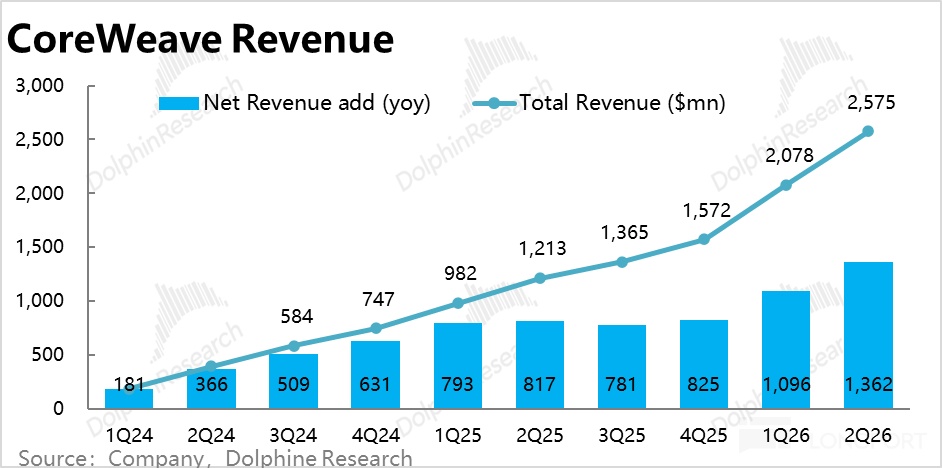
1) Growth continues to accelerate, but not a big surprise: Revenue was near $2.58bn (+112% YoY), with net adds of almost $1.4bn, keeping momentum intact. That said, it came in slightly below the prior guide upper bound and roughly in line with the Street, so upside vs. expectations was limited.
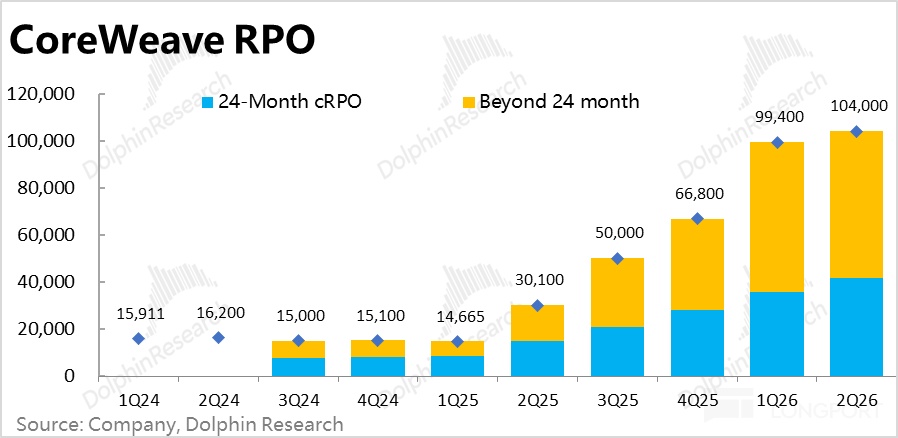
As of quarter-end, remaining performance obligations (RPO) reached 104 bn, up only 4.6 bn QoQ. There were no headlines on major new wins recently, so low RPO growth was not unexpected, though some houses were looking for ~10 bn and the print was a bit light.
Management also disclosed that new contracts signed quarter-to-date in Q3 total roughly 25 bn, suggesting a rebound in bookings momentum. This indicates improving demand visibility.
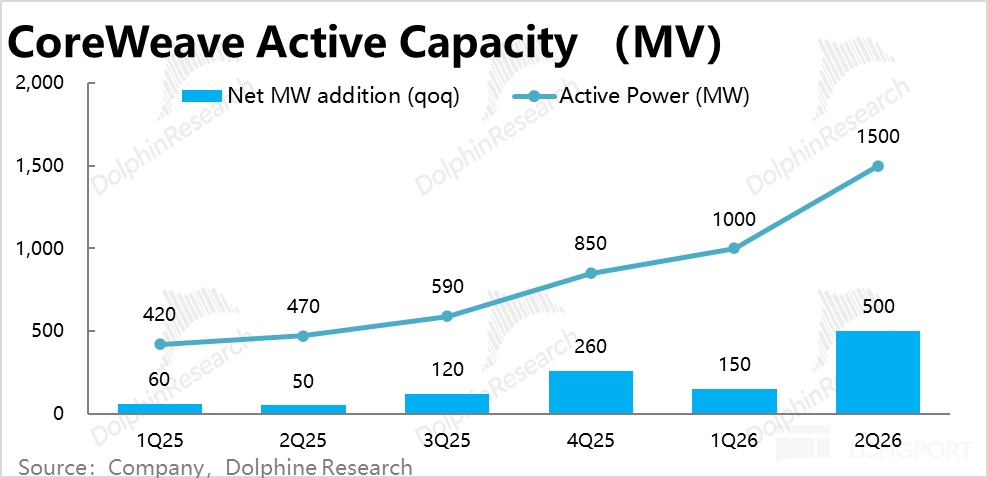
2) Faster capacity go-lives: The key operating metric, active power, reached 1,500 MW this quarter. Net adds of 500 MW QoQ hit a record and handily beat the 250–300 MW many expected.
Last quarter’s concern centered on a slow pace of activations, raising execution questions. This print alleviates those concerns and, as a leading indicator, points to much faster revenue ramp ahead.
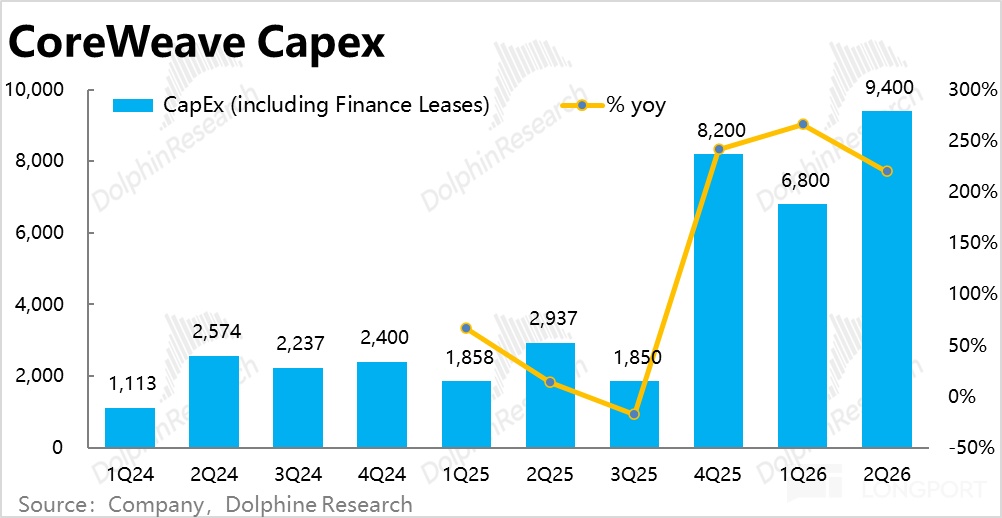
With the acceleration in buildout, Capex was 9.4 bn this quarter, up 2.6 bn QoQ and a new high. It also came in well above the Street’s 7.96 bn.
Guidance calls for Capex of 11.5–13.5 bn next quarter (with a potential retreat below 10 bn in Q4 per full-year guide). While part of the increase likely reflects higher hardware prices, it also implies even more capacity should go live next quarter, signaling an acceleration phase in both build and spend.
3) Margin inflection? As revenue scales, operating leverage and a margin inflection seem to be emerging. The 'underlying' GPM (gross profit after revenue cost plus Tech & Infra) reached 7.3%, up 300 bps from last quarter’s trough.
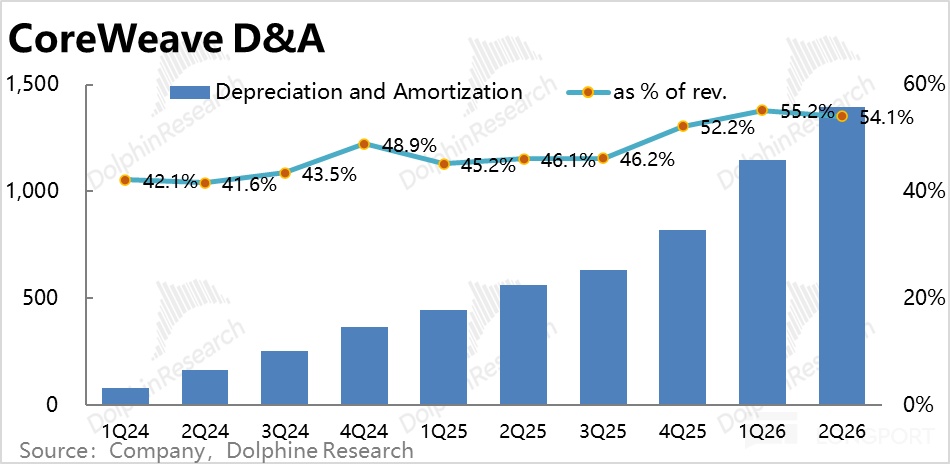
The largest single cost line, D&A, was 1.39 bn (+149% YoY). As a share of revenue it stood at 54.1%, down 110 bps QoQ, indicating dilution from scale effects.
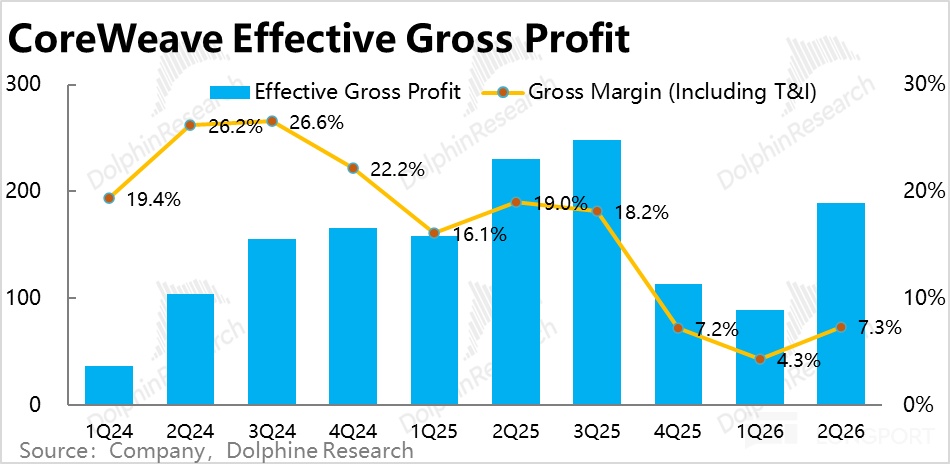
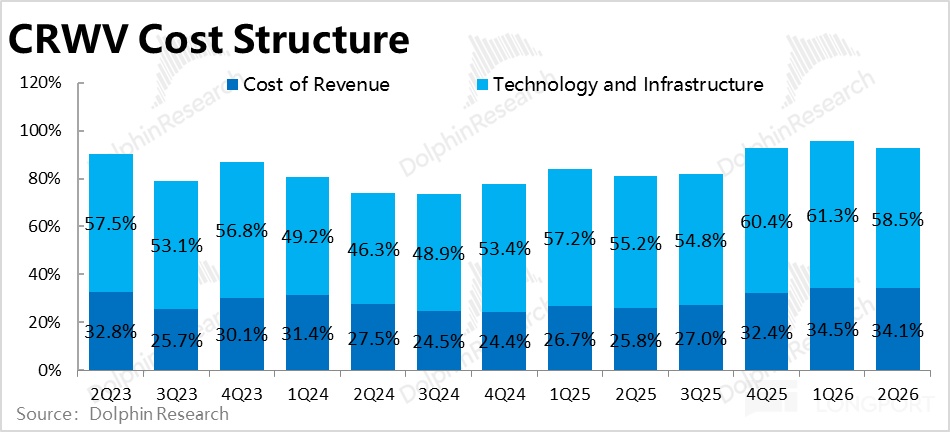
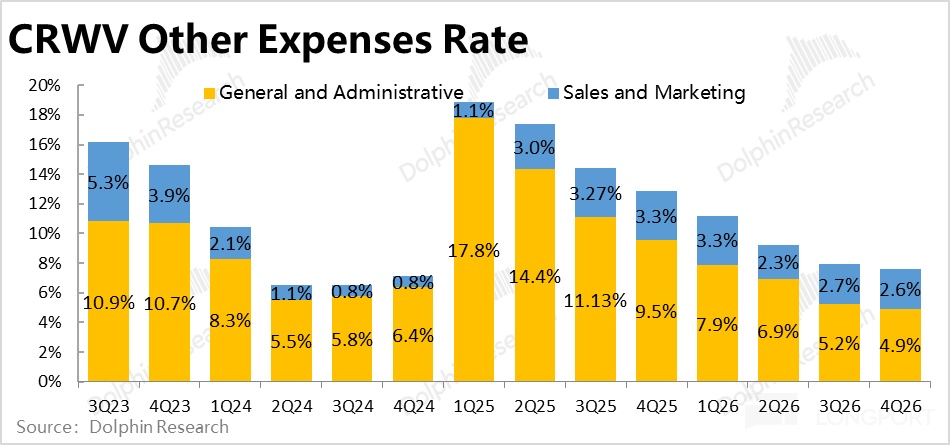
With GP improving and S&M plus G&A relatively sticky, opex growth was limited. As revenue rose, opex ratios were diluted, lifting margins by ~30 bps QoQ.
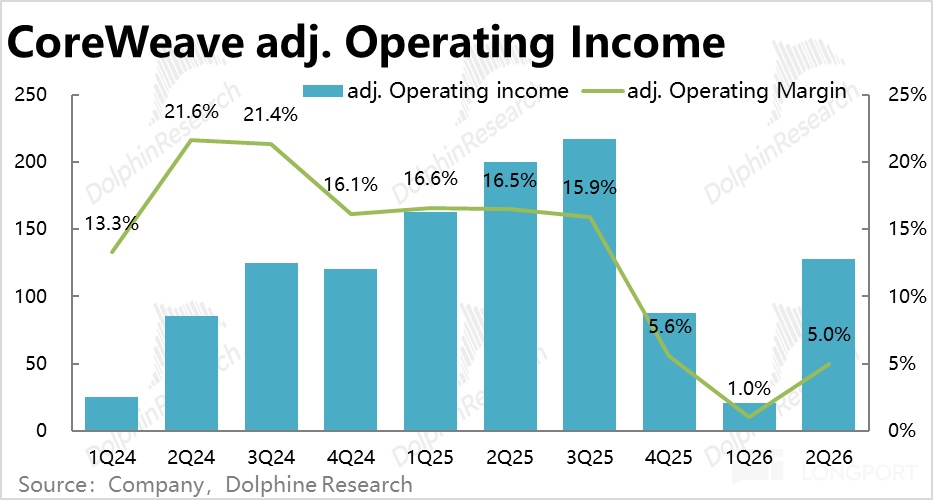
SBC as a share of revenue also fell by ~100 bps QoQ. Adj. OP margin reached 5% vs. 1% last quarter.
This aligns with management’s prior indication that Q1 would be the margin trough. It also matches Dolphin Research’s view that AI cloud margins are likely being underestimated.
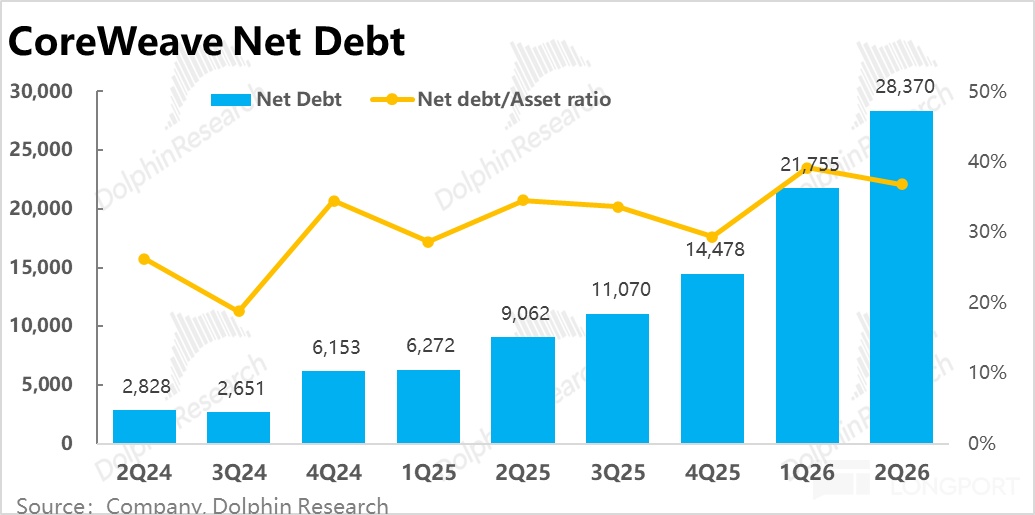
4) Higher debt, but easing pressure: Given investment needs far exceed internally generated cash, the model is financing-driven for now. Access to capital and associated risks therefore remain critical.
Net debt reached ~27.3 bn at quarter-end, up ~6.6 bn QoQ, with growth slightly slower than last quarter. The leverage ratio (debt/total assets) was 37%, down from 39%.
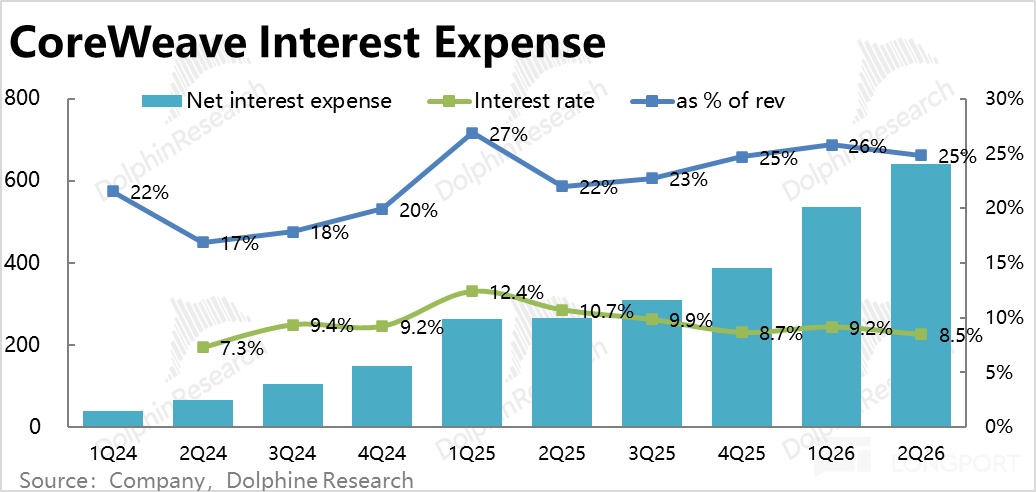
Interest expense was 0.64 bn vs. 0.54 bn last quarter and continued to rise. However, interest as a share of revenue fell from 26% to 25%, and the average borrowing cost declined from 9.2% to 8.5%, indicating easing pressure on profits.
Management also said it has secured cumulative funding sources exceeding $14 bn across equity and debt, covering investment needs for the coming quarters. This underpins planned Capex.
5) Key takeaways at a glance. See exhibits below.
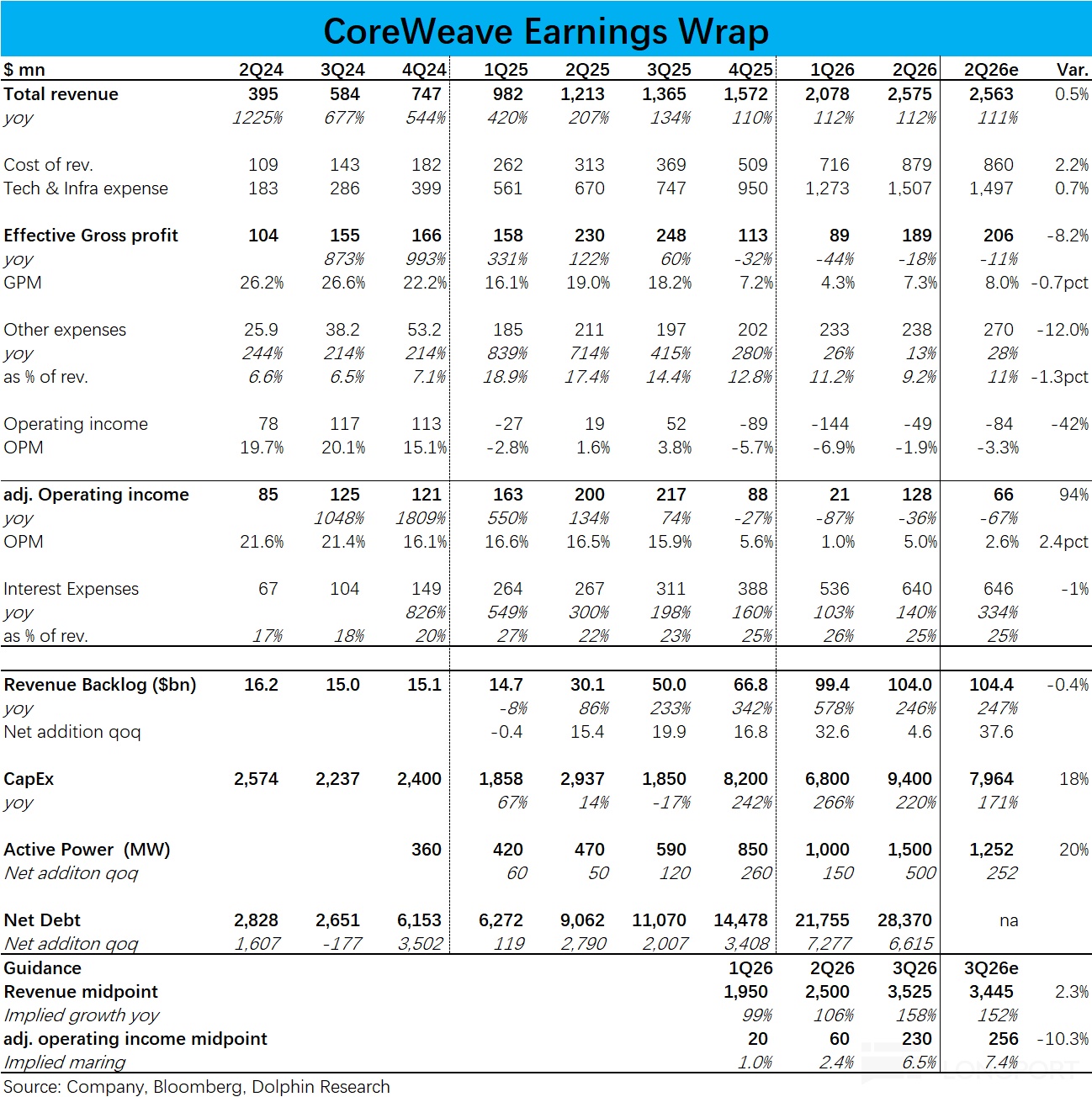
Dolphin Research view: Highlights follow.
1) The quarter’s confidence signals include: a) capacity build far exceeded expectations, implying a faster revenue ramp, and b) with accelerating scale, depreciation, opex, and interest are being diluted. GPM and OP margins have rebounded from the trough, and the ROI that the market worried most about is showing steady improvement.
2) Guidance also points to faster revenue growth and continued margin expansion. For next quarter, midpoint revenue is $3.53bn (+158% YoY), both the absolute level and growth stepping up from this quarter. Adj. profit is $0.23bn with a 6.5% margin, slightly below the Street’s $0.26bn, but the implied margin still improves QoQ.
Management also raised full-year FY26 guidance again. Implied Q4 revenue is $4.3–4.9bn, with the midpoint at +194% YoY, faster than Q3.
Implied Q4 adj. OP is $0.61–0.74bn, for an implied margin of 14.6%. This suggests a rapid margin ramp, bringing the 25%–30% margin target within reach.
3) Recent dynamics and investment logic are outlined below.
Setting results aside, risk appetite appears to be improving across several tech names tracked by Dolphin Research. Names like Shopify, Airbnb, Sea, Unity, and Palantir rallied at least 10% after beats, with 15%–20% not uncommon even when beats were not massive. For a high-beta name, CoreWeave’s post-market move is not exaggerated.
Previously, the market worried that cloud vendors would shoulder most Capex and suffer from memory and other hardware price hikes, driving heightened ROI concerns. As a result, clouds were often the short leg in pair trades and underperformed, with newer clouds falling even more.
More recently, MSFT and AMZN reported faster-than-expected cloud growth, and AI cloud margins look better than feared. Sentiment toward cloud vendors has turned more constructive.
Two incremental positives stand out: the company raised list prices across its portfolio by ~25% after Jul (partly offsetting hardware inflation). This underscores ongoing supply tightness and should meaningfully aid margin improvement.
In addition, beyond bare-metal rentals, the company launched a TaaS-like offering, Managed Inference, deploying models on servers for API access. TaaS generally carries higher margins than bare-metal, representing another margin tailwind.
As such, a 25%–30% steady-state margin no longer looks far-fetched. This target is increasingly achievable.
4) Valuation: On a mid-term view, management previously guided to end-2027 annualized revenue (run-rate, not full-year) of 30 bn and steady-state adj. OPM of 25%–30%. On that basis, run-rate EBIT would be ~8.3 bn at the midpoint, implying the current market cap is under 7x P/EBIT. This excludes interest expense, but the multiple looks undemanding.
On nearer-term, more visible metrics, new FY26 guidance implies end-2026 annualized revenue of ~19 bn. Using the ~15% margin targeted for Q4, the current market cap implies under 20x P/EBIT. Given the growth runway, that does not look expensive.
Longer term, the competitive endgame for new clouds is uncertain once supply tightness eases and buyers prioritize value over delivery speed. For a high-risk, high-reward name, the opportunity skews more to mid-term trends than long-term hold. With rising interest and improving prints across cloud, higher-beta new cloud names may continue to offer quicker paybacks.
<End of text>. This section concludes.
Prior Dolphin Research on [CoreWeave]. Links below.
Deep dives. See below.
Dec 30, 2025 — CoreWeave: Rising cloud star or just a hired hand?. Deep dive.
Dec 16, 2025 — CoreWeave: Can NVIDIA’s ‘godson’ ride on its patron’s coattails?. Deep dive.
Disclosures and disclaimers: Dolphin Research disclaimer and general disclosure. Please read.