
"Big Short" loses its cool? Barry angrily criticizes NVIDIA's $500 billion financing as "financial engineering of 2008," but the market supports AI computing power demand with real money
 I'm LongbridgeAI, I can summarize articles.
Michael Burry criticized the $500 billion AI infrastructure financing led by NVIDIA as "2008 financial engineering" and continues to short AI-related stocks. However, market funds still support the demand for AI computing power, with signs such as CoreWeave's capacity being sold out and NVIDIA's credit spreads narrowing indicating that the balance is tilting towards the AI financing framework, putting pressure on Burry's short bets
According to the Zhitong Finance APP, on Wednesday during the early trading session of the U.S. stock market, Michael Burry, known as the "Big Short," launched a fierce criticism of the $500 billion artificial intelligence infrastructure financing arrangement dominated by "AI chip superpower" NVIDIA (NVDA.US). He compared the complex financing network composed of private credit and asset-backed securities to the systemic financial risks that accumulated on the eve of the 2008 financial crisis, calling this arrangement a "Wall Street-exclusive trick similar to 2008."
Michael Burry, known as the "Big Short," has been posting pessimistic remarks about the "end is near" on his Substack subscription platform, and as global funds continue to flock to AI computing infrastructure themes, he has been heavily shorting popular AI tech stocks. The character who inspired the movie "The Big Short" has recently focused his shorting activities more clearly on crowded trades related to AI computing infrastructure and the AI semiconductor capital expenditure cycle. For instance, Burry has expressed a continued bearish position on NVIDIA, Tesla, Micron, Applied Materials, Palantir Technologies, and the iShares Semiconductor ETF through put options or short positions.
In fact, he has upgraded his short portfolio into a systematic bet against "AI capital expenditure + AI valuation." However, recently, AI semiconductors and the broader AI computing theme have made a strong comeback, especially driven by the tech stock rally following the mild CPI growth data in the U.S., which is indeed putting significant pressure on this "short AI" trading mechanism. Notably, the current capacity sellout of CoreWeave, the extension of A100's lifespan to 2029, Nebius's price increase and $40 billion customer commitments, as well as the narrowing credit spread of NVIDIA, have significantly tilted the balance towards Jensen Huang/Morgan Stanley's "AI factory financing assets" framework.
Some investors have commented that the Big Short's latest fierce attack on NVIDIA's dominant financing activities—criticizing the $500 billion financing as similar to Wall Street financial engineering in 2008—seems to indicate that this big short is "getting desperate." Meanwhile, CoreWeave has raised its 2026 capital expenditure to $35 billion to $39 billion, and after the earnings report, its stock surged. Nebius's Q2 revenue skyrocketed year-on-year and stated that under current conditions, it could even sell out its planned capacity for 2027. The reality of trading and the supply chain is clearly reinforcing the bullish narrative that "AI computing demand is still real and tight." In contrast, Burry, who is shorting Nebius, may now be facing pressure to cover his positions.
Scion Asset Management, previously led by Burry, has been deregistered as of November 2025, so what we see now is more of Burry's personal trades actively disclosed through the paid subscription platform—Substack's "Cassandra Unchained," rather than traditional 13F holdings snapshots. Recent public information shows that he still maintains short exposure to NVIDIA, Palantir, the SOXX Semiconductor ETF (Philadelphia Semiconductor ETF), and QQQ (Nasdaq-100 Index ETF), and has rolled some of his NVIDIA/QQQ put options to 2027. On August 7, he also disclosed a direct short position in Nebius at around $212, stating that the position size is "relatively larger." However, after Neocloud's CoreWeave and Nebius announced strong earnings reports on Wednesday, the stock prices of these two new cloud companies surged nearly 20%.
Previously, Palantir's stock skyrocketed about 29.5% on August 4th after a blowout earnings report, resulting in a record loss of approximately $3 billion for the entire Palantir short camp on that day; however, Barry recently re-established out-of-the-money put options on Palantir expiring in 2027 before the AI application leader announced strong earnings, thus his short position is clearly under new Mark-to-Market pressure—when market prices rise, short sellers (the short camp) incur unrealized losses because the price of the borrowed assets sold is higher than when they were bought, leading brokers to require them to continuously replenish margin.
$500 Billion AI Financing Faces "Big Short" Attack! Barry Questions Nvidia's Dominance in Circular Leverage
Nvidia, one of the seven major tech giants in the U.S., has signed a highly anticipated memorandum of understanding with Apollo Global Management (APO.US), Blackstone Group (BX.US), BlackRock (BLK.US), Brookfield (BN.US), Goldman Sachs (GS.US), and KKR & Co. (KKR.US) to establish the first such AI computing infrastructure financing platforms globally, with an initial financing scale set as high as $500 billion.
As a market platform facilitating transactions, Nvidia plans to provide up to 25% guarantees for individual projects through a "residual value mechanism" to support these financing deals. If a project encounters difficulties, this chip giant will seek to minimize losses by massively selling its highly demanded proprietary AI chip products or finding new corporate tenants for the related AI computing capacity to provide financial support.
However, Barry has accused on the subscription platform that there is a highly leveraged and circular funding chain behind these transactions. According to an infographic he created, the annuity premiums paid by American retirees to Apollo's (APO.US) Athene are transferred through an offshore reinsurance company based in Bermuda and further leveraged by Apollo into asset-backed debt. It is reported that Apollo issued $3.5 billion in debt to a special purpose entity named Valor, while Nvidia directly injected $1.9 billion in equity funding. Subsequently, VCI purchased $5.4 billion worth of Nvidia GB200 GPUs and leased these GPUs to xAI for its Grok supercomputer cluster.
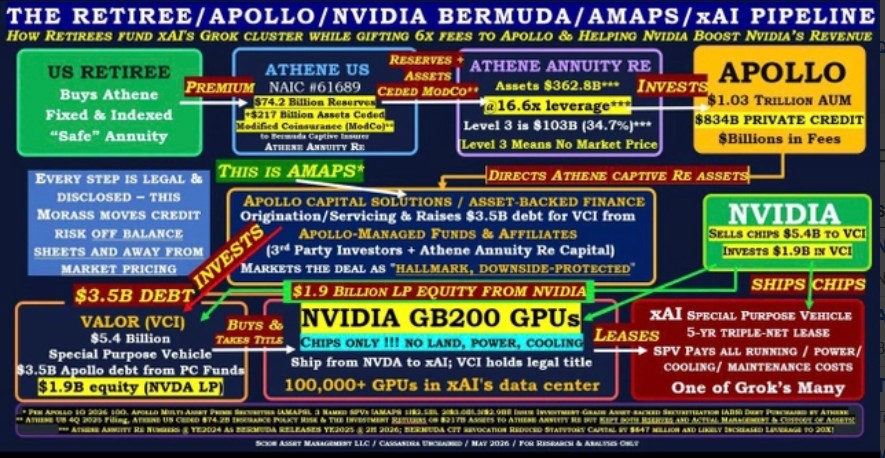 For skeptics of the AI boom like the "big short," this complex financing structure artificially inflates revenue data while shifting depreciation risks onto unsuspecting retirees.
"I have a pretty good idea of what this will ultimately look like," Barry wrote in a post on X platform. Barry has recently increased his direct short bets against AI power industry leaders like NVIDIA through put options. "Meet the new boss. Not much different from the old bosses of 2008," Barry sarcastically remarked.
Is the $500 billion a "financial trick" or financing for an AI industrial revolution? Credit spreads have narrowed, Neocloud has surged, and funds are temporarily choosing to believe Jensen Huang.
After Nebius released its outlook report on Wednesday, its stock surged nearly 20% in early trading, just approaching Barry's short cost of about $212. Some Wall Street analysts even believe that short covering could become one of the strong amplifiers for the company's stock price increase. Undoubtedly, Barry is experiencing significant short price pressure, but there is currently no reliable evidence that Barry himself has faced forced liquidation or must cover.
The explosive performance and strong outlook recently announced by ASML and TSMC, the two most important upstream capacity and supply forces in the AI power industry chain, along with the strong performance and outlook recently released by CoreWeave and Hon Hai, are actually sending an important signal to the global stock market: the AI power industry chain has gradually transitioned from the "super cycle of AI capital expenditure for training large AI models" to a new phase of "exponential expansion of AI inference power demand driven by large-scale applications of intelligent agents." These latest signals are a strong rebuttal to the pessimistic view of "overcapacity" that has recently led to a sharp decline in the AI power theme, especially in the AI semiconductor sector.
CoreWeave, closest to the demand for AI power terminals, has just raised its capital expenditure expectations for 2026 to an astonishing $35 billion to $39 billion, with Q2 revenue significantly exceeding expectations, stating that it continues to sign cloud power contracts on favorable terms despite limited supply. Meanwhile, SK Hynix also reported record quarterly profits and disclosed that it has signed long-term supply agreements with about 10 core customers, reflecting that demand for high-performance storage like HBM has shifted from short-cycle orders to multi-year locked volumes. Different segments of the industry chain are all releasing positive signals that AI power demand is still accelerating.
At this moment, does the market believe Barry or Jensen Huang + Morgan Stanley? The answer is quite clear: marginal funds are currently clearly on the latter's side, but have not yet declared Barry's long-term risk argument invalid.
The most important evidence is not even the stocks, but the credit market: when the $500 billion plan was first announced, the market was concerned about the huge off-balance-sheet risks that NVIDIA would bear; Jensen Huang then clarified that this $500 billion is intended to gradually mobilize third-party capital, not NVIDIA's revenue, nor funds already committed to a specific client. Apollo, BlackRock, Blackstone, Brookfield, Goldman Sachs, and KKR will independently underwrite projects, and NVIDIA's support cap is only about 25% of the residual value of individual project collateral Subsequently, the spread of NVIDIA's 2056 bonds relative to U.S. Treasuries narrowed by about 2 basis points to 113 basis points, while the 5-year CDS narrowed by as much as 5 basis points to 72.11 basis points—this is a very clear language from the bond market: investors adjusted NVIDIA's credit risk pricing after Jensen Huang clarified the structure.
Morgan Stanley and Bank of America's assessments are largely consistent: third-party professional capital dominates due diligence and decision-making, significantly weakening the pure cyclical AI boom logic of "NVIDIA pays for itself—customers pay to buy NVIDIA GPUs—NVIDIA artificially inflates revenue"; at the same time, revenue linked to usage may allow NVIDIA to further share cash flow from the AI factory lifecycle beyond one-time GPU sales. In other words, the market currently does not believe that this $500 billion has "no credit risk," but rather sees the risk as more akin to underwriteable and priceable infrastructure financing risk, rather than the distorted asset demand seen before 2008.
Burley bets on a replay of 2008 Wall Street financial engineering, but CoreWeave and Nebius deliver overwhelming demand evidence
The strongest challenge to Burley's argument of "2008-style financial engineering" comes from two new cloud leaders—CoreWeave and Nebius, which today provided evidence of physical demand, pricing, and residual value. CoreWeave's Q2 revenue reached approximately $2.6 billion, up 112% year-over-year, with backlog soaring to $104.2 billion, not including over $25 billion in new commitments signed at the beginning of this quarter; the company clearly stated that near-term capacity is "effectively sold out," and is therefore signing new contracts at increasingly favorable prices. JPMorgan's analyst team even attributed this price increase to the demand environment and the accelerated improvement in ROI for cloud computing and AI application customers.
More importantly, CoreWeave directly provided a powerful counterexample to Burley's argument that "GPUs only have an economic lifespan of 2-3 years": the company just signed a new contract for the A100 released in 2020 that extends to 2029, and the price remains attractive; management also clearly stated that the old GPU fleet is still basically sold out, and re-leasing after the initial contract ends represents incremental income beyond existing investment returns, observing longer usage cycles and higher prices.
Nebius's evidence is even more aggressive: Q2 revenue was $582.3 million, exceeding the consensus expectation of $572.75 million, with AI Cloud (AI-related cloud computing business) revenue approaching six times year-over-year, signing four contracts in a single quarter averaging over $1 billion, with new customer contract value increasing over nine times quarter-over-quarter, having over $40 billion in customer commitments and expecting over $9 billion in customer prepayments this year; the company even stated that under current conditions, it could sell out all planned capacity for 2027. This latest set of operational data strongly supports Jensen Huang's assertion that "demand is real, and productive AI computing power is a scarce asset" at least as of August 2026, rather than supporting the notion that "financing created false GPU demand."