
In the Era of Agentic AI, Will CPU-to-GPU Ratio Reach "1:1"?
 I'm LongbridgeAI, I can summarize articles.
Agentic AI is triggering a shift in computing power dynamics, leading to a historic revaluation of CPUs as they shed their "supporting role." Bank of America predicts that CPUs are ascending to become the "control hub" of data centers, with the CPU-to-GPU ratio narrowing from 1:4 to nearly 1:1. The market size is projected to exceed $210 billion by 2030. In this hundred-billion-dollar feast, the ARM camp is poised for a strong rise, capturing nearly half the share; AMD emerges as the top pick due to its core performance, while Intel faces the challenge of shrinking market share
The wave of Agentic AI is fundamentally reshaping the computing architecture of data centers, significantly elevating the strategic status of CPUs.
In its latest research report, Bank of America Securities raised its forecast for the total addressable market (TAM) of server CPUs in 2030 to over $210 billion, an increase of more than 20% from the previous estimate of approximately $170 billion. It also upgraded the expected compound annual growth rate (CAGR) from 30% to 36%.
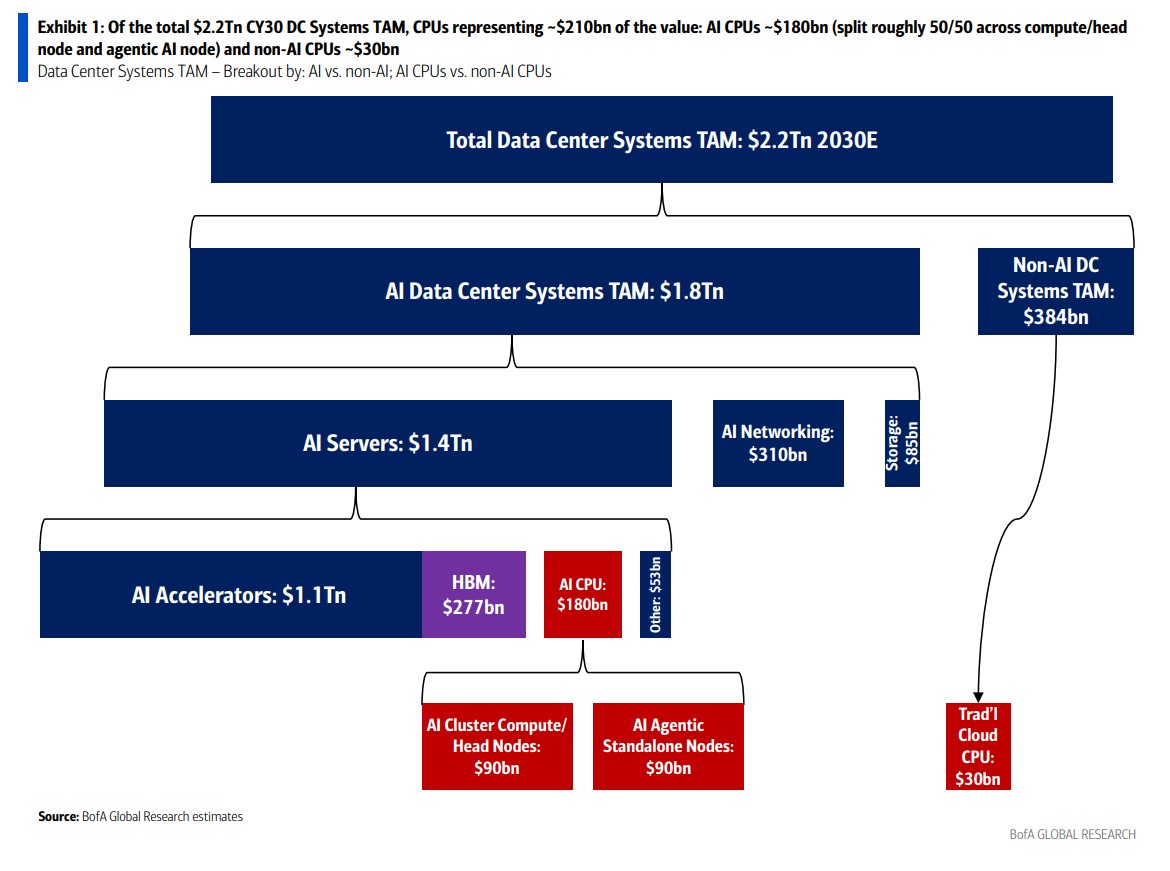
The core logic behind this adjustment is: As AI workloads evolve from training to inference, and further to Agentic AI, the role of CPUs in data center systems is upgrading from a "supporting character" for GPUs to the "control plane" for agent orchestration. Bank of America expects the CPU-to-GPU ratio to narrow gradually from about 1:4 in the training era to approximately 1:2 in the AI inference stage, and finally approach 1:1 in the Agentic AI era. This implies that by 2030, CPUs will account for about 10% of the overall data center system TAM of approximately $2.2 trillion, higher than the less than 7% seen during the training era of 2024–2025.
At the individual stock level, Bank of America maintains a Buy rating on AMD with a price target of $620, viewing it as the best CPU pick; it also maintains a Buy rating on NVIDIA (NVDA) with a price target of $350, considering it the top choice for the semiconductor sector as a whole.
Agentic AI Restructures CPU Demand Logic
Bank of America analyst Vivek Arya’s team points out that the evolution of AI workloads is systematically raising the demand density for CPUs.
During the training era, CPUs primarily handled auxiliary functions such as data preprocessing, tokenization, batch processing, and feeding data to GPUs, while GPUs/accelerators were the core of computing power. This landscape led to a surge in the AI accelerator market with a CAGR of +139% from 2022 to 2025, whereas server CPUs recorded only a +14% CAGR. By 2025, AI accelerators accounted for 85% of data center computing spending, with CPUs taking just 15%, compared to a 26% to 74% split in 2021.
Entering the Agentic AI phase, the situation has undergone a structural shift. Agentic AI is not simply a "question-and-answer" process but involves multi-step cyclical workflows including planning, context retrieval, tool invocation, state management, API interaction, multi-model routing, and result evaluation. These tasks are essentially CPU-intensive sequential processing, rather than the parallel matrix operations at which GPUs excel. Bank of America believes that CPUs are thus upgrading from "host processors" to the "control plane" for AI inference.
Notably, Bank of America emphasizes that this is not about CPUs replacing GPUs, but rather the simultaneous expansion of demand for both. The core status of GPUs in matrix operations, large model inference, high-throughput pre-filling, and frontier model inference remains unchanged; meanwhile, CPUs assume more responsibilities in dimensions such as orchestration, memory management, tool execution, and data movement. The system bottleneck has expanded from single GPU computing power to a broader infrastructure level, thereby enlarging the overall data center TAM.
2030 Market Landscape: ARM Rises, Intel Under Pressure
Bank of America breaks down the 2030 server CPU TAM into three categories: Traditional/IaaS at approximately $30 billion, AI Computing/Head Nodes at approximately $90 billion, and Agentic AI Independent Nodes at approximately $90 billion. The latter two, constituting an AI CPU market of about $180 billion, will account for approximately 86% of the total.
In terms of market share forecasts, the ARM camp will be the biggest winner. Bank of America expects that by 2030, ARM commercial CPUs (including NVIDIA Vera, ARM AGI, Qualcomm CPUs, etc.) will hold about 38% of the server CPU value share, and ARM custom CPUs (including AWS Graviton, Google Axion, Microsoft Cobalt, etc.) will hold about 9%, totaling nearly 47%. AMD is expected to maintain a value share of about 31%, while Intel (INTC) will drop from about 34% in 2026 to about 22%, although its absolute revenue will still grow at a CAGR of approximately 22%.
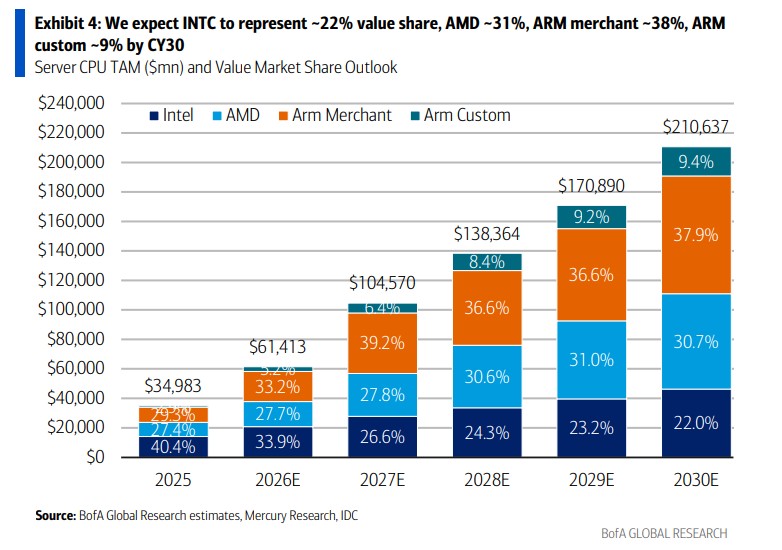
In terms of unit share, Intel will still lead with about 36%, but the continuous decline in value share reflects its competitive disadvantage in high-value-added AI workloads. Bank of America notes that Intel's relative advantage lies in traditional enterprise workloads, and its Coral Rapids platform based on the 18A-P process is expected to narrow the performance gap with competitors by 2028.
AMD: Dual Leadership in Core Count and Frequency
Bank of America lists AMD as the best CPU pick, primarily based on its dual leadership in high frequency and high core count.
In terms of high frequency, AMD Turin (5th Gen EPYC) reaches a peak frequency of 5.0 GHz, higher than Intel Granite Rapids' 4.3 GHz and NVIDIA Grace's approximately 3.35 GHz. The upcoming Venice (6th Gen EPYC), scheduled for release in the second half of 2026, is expected to further consolidate this advantage, making AMD CPUs an ideal choice for head/compute nodes in AI scaling clusters.
Regarding core count, AMD's advantage is even more pronounced. Venice is expected to support up to 256 cores/512 threads, far exceeding NVIDIA's upcoming Vera (88 cores/176 threads) and Intel Diamond Rapids (expected max 192 cores). Bank of America calculates that the AMD EPYC 9965 (Turin, 192 cores) delivers 2.37 times the rack-level performance of NVIDIA Vera in Agentic AI workloads, while Venice (256 cores) is expected to expand this advantage to 3.30 times.
Furthermore, Bank of America is optimistic about AMD's execution capabilities and supply chain visibility regarding the Zen 6/2nm process, as well as the x86 ecosystem's adaptation advantages in Reliability, Availability, and Serviceability (RAS) features for Agentic AI workloads.
NVIDIA's Independent CPU Racks Open New Demand Space
NVIDIA's independent Vera CPU racks (CPX racks), launched alongside the Vera Rubin platform in the second half of 2026, are one of the key catalysts for Bank of America's upward revision of the CPU TAM forecast.
This rack can integrate up to 256 Vera CPUs, adopts a liquid-cooling design, and is optimized for Agentic AI workloads. It is responsible for orchestration, memory control, and I/O management, and can test, execute, and verify the output of Vera Rubin NVL72 compute racks. In a complete 40-rack Vera Rubin SuperPOD, each Pod contains 1,152 Rubin GPUs, 576 Vera CPUs as part of the compute racks, and potentially another 512 Vera CPUs in independent CPU racks, bringing the CPU-to-GPU ratio close to 1:1.
Bank of America believes that these independent CPU racks will handle workloads previously considered too fragmented for expensive GPU racks, such as RAG pipelines, vector databases, data preparation, API/tool execution, and small-to-medium model inference, thereby substantially expanding the overall TAM rather than merely substituting existing demand.