
U.S. Stock Market Preview | The three major index futures are mixed. U.S. July retail sales will be released tonight. Sandisk continues to rise over 6% in pre-market trading
 I'm LongbridgeAI, I can summarize articles.
On August 14th, before the US stock market opened, the three major stock index futures showed mixed results. The market is focused on the US retail sales data for July. Bank of America’s Hartnett believes that the midterm elections in 2026 will be a watershed moment for the AI bull market, and if the Republican Party retains control of the Senate, AI stocks may continue to rise; Steve Eisman warned that Anthropic and OpenAI are weak links in AI trading. Additionally, there are rumors that the Bank of Japan may raise interest rates as early as September
Pre-Market Market Trends
- As of August 14 (Friday), U.S. stock index futures are mixed before the market opens. As of the time of writing, Dow futures are down 0.14%, S&P 500 futures are up 0.12%, and Nasdaq futures are up 0.28%.

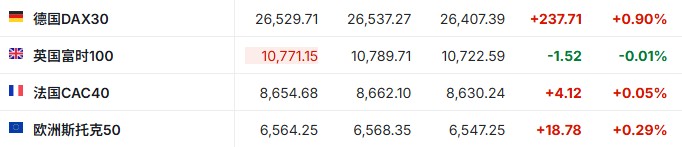
- As of the time of writing, the German DAX index is up 0.90%, the UK FTSE 100 index is down 0.01%, the French CAC 40 index is up 0.05%, and the Euro Stoxx 50 index is up 0.29%.
- As of the time of writing, WTI crude oil is up 0.48%, priced at $81.64 per barrel. Brent crude oil is up 0.18%, priced at $87.23 per barrel.

Market News
Will the Midterm Elections be a Watershed for the AI Bull Market? Bank of America’s Hartnett: If the Republicans hold the Senate, AI stocks could soar until 2027. Bank of America’s Hartnett points out that the 2026 midterm elections are a critical watershed for the U.S. AI bull market. If the Republicans hold the Senate and Texas Governor Abbott is re-elected, AI capital expenditures will continue, and U.S. stocks, especially in the AI sector, could "soar" until 2027; conversely, the market could drop more than 10%. Currently, earnings and AI investments support the bulls, but positions are extremely crowded, and rising bond yields pose a major risk.
"Big Short" investor Steve Eisman: Anthropic and OpenAI are the "Achilles' heel" of AI trading. The market is eagerly anticipating the IPO moments of OpenAI and Anthropic, but in the eyes of well-known short-seller Steve Eisman, these two AI giants are precisely the weakest link in the entire AI trading chain. He points out that about 70% of the AI revenue of tech giants comes from these two companies, and if China's low-cost models trigger a price war, trouble will ensue. Although the market is eagerly awaiting Anthropic's IPO (which could be valued at $2 trillion), Eisman states that a judgment should be made after the company discloses real data post-IPO; current concerns are merely "hearsay."
Reports suggest the Bank of Japan may raise interest rates as early as September and could accelerate subsequent rate hikes. Informed sources reveal that the Bank of Japan may raise interest rates as early as September and is considering advancing tightening at a faster pace than the current approximately twice a year. This move reflects the central bank's growing concerns about inflationary pressures from Middle Eastern conflicts, rising prices driven by global AI demand, and the ongoing depreciation of the yen; despite rare joint intervention in the foreign exchange market last month, the yen's depreciation trend has not reversed Insiders say "early interest rate hikes are showing signs," suggesting a high possibility of rate hikes at the policy meeting on September 17-18, and that the pace of rate increases may further accelerate.
AI infrastructure bonds are a "capital black hole" driving up real yields, posing a "capital scarcity" challenge to global economic and stock market prosperity. As AI companies and governments increase bond issuance, the market indicators for borrowing costs in major economies, adjusted for inflation, have soared to their highest levels in over a decade, exacerbating risks for the stock market and the global economy. The real yield on 30-year U.S. Treasury Inflation-Protected Securities (TIPS) is nearing its highest level since the 2008 financial crisis. The nominal yield on 30-year U.S. Treasuries has reached its highest level since 2007. The yield on 10-year U.S. Treasuries recently hit an 18-month high. This trend is not unique to the U.S.; the real yields on 10-year bonds in the UK and Germany are also near their highest levels in over a decade.
Reports say OpenAI's annual revenue exceeds $40 billion! Strong growth momentum ahead of potential IPO. According to insiders, OpenAI's current annual revenue has surpassed $40 billion, roughly doubling since the end of 2025. Insiders say that OpenAI's revenue has accelerated in recent months, partly due to the rapid growth of its artificial intelligence (AI) programming software business. The revenue growth also reflects ongoing momentum in subscription sales and its nascent advertising business. Meanwhile, OpenAI's core consumer business continues to grow.
Individual Stock News
Sandisk (SNDK.US) continues to rise over 6% in pre-market trading. Recently, Sandisk released core signals at its investor day, announcing that it will pull storage demand towards sustainable growth expectations through long-term agreements. Currently, Sandisk has signed contracts with 8 data center customers, with related long-term agreements covering approximately 50% of FY2027 and about two-thirds of FY2028's bit shipments, corresponding to a minimum revenue commitment of up to $93.9 billion, along with $16.5 billion in financial guarantees. Based on this, Sandisk provided a financial framework for FY2028-FY2030, expecting revenue to achieve mid-to-high double-digit growth, with a gross margin of about 80%. At the same time, the company expects the total addressable market (TAM) for enterprise data center flash memory to reach 1.2ZB by 2030, with AI inference becoming a key driver for new growth.
U.S. drone concept stocks soar across the board. On Friday pre-market, drone concept stocks surged across the board, with Unusual Machines (UMAC.US) stock price skyrocketing over 15%. In the news, U.S. President Trump signed a notice on the 13th, stating that the U.S. will impose a 10% to 100% ad valorem tariff on imported drones and parts. According to the notice, the new tariff measures will take effect on September 3. For drone parts that are not particularly sensitive or products and parts exempted by the U.S. Department of Defense, the new tariff measures will take effect on February 9, 2027.
Market appetite has hit the ceiling! Applied Materials (AMAT.US) also cannot escape the "sell the fact" curse: Strong demand for AI equipment, Q3 earnings report exceeds expectations across the board. After the market closed on Thursday, Applied Materials delivered a "completely exceeding expectations" report, with revenue of $9.12 billion not only surpassing analysts' expectations of $9 billion but also setting a new historical high for the company Adjusted earnings per share of $3.50 also set a record. GAAP gross margin reached 50.3%, an increase of 1.5 percentage points year-on-year, marking the 13th consecutive quarter of year-on-year improvement. However, the stock price fell about 5% in pre-market trading. This "good performance, bad stock price" trend reflects that the AI equipment sector, after experiencing a year of doubling growth, is now being scrutinized by the market with unprecedented stringent standards for every financial report.
AMD (AMD.US) issues a record $4.75 billion in bonds. AMD issued bonds on the 13th local time, raising $4.75 billion. This also set a record for the largest bond issuance by the company, with the bonds expected to settle on August 17. Analysts pointed out that this bond issuance highlights the increasing reliance of semiconductor companies on capital markets for financing, accelerating investments in artificial intelligence, expanding data centers, and advancing manufacturing projects. Recently, AMD announced multiple collaborations with Anthropic and Microsoft (MSFT.US), which will expand the application range of its chips. Market analysis shows that AMD's revenue is expected to grow by 47% this year compared to 2025, potentially exceeding $51 billion.
Apple (AAPL.US) finally fills the AI puzzle in the Chinese market! Partnering with Alibaba (BABA.US) to create edge AI. Sources revealed that Apple has specifically trained a large language model for the Chinese market, indicating that the tech giant has deviated from its previous strategy of relying on third-party models to support its AI functions in China. The AI large model (LLM) was developed in collaboration with Chinese cloud computing and e-commerce giant Alibaba and was trained with the technical support of this Chinese tech giant. Official representatives from both Apple and Alibaba have not responded to media requests for comments on the latest news.
Lam Research (LRCX.US) invests heavily in R&D! Plans to spend $3 billion to expand laboratory network over the next five years. Semiconductor manufacturing equipment supplier Lam Research announced that the company plans to invest $3 billion in its R&D laboratory network over the next five years. This multi-site expansion is expected to enhance experimental capabilities by over 50%. Lam Research stated that this model has already helped the company reduce the process development cycle to about 40% of the original time in recent collaborations with clients, potentially increasing the speed of process development by up to 2.5 times.
Agora (API.US) achieves GAAP profitability for seven consecutive quarters, with Q2 revenue up 18% to $40.4 million. Agora's total revenue for the second quarter reached $40.4 million, an 18.0% increase from $34.3 million in the same period last year, mainly due to the continued expansion of real-time interactive services in live shopping, financial services, and other fields. The net profit was $2.2 million, compared to $1.5 million in the same period last year. The basic and diluted net earnings per ADS for this quarter were $0.03 and $0.02, respectively, compared to $0.02 and $0.01 in the same period last year. This marks the company's seventh consecutive quarter of GAAP profitability.
Fog Core Technology (RLX.US) reports a 14.8% year-on-year increase in net revenue for Q2 2026, with a diversified product portfolio accelerating expansion. On August 14, Fog Core Technology announced its unaudited financial report for the second quarter of 2026 The financial report shows that Wuxi AppTec's net revenue for the second quarter of 2026 was RMB 1.0105 billion (USD 148.9 million), a year-on-year increase of 14.8%; under non-GAAP, the net profit for the second quarter was RMB 238.8 million (USD 35.19 million), compared to RMB 291.2 million in the same period last year.
Important Economic Data and Event Forecast
Beijing time 20:30: U.S. July retail sales month-on-month, Canada June manufacturing sales month-on-month.
Beijing time 22:00: U.S. August University of Michigan Consumer Confidence Index preliminary value.
Beijing time the next day 01:00: U.S. total number of active drilling rigs as of the week ending August 14