
"AI-Style Financial Innovation": NVIDIA's "$500 Billion Grand Plan"
 I'm LongbridgeAI, I can summarize articles.
NVIDIA is providing credit enhancement to emerging AI cloud service providers (neoclouds) through a "guaranteed floor for revenue share" model, exchanging this backing for a share of profits. This strategy aims to bypass the capital expenditure constraints of traditional cloud giants and create annuity-style recurring revenue. Morgan Stanley is bullish on its long-term profitability and industry dominance but notes that this recurring revenue structure has intensified market divergence between bulls and bears
NVIDIA is reshaping its business boundaries in an unprecedented way—transforming from a chip manufacturer into a "financial partner" for AI infrastructure. At its core is a new cloud service revenue-sharing model based on the logic of "guaranteed floor for revenue share."
NVIDIA is actively advancing revenue-sharing agreements with emerging AI cloud service providers (neoclouds): NVIDIA provides credit enhancement for the initial construction of these cloud providers in exchange for a percentage of their cloud revenue. According to Zhuifeng Trading Desk, Morgan Stanley analyst Joseph Moore likened this mechanism to "financial innovation in the AI sector," believing its potential scale is substantial—if the neocloud ecosystem develops to a computing power scale of 25 gigawatts, comparable to large hyperscale cloud providers, it could generate an annual revenue pool of $500 billion, calculated at a leasing price of $20 million per megawatt. If NVIDIA captures a quarter of the profit share, assuming a 100% gross margin, it would create up to 60% upside potential for its FY28 Earnings Before Interest and Taxes (EBIT).
Morgan Stanley maintains an "Overweight" rating on NVIDIA, listing it as the top pick in the semiconductor industry, with a target price of $288, compared to the current stock price of $225.30. The analysts pointed out that this new business model combines high upside potential with limited downside risk, while also acknowledging that market skepticism regarding its recurring revenue structure will further intensify the divergence between bulls and bears.
Guaranteeing Revenue Share to Build Annuity-Style Income
According to the Morgan Stanley report, NVIDIA's newly launched neocloud cooperation model operates around a core mechanism: NVIDIA provides credit enhancement to AI cloud service providers by committing to pay a specific hourly leasing price for GPUs, enabling them to finance data center construction at costs close to investment-grade levels. In return, NVIDIA receives a share of the revenue exceeding the guaranteed floor price.
Citing insights from tracking NVIDIA CEO roadshows, Morgan Stanley stated that both parties negotiate a guaranteed hourly price for GPUs, allowing AI cloud providers to secure financing based on this guarantee; NVIDIA then takes a revenue share on the portion of the leasing price above the guaranteed floor, with specific ratios varying by agreement. The report also noted that in some cases, NVIDIA's endorsement is not purely a cash credit guarantee but involves obtaining usage rights to the cloud provider's GPUs for its own R&D as consideration—similar to previous contractual arrangements with CoreWeave, but with greater upside potential for NVIDIA.
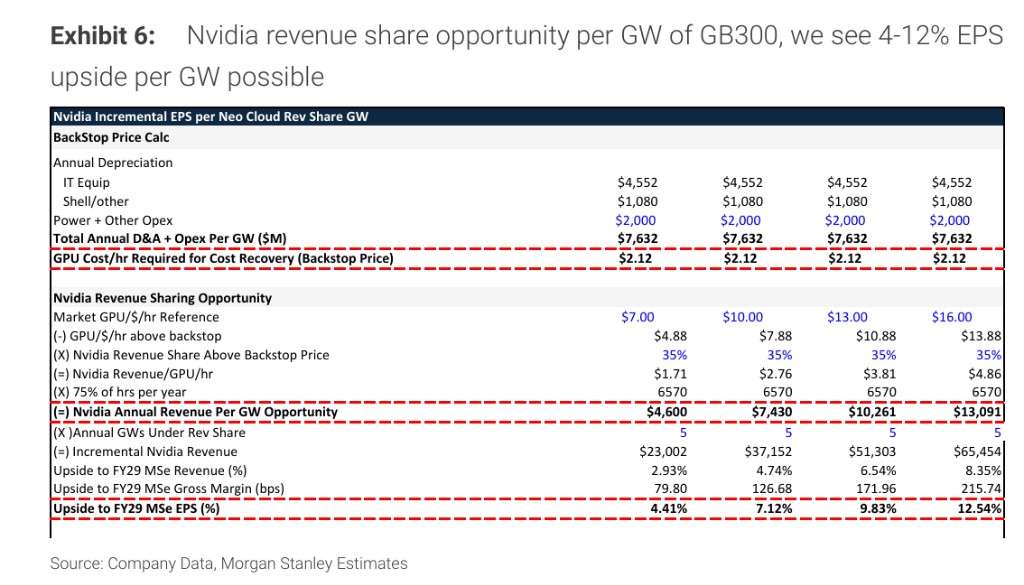
In its sensitivity analysis, Morgan Stanley assumed NVIDIA receives a 35% revenue share on the amount exceeding the guaranteed floor price. For every 5 gigawatts of computing power, using GB300 data centers per gigawatt as a unit, NVIDIA could generate incremental annual revenue of $37 billion to $65 billion in scenarios where GPU leasing prices range from $10 to $16 per hour, boosting FY29 earnings per share (EPS) by approximately 7% to 13%. Even in a more conservative scenario of 2 to 5 gigawatts, the EPS uplift potential remains around 10%.
Strategic Drivers: Hyperscaler Underinvestment, NVIDIA Seeks New Growth Poles
The Morgan Stanley report revealed the strategic logic behind NVIDIA's move. NVIDIA management believes that traditional hyperscale cloud providers, constrained by free cash flow pressures and increasingly scarce land, power, and data center resources in the United States, are unable to expand capital expenditures fast enough to match the growth in token demand, and are even forced to shift computing power originally intended for model training to inference scenarios.
Meanwhile, geopolitical factors are accelerating this structural evolution. As U.S. cloud providers face policy pressures when building data centers in other countries, some nations and regions are beginning to view local land and power resources as strategic AI assets,转而 supporting local sovereign clouds or regional neocloud providers. Morgan Stanley cited Yotta, YTL, and SK Telecom as typical examples.
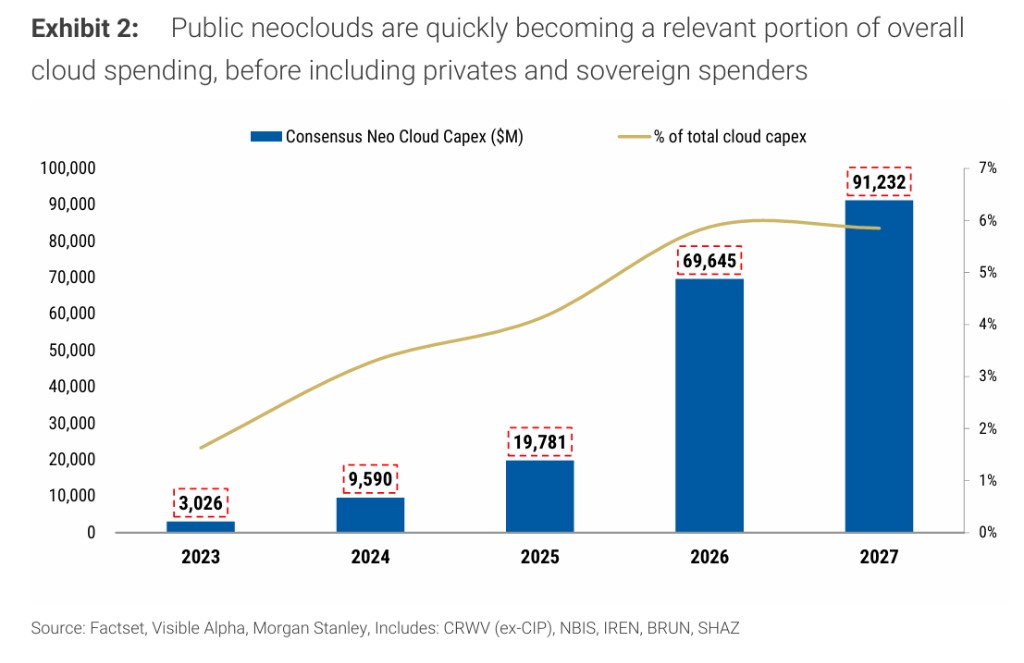
In this context, NVIDIA has chosen to actively intervene, cultivating a new group of computing power buyers through capital endorsement. This allows NVIDIA to strengthen its dominant position in the global computing landscape while bypassing the capital expenditure constraints of hyperscalers. The report pointed out that the capital expenditure scale of publicly listed neoclouds currently accounts for about 6% of global cloud capex, with significant growth rates, not yet including sovereign cloud and private cloud players.
Existing Layout: From CoreWeave to a $500 Billion Industry Fund
NVIDIA's layout in the neocloud sector has been long in the making. According to the Morgan Stanley report, since investing in CoreWeave in 2023, NVIDIA has extended this strategy to multiple cloud providers: it currently holds over 10% equity in CoreWeave and has committed to purchasing all its unsold computing power until April 2032; it holds approximately 10% equity in Nebius; it signed a five-year cloud service contract worth $3.4 billion with IREN, accompanied by $2.1 billion in warrants; additionally, it has made private equity investments in Nscale, Crusoe, Lambda, Firmus, and others.
On the software front, NVIDIA launched the DGX Cloud Lepton platform, a market-based matching platform connecting developers with GPU computing power from its cloud partners, dynamically routing computing demands to cloud providers with available capacity.
On the hardware infrastructure front, NVIDIA has also taken substantive steps recently. Reportedly, NVIDIA and its partners jointly announced the construction of 16 new fiber optic lines in the United States, involving 8,000 miles of long-haul fiber, with neocloud support explicitly listed as one of the project drivers. Additionally, media reports indicate that NVIDIA is signing a 15-year, $20 billion lease for HUT 8's 1-gigawatt Beacon Point campus.
In terms of capital operations, NVIDIA recently announced the mobilization to establish a $50 billion investment fund, explicitly stating in its official announcement that the fund would be used to "support long-term use linked to revenue." Morgan Stanley pointed out that the fund's mechanism requires NVIDIA to limit its maximum direct exposure to any single investment to within 25%, thereby reducing circular risk to some extent.
Bull-Bear Clash: High Growth Potential Coexists with Circular Risk
Morgan Stanley acknowledged that the new model has triggered significant divergence in the market.
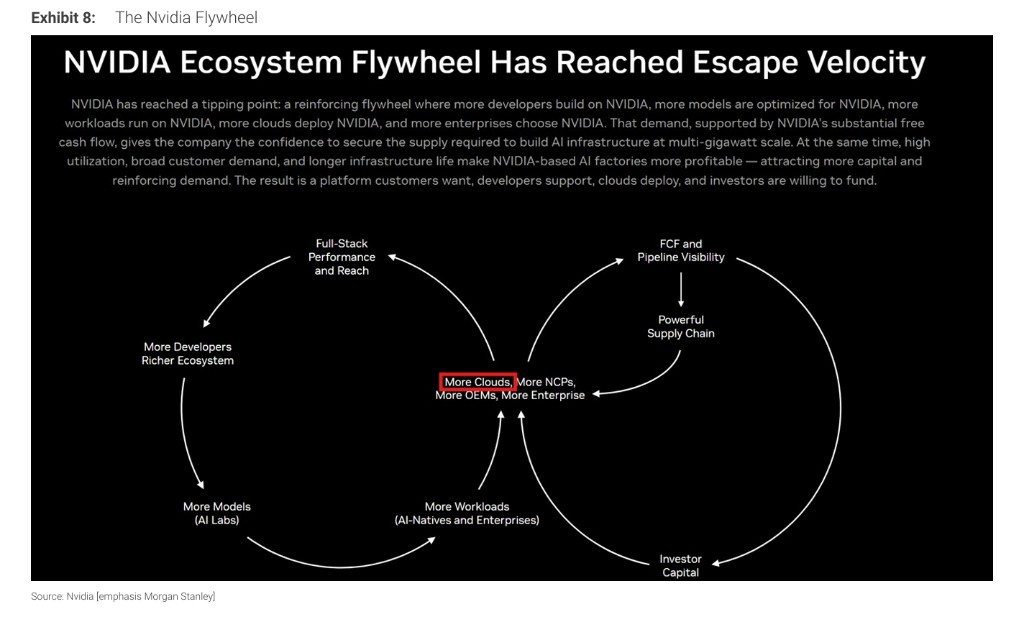
Bulls argue: First, current computing supply continues to lag behind token demand growth, meaning new computing capacity has real demand support; Second, annuity-style income obtained through minority stakes in multiple cloud providers will enhance the predictability of NVIDIA's long-term profitability; Third, this move helps NVIDIA further establish its chips as the de facto industry standard as the Vera Rubin product cycle arrives—for smaller cloud providers, adopting NVIDIA chips, which have an ~85% market share and the most complete ecosystem, remains the optimal choice.
Bears, however, focus on the following risks : This model may create "artificial demand"—meaning that without NVIDIA's credit enhancement, some computing investments would not be viable; furthermore, participants have varying capital strengths, and the overall model may face significant pressure in scenarios of computing oversupply. Morgan Stanley stated that high-transparency disclosure is a key prerequisite for this model to maintain market trust.
In downside scenarios, Morgan Stanley also identified a potential hedging path: if computing power becomes oversupplied, NVIDIA can use the acquired GPU usage rights to advance its own model R&D. NVIDIA's current flagship open-source model, Nemotron 3 Ultra, has 550 billion parameters and is already leading in the open-source model market outside China; the next-generation Nemotron 4 is expected to break the trillion-parameter threshold, further solidifying its competitiveness in model development.
Impact on Existing Neoclouds: Intensified Competition, Execution is Key
Morgan Stanley pointed out that NVIDIA's move is a double-edged sword for existing neocloud players. In the long term, the increase in potential competitors constitutes pressure; but in the short term, cloud providers with reliable operating records have the opportunity to absorb more new computing investment.
The report emphasized that NVIDIA's credit enhancement only solves the financing problem; cloud providers still need to complete construction on time and convert it into revenue amidst complex geopolitical and supply chain environments—this places quite high demands on operational execution.
Overall, Morgan Stanley maintains NVIDIA as the top pick in the semiconductor industry, with a target price of $288, corresponding to a CY27 P/E valuation of approximately 22x. Analysts expect NVIDIA's revenue to grow 82% year-over-year in fiscal 2026, and further grow by 52.4% in fiscal 2027; the FY29 EPS forecast is $17.63.