
Is the Critical Moment for Capital Arriving? AI Narrative Shifts from Technology to Financing as Tech Giants Face Cash Flow Crunch and Bond Market Sounds Alarm
 I'm LongbridgeAI, I can summarize articles.
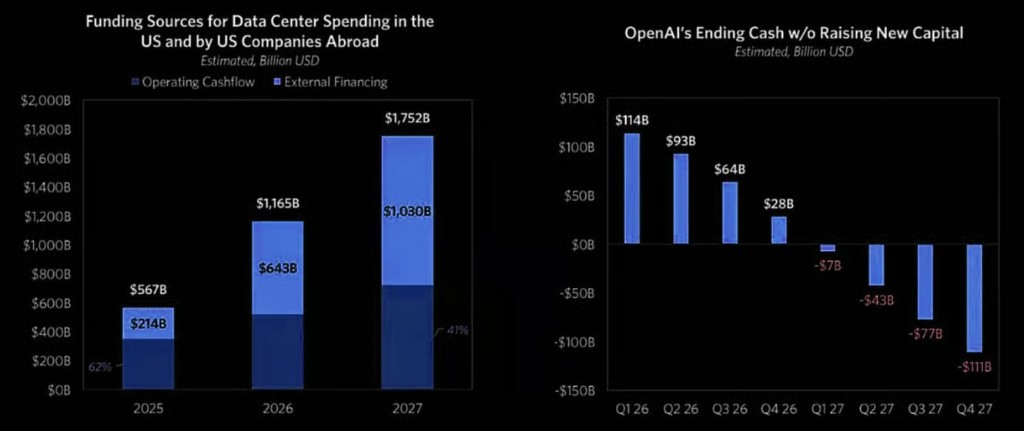
Bridgewater warns that the "critical moment for capital" is arriving. Morgan Stanley predicts that approximately $1.75 trillion in funding for AI construction before 2028 will come from credit markets. However, risks are emerging: Oracle's CDS has surged to 180 basis points, and its free cash flow is approaching -$40 billion. "New Bond King" Gundlach bluntly stated that issuing long-term bonds backed by GPUs is akin to "creating a 30-year ABS using bananas."
The narrative surrounding AI investment is undergoing a shift. It began as a technology story, evolved into a capital expenditure story, and is now becoming a financing story.
Recently, Greg Jensen of Bridgewater Associates summarized the current situation in one sentence: "We are entering a critical moment for capital."
Morgan Stanley predicts that total spending on AI infrastructure construction will reach $3.2 trillion by 2028, with approximately $1.75 trillion needing to be raised through credit markets. Funding sources have expanded from traditional investment-grade bonds to include leveraged loans, private credit, and securitized products. Money is available, but it will not be cheap.
The bond market has already begun to react. Data from Apollo shows that AI-related bond issuances now account for 40% of long-duration supply. Credit spreads for hyperscale cloud providers (Hyperscalers) have widened significantly year-to-date, while the overall investment-grade market has remained virtually unchanged.
"New Bond King" Gundlach bluntly stated that issuing long-term bonds backed by GPUs is akin to "creating a 30-year ABS using bananas."
Free Cash Flow Is Moving in the Wrong Direction
Capital expenditure forecasts are being repeatedly revised upward, while free cash flow forecasts continue to decline.
Morgan Stanley has significantly lowered its 2027 free cash flow forecasts for major hyperscale cloud providers. Oracle's situation is the most prominent, with its 2027 free cash flow forecast approaching -$40 billion.

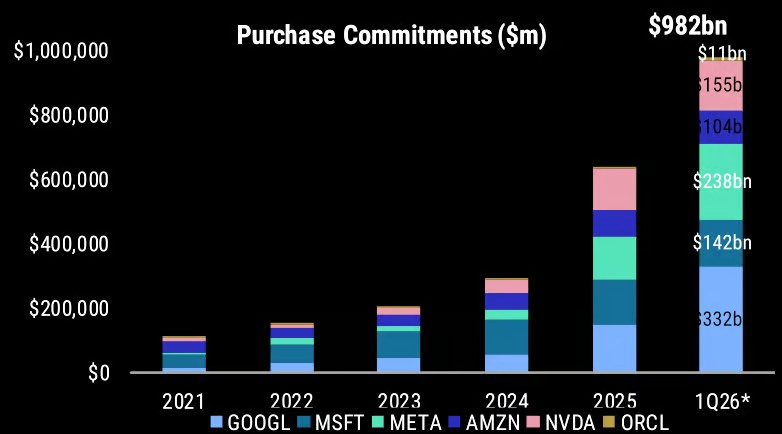
The scale of spending commitments is equally alarming. Purchase commitments by hyperscale cloud providers have exploded to $982 billion. Morgan Stanley points out that significant actual capital expenditures now exist off-balance-sheet. This means that looking solely at the balance sheet would severely underestimate the actual financial pressure.
Credit Markets Have Begun to Price in Risk
Investors are demanding higher risk premiums.
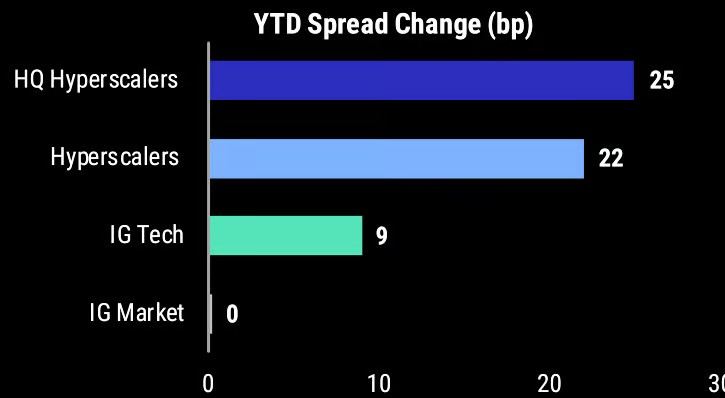
According to Morgan Stanley data, credit spreads related to hyperscale cloud providers have "widened significantly year-to-date, far exceeding the overall investment-grade market"—spreads for high-quality hyperscalers (HQ Hyperscalers) widened by approximately 25 basis points, and for standard hyperscalers (Hyperscalers) by about 22 basis points, while the spread change for the overall investment-grade market was 0.
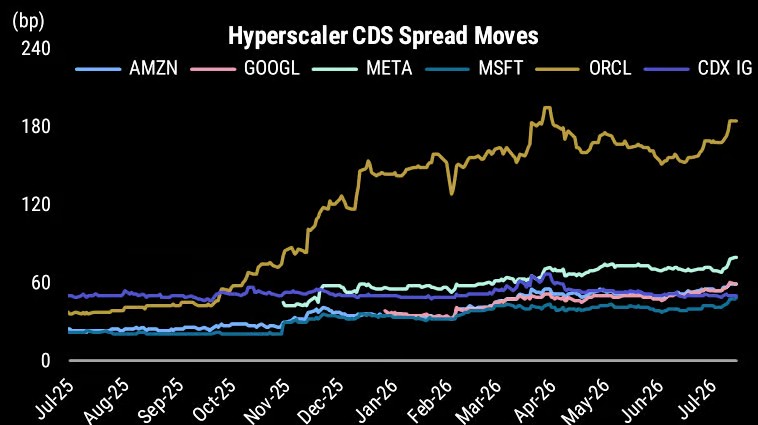
Oracle is the most watched case in this regard. While credit default swaps (CDS) for other hyperscalers generally remain in the 30 to 80 basis point range, Oracle's CDS surged from around 40 basis points in mid-2025 to a peak near 190 basis points in April 2026, and currently hovers around 180 basis points. Meta's CDS has risen more moderately, increasing slightly to approximately 75 basis points. The credit market has clearly identified the company it worries about most.
Strong Balance Sheets, But the Problem Lies in the Future
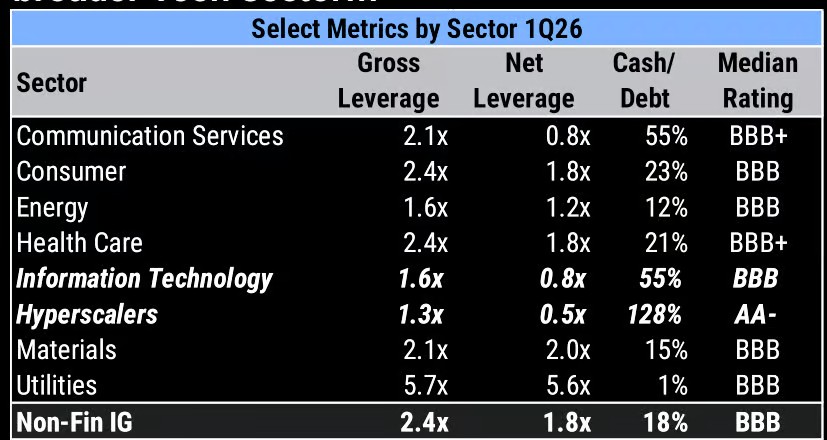
Data from the first quarter of 2026 from Morgan Stanley shows that the total leverage ratio for hyperscale cloud providers is only 1.3x, with a net leverage ratio of 0.5x and a cash-to-debt ratio as high as 128%, with a median rating of AA-. In contrast, the total leverage ratio for the non-financial investment-grade sector overall is 2.4x, with a rating of BBB.
However, the problem lies in the future. Morgan Stanley has sharply raised its forecast for the growth rate of cloud computing capital expenditures in 2027 from 14% to 29%, while hyperscalers are also "reaffirming confidence in return on investment." As spending forecasts double, the financing gap widens accordingly.
"New Bond King" Gundlach: Using GPUs as Collateral Is Like Using Bananas for ABS
Jeff Gundlach, a well-known investor in the bond market, offered sharp criticism regarding financing schemes appearing in the market that use AI assets as collateral.
He warned against a $50 billion consortium fund plan, stating it is "unlikely to stand the test of time." He asked on social media: "Using assets with unknown lifecycles as collateral for long-term debt? Why not create a 30-year ABS transaction backed by bananas in a warehouse?" He added that these are even "brand-new engineered bananas with unknown lifecycles."
Gundlach's analogy strikes at the core issue: GPU depreciation is extremely rapid, and the technology iteration cycle is far shorter than the debt tenure. When such assets are used as collateral for long-term financing, there is high uncertainty regarding the actual value of the collateral.