
Arm and AMD Are Eroding Intel's Market Share
 I'm LongbridgeAI, I can summarize articles.
Data shows that, driven by AI demand, the server CPU market is expected to exceed $210 billion by 2030. AMD and Arm are eating into Intel's share, but x86 still dominates in the AI sector. Intel's share is projected to fall from 62% to 35.8%, with AMD at around 31% and Arm architecture capturing 30-35%
The server CPU market is expected to see significant growth in the coming years, with statistical data indicating that its total addressable market (TAM) will exceed $200 billion by 2030.
AMD and Arm have already captured a substantial portion of Intel's server market share, but the x86 architecture is still poised to lead the artificial intelligence sector in the future.
Recent data from multiple research institutions, including Bank of America Global Research, Mercury Research, and IDC, shows that the TAM for server CPUs will expand significantly in the coming years due to a surge in AI demand, particularly for agent workflows that rely more heavily on CPUs than GPUs. Demand for server CPUs has already grown substantially as the latest architectures are specifically designed to meet AI needs.
According to statistics, the total market size for server CPUs is expected to exceed $210 billion (consistent with AMD's estimate of $220 billion), with AI CPUs accounting for 86% of the market share. From 2026 to 2030, the market size for non-AI server CPUs will reach $30 billion, while the market for AI-specific server CPUs is projected to hit $180 billion by 2030. The market share for AI-specific server CPUs is expected to reach 69% this year, an increase of 16% from 2025 and 46% from 2024.
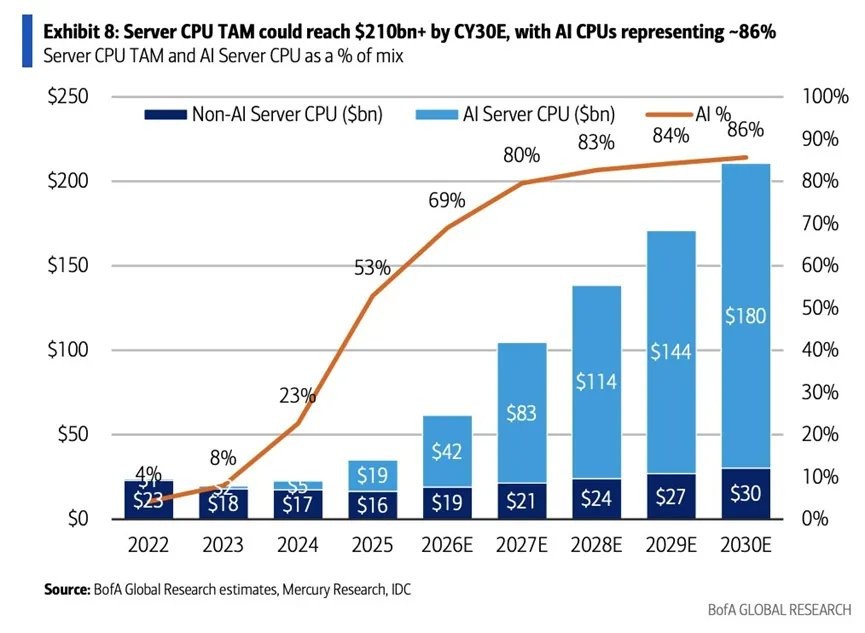
Multiple vendors are competing for market share in the server CPU space. While x86 architecture rivals like AMD and Intel have been battling for decades, the Arm architecture poses a significant threat to both giants.
Although Intel has been eroding AMD's market share for years with its strong EPYC product line, the emergence of Arm has introduced another formidable competitor to the fray. Many companies are manufacturing their own custom AI chips, while firms like NVIDIA, Qualcomm, and Arm itself are going all-in on the AI server sector.
In the coming years, Intel's market share is expected to decline from 62% to 35.8% (by 2030), while AMD's share will be approximately 31%. Arm Merchant and Arm Customers will capture the remaining 30-35% of the market.
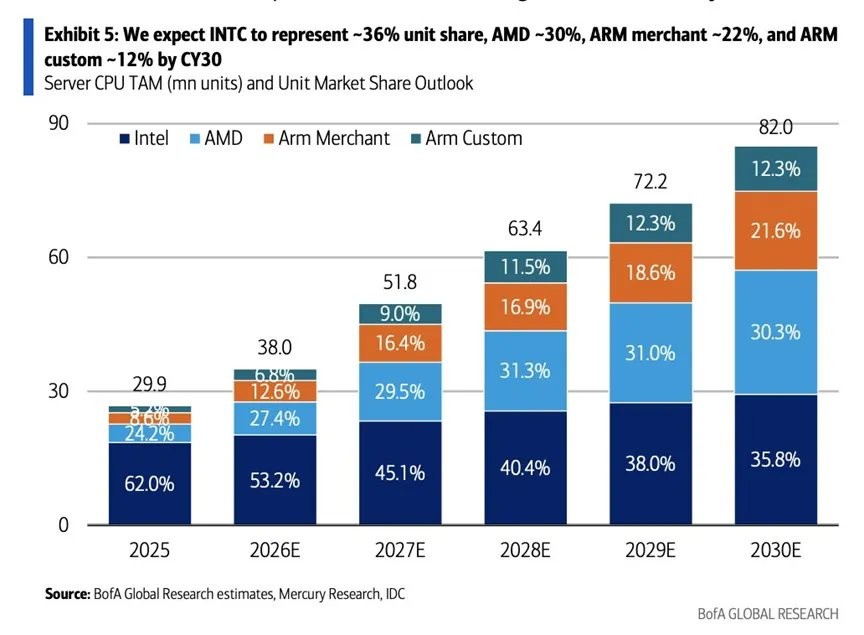
In terms of shipment volume, total shipments of AI server CPUs are expected to reach 38 million units in 2026, a 27% increase from the 29.9 million units in 2025.
It is estimated that total shipments of AI products will reach a staggering 82 million units by 2030, illustrating the massive scale of market demand. While we cannot predict the future or assert whether this demand will persist, current forecasts suggest that AI demand will remain strong over the next few decades, as companies have signed multi-year contracts, established partnerships, and reached various agreements to continuously refine the AI ecosystem.
Intel's Revenue Share Is Growing
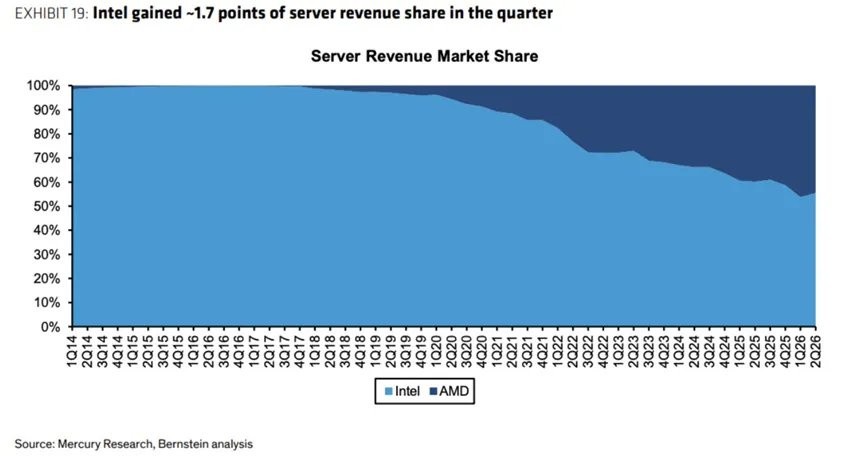
On the other hand, while Intel's unit market share has been eroded by AMD, the company appears to be performing well in terms of revenue market share.

As chip prices rise and CPU demand increases, coupled with shortages across various sectors of the tech industry, Intel's server chips have become an increasingly valuable resource for AI companies. Intel itself has highlighted this, noting that it continues to ship older chips even as supplies of new chips dwindle.
Intel Shows Signs of Improvement in the Client Segment
Meanwhile, in the client market, Intel seems to be experiencing a modest recovery. AMD's Ryzen desktop and mobile processors have captured a significant amount of market share from Intel. However, Intel has recently begun to see some customers returning to its platform.
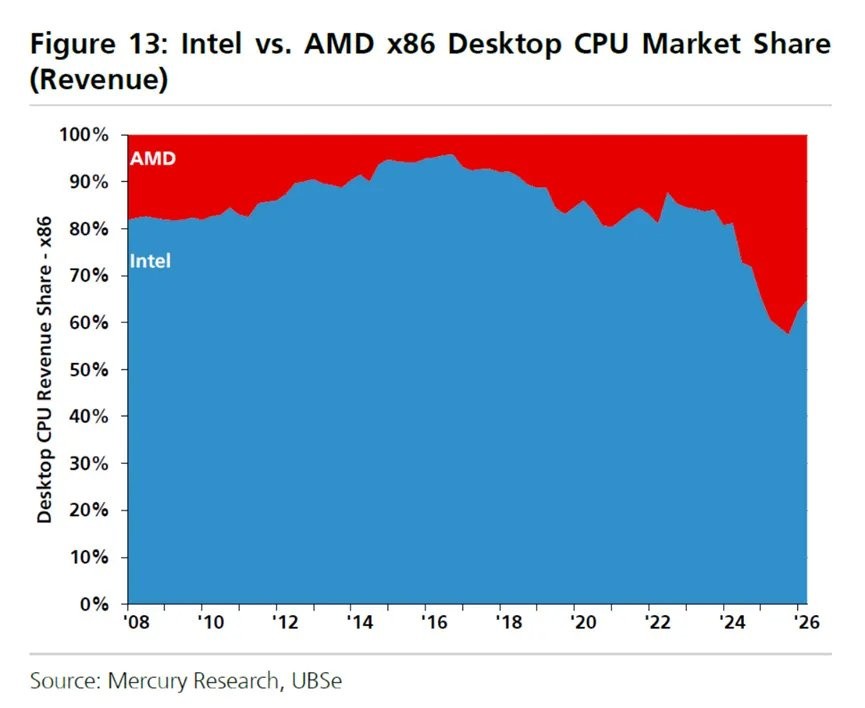
Due to the higher cost of DDR5 memory, the company is aggressively promoting its DDR4-based platforms and extending the lifecycle of Raptor Lake CPUs for several more years. Additionally, retail discounts on Intel CPUs have increased substantially, leading to growth in both unit and revenue market shares for desktop and client CPUs.
However, we know that the overall PC market is currently in its worst period, with reports indicating a significant decline in the PC market in the coming years due to rising prices and ongoing component shortages. Meanwhile, AMD and Intel will strive to provide competitive solutions to maintain their existing revenue targets in the client segment, while aiming for record profits from the server sector.

The surge in AI demand, especially from agent workflows that heavily rely on CPUs, is expected to expand the TAM for server CPUs to over $210 billion by 2030, with AI-specific chips capturing the vast majority (approximately 86%).
Shipments are expected to climb significantly, and competition among Intel, AMD, and emerging Arm architecture vendors will intensify. Although Intel's market share continues to decline, its revenue is growing. In the client segment, despite challenges in the PC market, Intel is showing signs of a mild recovery. However, the true growth engine remains the booming AI server sector, with multi-year industry commitments suggesting sustained demand in this area for the coming years.
Risk Warning and Disclaimer
The market involves risks, and investment should be approached with caution. This article does not constitute personal investment advice, nor does it take into account the specific investment objectives, financial status, or needs of individual users. Users should consider whether any opinions, views, or conclusions in this article align with their specific circumstances. Investment decisions made based on this content are at the user's own risk.