
BofA Global Fund Manager Survey: Disorderly Bond Markets Rise to Second-Largest Tail Risk, Trailing Only AI Bubble
 I'm LongbridgeAI, I can summarize articles.
Global equity allocations hit a three-year high, while cash positions drop to historic lows! Amidst the frenzy, alarms are sounding: extreme crowding has triggered BofA's dual "sell" signals, with the "AI bubble" and "disorderly bond markets" emerging as the two core risks. Institutions warn that the euphoria has reached extremes, and it is time for investors to consider withdrawing or rotating into defensive positions!
Sentiment among global fund managers has reached recent peaks, but alarms are quietly sounding over the disorderly rise in yields.
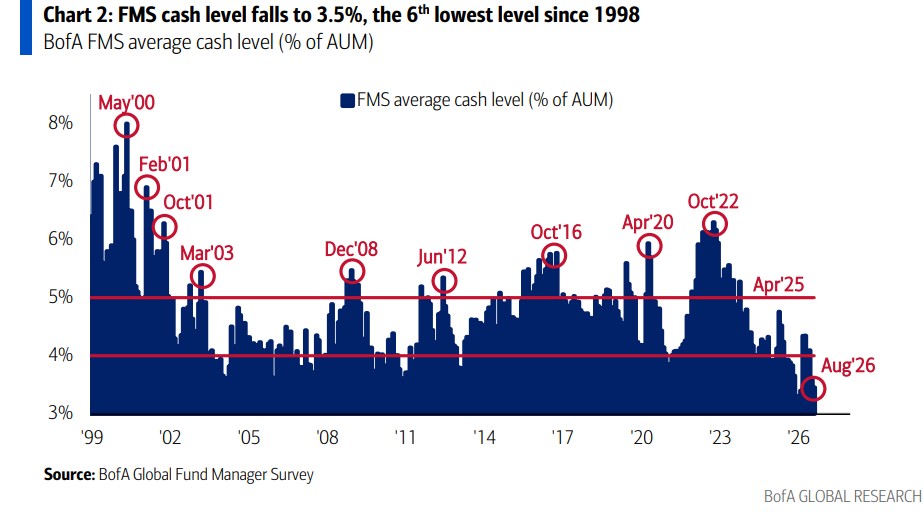
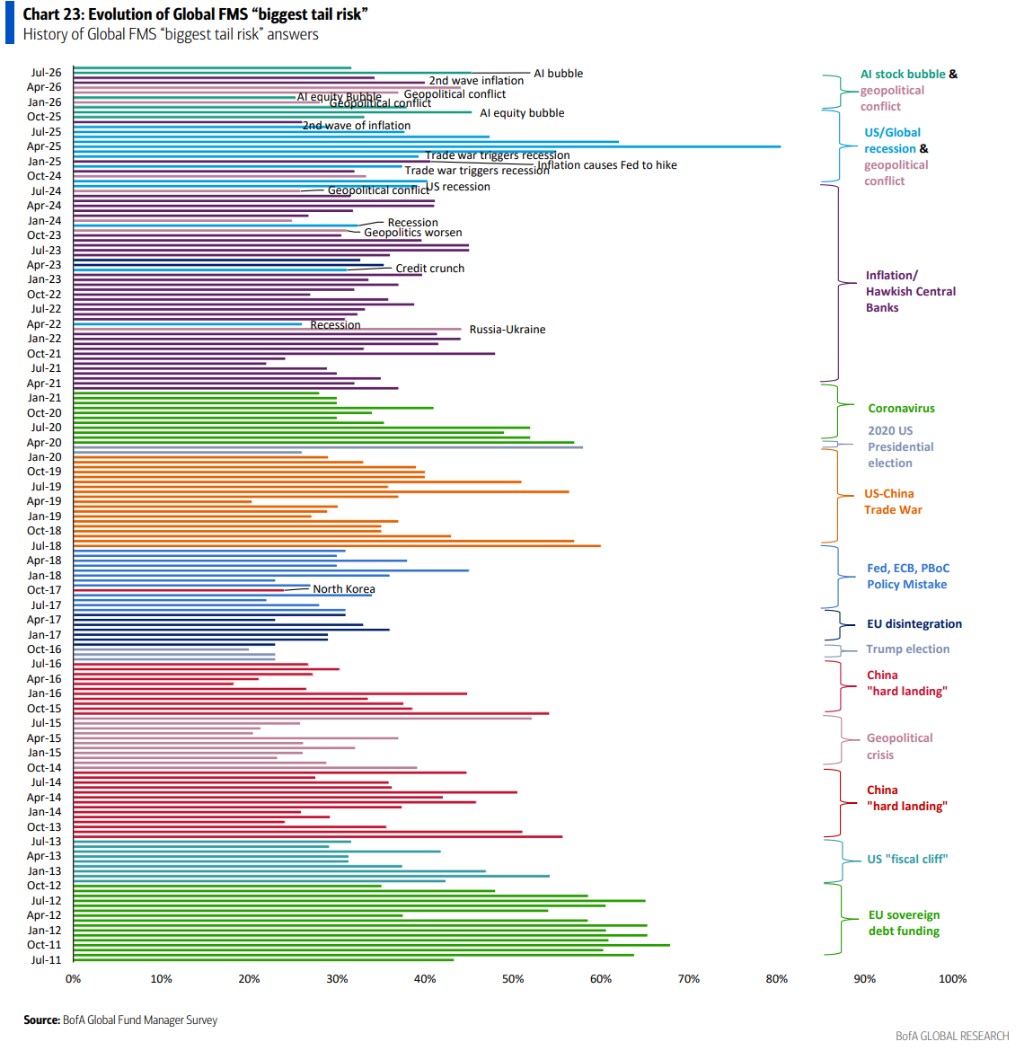
The August Bank of America (BofA) Global Fund Manager Survey shows investor sentiment is the third most optimistic since 2022. Global equity allocations have risen to their highest level since November 2021, while the cash ratio has fallen to 3.5%, the sixth lowest in history. At the same time, risk signals are becoming clearer: "disorderly rise in bond yields" has jumped to become the second-largest tail risk at 27%, trailing only the "AI bubble" (32%), which has topped the list for two consecutive months.
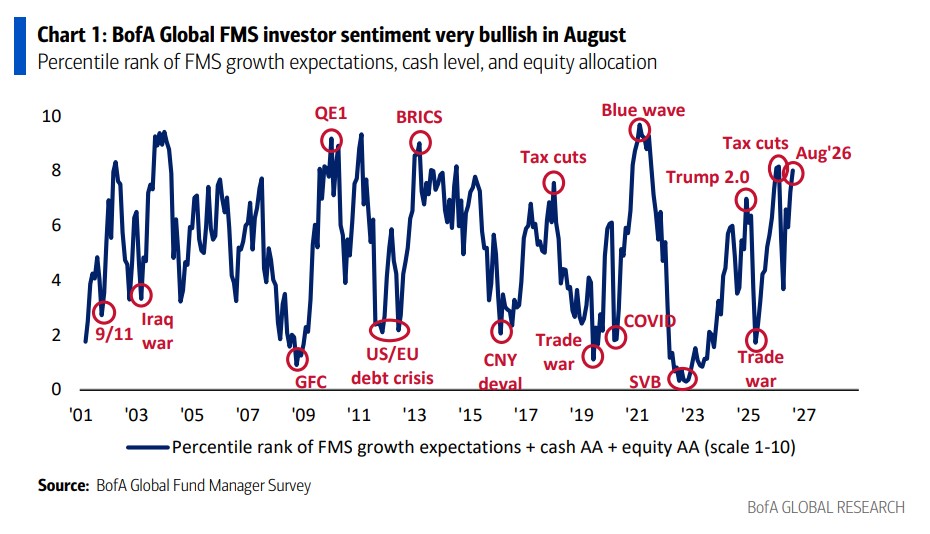
The survey was conducted from August 7 to 13, with 203 fund managers participating, managing a total of $581 billion in assets. The results triggered BofA's two contrarian indicators—the FMS Cash Rule and the Bull/Bear Indicator—both issuing "sell" signals simultaneously, highlighting that current position crowding is approaching historical extremes. BofA strategists suggest that rather than continuing to add positions, investors should consider withdrawing or rotating within risk assets.
Regarding policy expectations, 72% of respondents believe the Federal Reserve will not raise interest rates before the midterm elections. As for the Jackson Hole Annual Economic Symposium scheduled for August 27–29, 53% of investors expect Fed Chair Kevin Warsh to maintain a neutral stance. However, hawkish expectations (31%) are significantly higher than dovish ones (7%), and uncertainty regarding the interest rate path remains a potential market disruptor.
Crowding Risks Amid Extreme Optimism
The current survey exhibits typical signs of overheating. The net overweight position in global equities rose to 56%, marking the 14th consecutive month of overweighting. The cash ratio of 3.5% is the lowest since February 2024 and the sixth lowest on record since 1998. The BofA FMS Cash Rule triggers a sell signal when the cash ratio falls to 4.0% or below; this signal is currently active. The Bull/Bear Indicator reading rose to 9.3, also in the sell zone (triggered above 8.0).
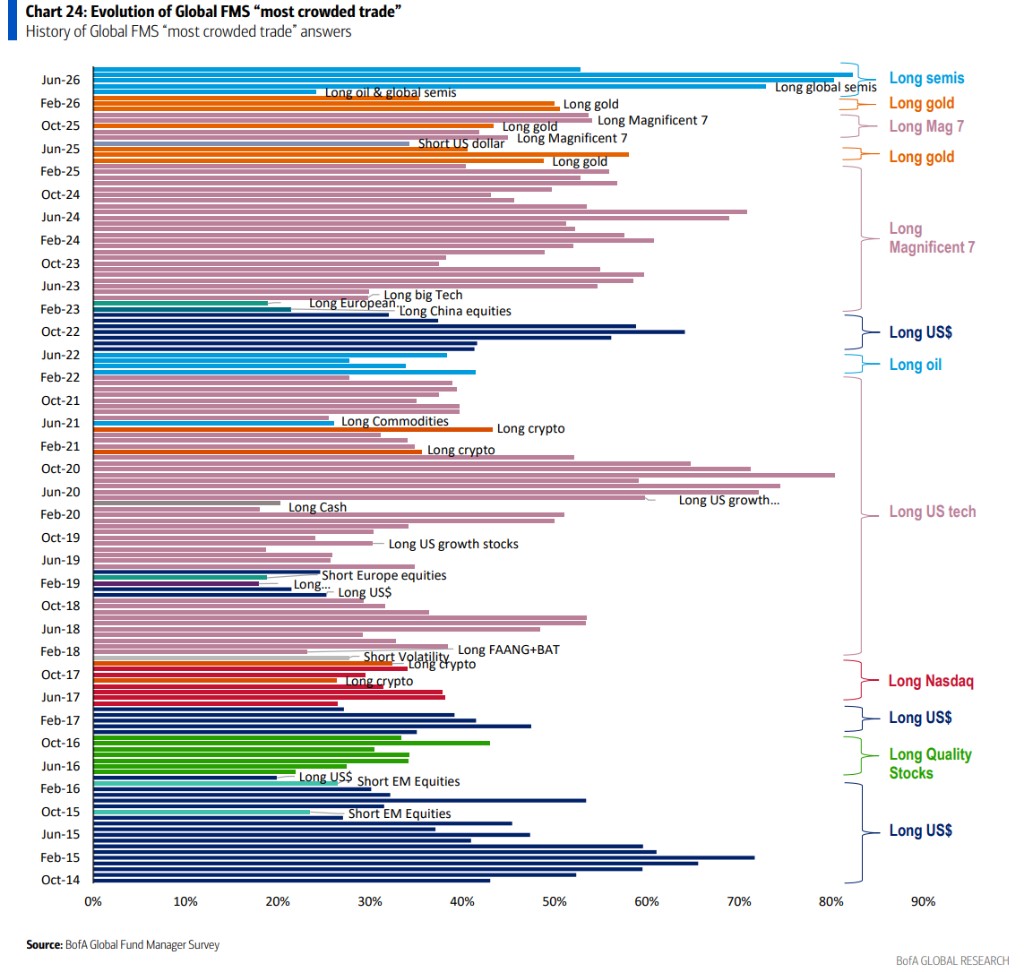
In terms of position structure, the most crowded trade is "long global semiconductors," held by 53% of respondents, although this is a significant drop from last month's historical peak of 82%. The second most crowded trade is "short JPY" (12%), followed by "long Magnificent 7" (11%). BofA's contrarian trade recommendations include: long bonds/short commodities, long consumer staples/short tech stocks, and long UK equities/short US equities.
Disorderly Bond Market Risk Surges, Joining AI Bubble as Core Threat
There have been notable changes in the tail risk landscape. The "AI bubble" remains the top concern at 32% for the second consecutive month, but "disorderly rise in bond yields" jumped from third place last month to second, accounting for 27%, surpassing "second-wave inflation" (25%).
Meanwhile, concerns have arisen regarding the health of corporate balance sheets. A net 19% of respondents believe corporate balance sheets suffer from excessive leverage, the highest level since March 2023, up significantly from 7% last month. When asked about the most likely market reaction if Democrats sweep both houses in the midterm elections, 37% of respondents chose "rising bond yields and falling stock markets." This expectation itself reflects the market's high alertness to fiscal expansion and its impact on the bond market.
AI: Both the Greatest Threat and the Strongest Conviction
AI-related issues present a distinct split in this survey.
On one hand, the "AI bubble" remains the largest tail risk. "AI hyperscale computing capital expenditure" is seen as the most likely source of systemic credit events for the second consecutive month (38%), followed by private credit (23%).
On the other hand, 71% of respondents do not believe any AI hyperscaler will announce cuts in capital expenditure in 2026, an increase from 61% last month. Additionally, 58% believe the broad impact of AI on the labor market will not occur before 2028, and 31% even believe AI will not cause substantial disruption to the labor market at all. This contradictory psychology of "worrying about a bubble while unwilling to reduce positions" echoes the extreme crowding in current overall positions.
Macro Expectations: No-Landing Narrative Hits Historic Peak
At the macro level, optimism continues to heat up. A record 56% of respondents expect the global economy to achieve a "no-landing" scenario in the next 12 months, up from 54% last month, making it the mainstream consensus for two consecutive months. The proportion expecting an "economic boom" (above-trend growth and above-trend inflation) rose to 43%, the highest since February 2022. The net proportion expecting double-digit growth in corporate earnings over the next 12 months reached 37%, the highest since August 2021.
Meanwhile, 49% of respondents expect "stagflation" (below-trend growth and above-trend inflation), slightly up from 47% last month. This seemingly contradictory combination—coexisting expectations of a boom and concerns about stagflation—reflects the internal tension in the current macro narrative. Regarding oil price expectations, respondents raised their target price for Brent crude at the end of 2026 from $71/barrel to $76/barrel.
Asset Allocation: Increase US Equities and Commodities, Reduce Bonds
In terms of allocation moves, respondents increased exposure to the technology, banking, and energy sectors in August, while reducing positions in industrials and healthcare. They also covered short positions in consumer staples and consumer discretionary sectors.
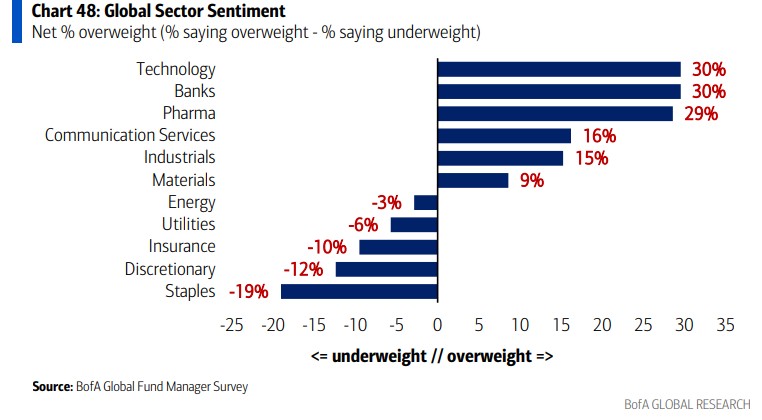
Regarding regional equities, the net overweight in US stocks rose to 27%, the highest since December 2024. Emerging markets saw a net overweight of 34%. UK stocks had a net underweight of 33%, a historically low level at 1.5 standard deviations below the mean. The net underweight in bonds widened further to 39%. Commodities saw a net overweight of 24%, which is 1.4 standard deviations above the long-term average. Notably, a net 16% of respondents believe gold is undervalued, the highest level since March 2023, highlighting potential demand for safe-haven assets. Regarding the US dollar, a net 39% believe it is overvalued, up from 34% last month.
Midterm Elections: Divided Congress as Base Case
Regarding political risk, 47% of respondents expect the midterm election result to be a divided government with "Democrats controlling the House and Republicans retaining the Senate." The expectation of a Democratic sweep of both houses dropped from 27% to 23%. If Democrats achieve a sweep, 37% of respondents expect rising bond yields and falling stock markets, while only 9% expect a "boom" scenario with both stocks and bonds rising. This reflects investors' high alertness to the pressure on the bond market from potential fiscal expansion.