
Xiaomi Q2 Revenue Hits RMB 108.9 Billion; Net Profit of RMB 9.46 Billion Beats Expectations; Smartphone Shipments Drop 26.5% Amid Rising Storage Costs and Weak Demand | Financial Insights
 I'm LongbridgeAI, I can summarize articles.
Xiaomi's total revenue in the second quarter amounted to RMB 108.92 billion, a year-on-year decrease of 6.1%, but a quarter-on-quarter increase of 9.9% from the first quarter. Net profit stood at RMB 9.46 billion, down 20.3% year-on-year, yet outperforming the average market expectation. Soaring component costs triggered by the global shortage of memory chips permeated the entire financial report—the Gross Profit Margin for smartphones plummeted from 11.5% in the same period last year to 8.5%, while the overall Gross Profit Margin fell from 22.5% to 19.8%, hitting a multi-year low
Xiaomi delivered a "better-than-expected" performance in the second quarter despite significant pressures.
The financial results released on Tuesday showed that Xiaomi's total revenue in the second quarter was RMB 108.92 billion, a year-on-year decrease of 6.1%, but a quarter-on-quarter increase of 9.9% from the first quarter; net profit was RMB 9.46 billion, down 20.3% year-on-year, but better than the average market expectation.
However, after excluding non-recurring items such as changes in the fair value of investments, the adjusted net profit for the second quarter was only RMB 6.22 billion, a sharp year-on-year decline of 42.6%. This figure truly reflects the core operational quality of Xiaomi for the quarter. Soaring component costs triggered by the global shortage of memory chips permeated the entire financial report—the Gross Profit Margin for smartphones plummeted from 11.5% in the same period last year to 8.5%, while the overall Gross Profit Margin fell from 22.5% to 19.8%, hitting a multi-year low.
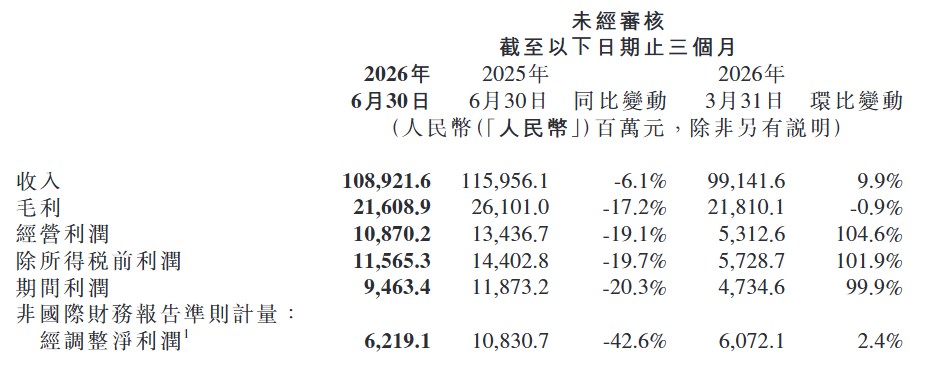
From a full-year perspective, Xiaomi's total revenue in the first half of 2026 was RMB 208.06 billion, a year-on-year decline of 8.4%; adjusted net profit was RMB 12.29 billion, halving by 42.8% year-on-year. The impact of the memory chip crisis has far from subsided, and Xiaomi is simultaneously bearing the continuous losses brought about by the expansion of its electric vehicle business. The combination of these dual pressures means that this technology company, once known for high growth, is experiencing a rare period of growing pains.
Since the beginning of the year, Xiaomi's stock buyback amount has reached approximately HKD 11.7 billion, repurchasing about 377.5 million shares, exceeding the total amount for the entire previous year, demonstrating management's sufficient confidence in the current stock price.
Smartphone Business: Sharp Decline in Shipments, Initial Success of Quality-over-Quantity Strategy
Smartphone shipments in the second quarter were only 31.2 million units, a sharp year-on-year drop of 26.5%. Xiaomi's active reduction of mid-to-low-end model shipments was one of the main reasons, but weak global demand cannot be ignored—according to Omdia data, global smartphone industry shipments overall declined by 6% year-on-year in the second quarter.
Nevertheless, Xiaomi's premiumization strategy delivered convincing numbers this quarter: the average selling price (ASP) of smartphones surged by 25.9% year-on-year, reaching a historical high of RMB 1,351 per unit. In the mainland China market, the proportion of models priced at RMB 3,000 and above reached 32.1% for the first time, with the market share in the RMB 3,000–4,000 price segment rising to 16.2%, both hitting historical peaks. The release of the Xiaomi 17T series in May also effectively boosted the proportion of high-end smartphone shipments overseas.
However, the erosion from rising component prices far exceeded the gains from the ASP increase. The Gross Profit Margin of the smartphone business fell from 11.5% in the same period last year to 8.5%, further deteriorating from 10.1% in the first quarter. The actual profitability of the smartphone business is now at a relatively fragile level.
IoT and Internet: Domestic Subsidies Fade, Internet Services Become the Most Stable Cash Cow
Revenue from IoT and lifestyle consumer products was RMB 31.3 billion, a year-on-year decrease of 19.2%, mainly dragged down by the withdrawal of domestic subsidy policies, leading to a significant shrinkage in revenue from mainland China.
The Gross Profit Margin also decreased from 22.5% to 20.1%, similarly impacted by the rise in core component prices. However, there were highlights in the overseas IoT business—tablets, smart TVs, and wearable products drove rapid growth in overseas revenue, with overseas tablet shipments and revenue both hitting historical highs.
In contrast, the internet services business demonstrated resilience across the cycle.
Internet revenue in the second quarter was RMB 9.04 billion, basically flat year-on-year, while the Gross Profit Margin rose against the trend to 76.8%, an increase of 1.4 percentage points year-on-year. This was mainly due to a 4.8% growth in advertising business revenue to RMB 7.2 billion, along with improved earnings quality. As of June, the global monthly active user count reached 766.5 million, a historical high, with the proportion of overseas internet service revenue rising to 32.1%, indicating the internationalization trend of Xiaomi's ecosystem monetization.
The number of devices connected to the AIoT platform (excluding smartphones and tablets) reached 1.1608 billion, a year-on-year increase of 17.4%; the number of users owning five or more connected devices reached 24.6 million, a year-on-year increase of 20.2%, showing continuously strengthening ecosystem stickiness.
Electric Vehicles: Deliveries Exceed 100,000, Gross Profit Margin Under Pressure, Losses Continue to Expand
The smart electric vehicle business was the biggest highlight on the revenue side this quarter, but also the biggest drag on profits.
Revenue from the automobile and AI innovation business in the second quarter was RMB 24.9 billion, a year-on-year increase of 17.1%; car deliveries totaled 104,199 units, a year-on-year increase of 28.2%, maintaining growth momentum for several consecutive quarters. Notably, this growth rate was achieved against the backdrop of a 22% year-on-year decline in the mainland China passenger car market. As of August 17, the cumulative deliveries of the SU7 series had exceeded 500,000 units.
However, financial pressure cannot be ignored. The ASP of the automobile business dropped from RMB 254,000 in the same period last year to RMB 229,000, mainly due to a decrease in the delivery proportion of the high-priced SU7 Ultra models, while the YU7 series gradually became the main delivery force. Rising core component prices and increased AI business costs led to a significant drop in the Gross Profit Margin of the automobile and AI innovation business from 26.4% in the same period last year to 19.2%. Coupled with continuously increasing R&D and sales investments, the operating loss of this segment reached RMB 2.6 billion in the second quarter, with operating expenses expanding by 25.7% year-on-year to RMB 7.4 billion.
The "Pengcheng" extended-range SUV series launched in July (N90 Max with a pre-sale price of RMB 299,900, N70 Max with a pre-sale price of RMB 259,900) will go on sale in September. This is Xiaomi's first extended-range vehicle model, expected to further enrich the product matrix, but it will inevitably bring more R&D amortization and channel investment pressure in the short term.
R&D and AI: Heavy Investment in Underlying Technologies, Breakthroughs in Robotics and Large Models
R&D investment continues to grow at a high intensity. R&D expenses in the second quarter were RMB 9.23 billion, a year-on-year increase of 18.9%, with AI infrastructure investment being the main source of incremental growth. As of the end of June, R&D personnel accounted for 47.2% of the total workforce, and the global patent holdings exceeded 47,000.
In the AI direction, Xiaomi's layout has expanded beyond smartphones. The MiMo-V2.5 large model ranked first globally in weekly calls on the OpenRouter platform, reaching 10.5 trillion tokens; the whole-home smart AI open-source solution Miloco 2.0, released in June, is dedicated to achieving proactive home intelligence that "can remember, recognize people, and understand execution."
Significant progress has also been made in the robotics sector: the Xiaomi-Robotics-U0 (a multimodal embodied model with 38 billion parameters) released in July ranked first among 126 models globally in the WorldArena benchmark test; the Xiaomi-Robotics-1 also took the top spot in the RoboCasa365 simulation evaluation. More intuitively, Xiaomi robots have been practically applied in automobile factories, increasing the success rate of dual-side operations from 90.2% to 98%, preliminarily verifying their commercial implementation capabilities in industrial scenarios.
Costs and Cash Flow: Surge in Subsidy Revenue Supports Profits, Ample Cash Reserves
Regarding operating expenses, R&D and sales promotion expenses in the second quarter totaled nearly RMB 18 billion, with both showing year-on-year increases of over 10%. Notably, other income surged from RMB 300 million in the same period last year to RMB 2.2 billion, mainly due to a substantial increase in subsidy income, which supported the operating profit performance of the quarter to some extent.
In terms of cash flow, net cash flow from operating activities in the second quarter was RMB 3.84 billion, reversing the negative cash flow situation of the first quarter; cash and cash equivalents at the end of the period were RMB 37.3 billion, with total cash reserves reaching RMB 219.3 billion, providing sufficient strategic flexibility to cope with current challenges. On the financing front, stock buybacks continue to advance, backed by the HKD 20 billion buyback plan, clearly demonstrating management's confidence in long-term value.