
Robotaxi Revenue Surges 691%! Pony AI Q2 Revenue Up 69% YoY; Operating Leverage Drives Significant Narrowing of Losses | Earnings Insight
 I'm LongbridgeAI, I can summarize articles.
Pony AI reported Q2 2026 revenue of $36.2 million, a 68.8% year-over-year increase, with Robotaxi revenue soaring 691.2% to become the core growth engine. Operating expense growth was only one-sixth of revenue growth, significantly narrowing the loss margin and highlighting emerging operating leverage. The fleet expanded to 1,975 vehicles in six months, achieving positive unit economics in certain regions. Overseas co-built fleet models with partners like Uber Tech have begun contributing to revenue, forming a dual drive of "domestic scaling + overseas asset-light replication."
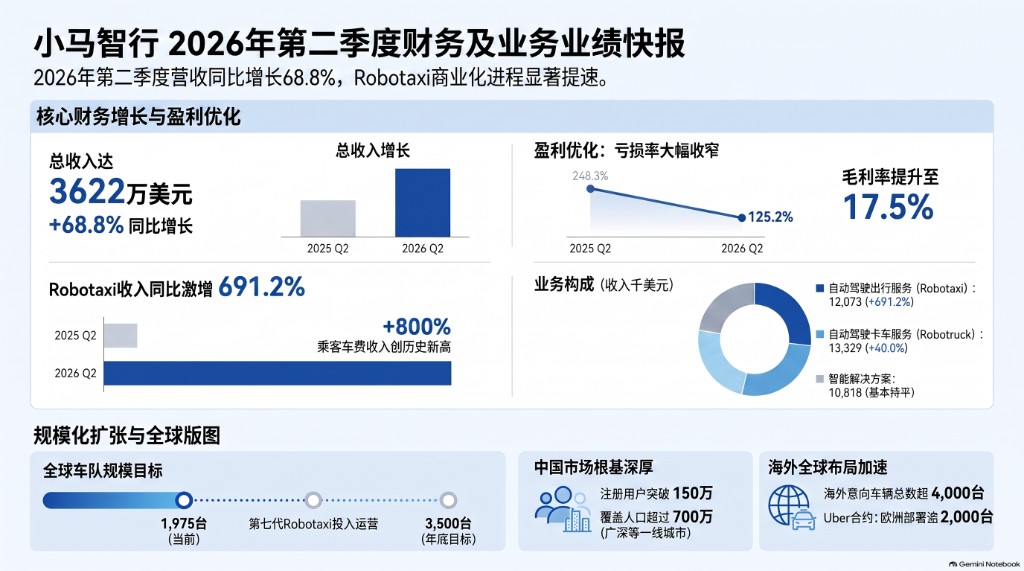
On August 18, autonomous driving company Pony AI released its financial results for the second quarter of 2026: total revenue amounted to $36.2 million, a year-over-year increase of 68.8%; GAAP net loss was $45.4 million, narrowing by 14.9% year-over-year.
Breaking down the revenue structure reveals significant divergence across the three business lines. The biggest highlight came from the autonomous ride-hailing service (Robotaxi): quarterly revenue reached $12.1 million, a year-over-year surge of 691.2%, with passenger fare revenue skyrocketing 849.3% year-over-year. Both metrics hit historical highs.
The autonomous trucking service (Robotruck) generated $13.3 million in quarterly revenue, a 40.0% year-over-year increase, primarily driven by freight services in collaboration with Sinotrans. According to the company, the fourth-generation autonomous trucks have entered mass production as scheduled, and commercial deployment of the fourth-generation driverless trucks with China Merchants Port has commenced at the Mawan Port in Shenzhen.
In contrast, intelligent solutions generated $10.8 million in quarterly revenue, a modest year-over-year increase of just 3.9%. This business line was a double-digit growth engine in the same period last year but slowed significantly this quarter, which the company attributed to fluctuations in the delivery rhythm of Autonomous Driving Controllers (ADC).
The three business lines showed a clear growth divergence of "+691% / +40% / +4%," indicating that the core driver of Pony AI's revenue growth this quarter is further concentrating on Robotaxi. Compared to the 2025 landscape where growth was jointly driven by intelligent solutions delivery and trucking collaborations, Robotaxi passenger fares are becoming an increasingly important component of new revenue.
Operating Leverage—Expense Growth Only One-Sixth of Revenue Growth
Looking solely at the 68.8% revenue growth, this represents Pony AI's strongest quarterly performance to date; however, what truly warrants attention is the significant slowdown in operating expense growth amidst rapid revenue expansion.
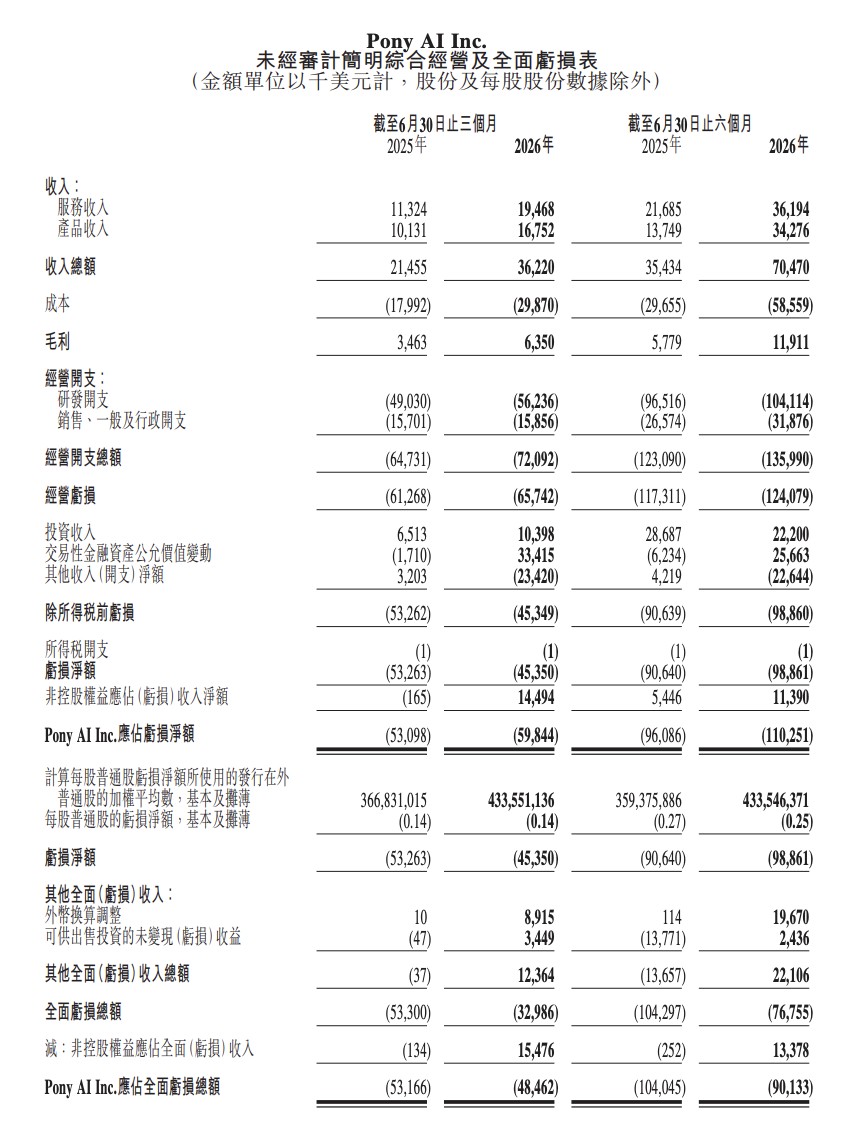
Operating expenses for the second quarter were $72.1 million, a year-over-year increase of 11.4%, which is only about one-sixth of the revenue growth rate; R&D expenses increased by 14.7% year-over-year, also significantly lower than the revenue growth rate. On a Non-GAAP basis, operating expenses increased by 9.6% year-over-year, with an operating loss of $56.7 million, up 4.9% year-over-year, remaining largely flat overall.
The clear misalignment between revenue and expense growth rates begins to reflect the operating leverage brought by scaling.
This change aligns with the company's technological roadmap. During the earnings call, the CTO emphasized that PonyWorld 2.0 supports "deploying autonomous taxi fleets in multiple countries and cities simultaneously without a proportional increase in engineering resource investment." Judging by the Q2 financial data, this technology and operational model is beginning to receive preliminary validation at the financial reporting level.
Specifically, the operating loss margin decreased from 285.6% in Q2 2025 to 181.5% in Q2 2026, a narrowing of 104 percentage points over one year; the net loss margin dropped from 248.3% to 125.2%, a narrowing of 123 percentage points. Revenue growth is starting to translate more distinctly into improved loss margins, with operating leverage gradually becoming evident.
Loss Analysis—GAAP Narrows, but Attributable Net Loss Expands
However, the "14.9% narrowing of net loss" does not fully reflect the actual changes in the company's losses.
The GAAP net loss for the second quarter was $45.4 million, but the net loss attributable to Pony AI Inc. reached $59.8 million, a difference of approximately $14.5 million, mainly related to the net income attributable to non-controlling interests under the co-built fleet model.
This means that as the co-built fleet business expands, Pony AI's financial statements are increasingly reflecting profit distribution impacts related to non-controlling interests. Looking solely at the company's overall GAAP net loss may underestimate this factor.
Additionally, the company recognized a $25 million impairment on long-term investment prepayments this quarter. Management stated that after proactively adjusting strategies for relevant businesses and introducing new strategic partners, the company recognized a $25 million impairment provision for certain long-term investment prepayments identified as unrecoverable.
On a Non-GAAP basis, after excluding $9 million in share-based compensation, $33.4 million in changes in fair value of trading financial assets, and $25 million in long-term investment impairments, the company's Non-GAAP net loss for the second quarter was $44.7 million, basically flat compared to the same period last year.
Therefore, this quarter's "loss reduction" needs to be observed through multiple lenses: while the GAAP net loss narrowed year-over-year, the Non-GAAP net loss remained essentially flat, with non-controlling interests and one-time impairments having a significant impact on final profit performance. Compared to focusing solely on year-over-year changes in net loss, the improvement in loss margins driven by operating expense control and revenue growth deserves more attention.
Fleet and Unit Economics—Nearly Doubling in Six Months
Beyond revenue and losses, another core metric watched by the market is the scale of the Robotaxi fleet.
As of June 30, 2026, Pony AI's autonomous taxi fleet reached 1,975 vehicles, compared to approximately 1,000 vehicles at the end of 2025, representing a 97.5% growth in six months.
The company's annual target is to reach a fleet size of over 3,500 vehicles, covering more than 20 cities domestically and internationally. This implies that approximately 1,525 additional vehicles need to be added in the second half of the year, averaging about 250 new vehicles per month. Compared to the average monthly expansion rate of about 160 vehicles in the first half, acceleration is required.
Meanwhile, positive signals have emerged regarding Robotaxi unit economics. In its Q1 2026 earnings report, Pony AI revealed that Robotaxis in Guangzhou and Shenzhen had achieved "city-level positive unit economics (UE)." Specifically, the average daily net revenue per vehicle in Shenzhen reached 394 yuan on March 22, with 25 orders recorded that day.
During the Q2 earnings call, the company maintained this statement but did not provide a clear timeline for achieving profitability at the company-wide level.
The CFO previously stated during the Q1 earnings call that for the Robotaxi business to move from "points" to "areas," the fleet needs to expand from the thousands to the tens of thousands to further dilute R&D and management expenses.
Therefore, the core transmission chain the market needs to verify next remains clear: Positive unit economics per vehicle → Continuous expansion of fleet size → Release of scale effects → Improvement in overall company profitability.
Overseas and Uber Tech—Co-Built Fleet Model Begins to Deliver
Progress in overseas business is also noteworthy in the Q2 results. Pony AI disclosed that it has entered into a contract with Uber Tech to deploy over 2,000 autonomous taxis in Europe; combined with other overseas partners, the total number of vehicles currently in agreement negotiations has increased to over 4,000.
The core of the co-built fleet model lies in transferring part of the heavy asset vehicle purchase costs to partners, such as Uber Tech and Ruqi Chuxing, while Pony AI participates in operations through technology licensing and fare sharing. Compared to a fully self-operated model, this approach reduces the pressure on the company's balance sheet from single-vehicle expansion and provides conditions for rapid overseas replication.
Currently, the company is advancing deployments in Luxembourg in cooperation with Bolt and Stellantis; in Singapore, it provides mobility services to the public through the Zig app under ComfortDelGro; public passenger transport has already opened in Zagreb, the capital of Croatia, and unmanned testing has launched in Dubai.
More notably, the Q2 earnings announcement explicitly mentioned that revenue contributions from co-built fleet models in China and overseas increased quarter-over-quarter.
The significance of this statement is that the co-built fleet model is gradually moving from previous cooperation signings and scale planning into the stage of actual operations and revenue contribution. If overseas fleets can continue to land successfully, Pony AI's growth logic will further shift from relying solely on domestic Robotaxi fleet expansion to a dual drive of "domestic scaling + overseas asset-light replication."