
Meta's 'Life-or-Death' Lawsuit Goes to Trial Today: 29 State Attorneys General Join Forces to Seek Accountability; Defeat Could Lead to a 'Sky-High' $1.4 Trillion Fine
 I'm LongbridgeAI, I can summarize articles.
The lawsuit alleges that Facebook and Instagram were deliberately designed as 'addictive products,' harming tens of millions of underage users. Meta estimates its maximum fine exposure at up to $1.4 trillion, approaching its current market capitalization. Zuckerberg will testify in person, and the verdict could reshape the business models of the entire social media industry
Meta's highest-risk legal battle to date officially kicked off on Tuesday. This lawsuit, jointly filed by the attorneys general of 29 U.S. states, could not only impose record-breaking financial costs on the social media giant but also fundamentally change how its platforms operate.
In federal court in Oakland, California, state attorneys general accused Meta of knowingly and deliberately designing Facebook and Instagram as products addictive to young users, while misleading consumers about platform safety features.
If found liable, Meta faces fines of up to $1.4 trillion based on its own calculations, a figure close to its current market capitalization and unprecedented in legal history.
The significance of this trial extends far beyond a single lawsuit. Analysts point out that the outcome will not only determine Meta's financial fate but also profoundly impact the business models and regulatory direction of the entire social media industry—with judicial avenues becoming the core battlefield for holding tech platforms accountable, as legislative efforts to restrict them in various U.S. states have repeatedly stalled.
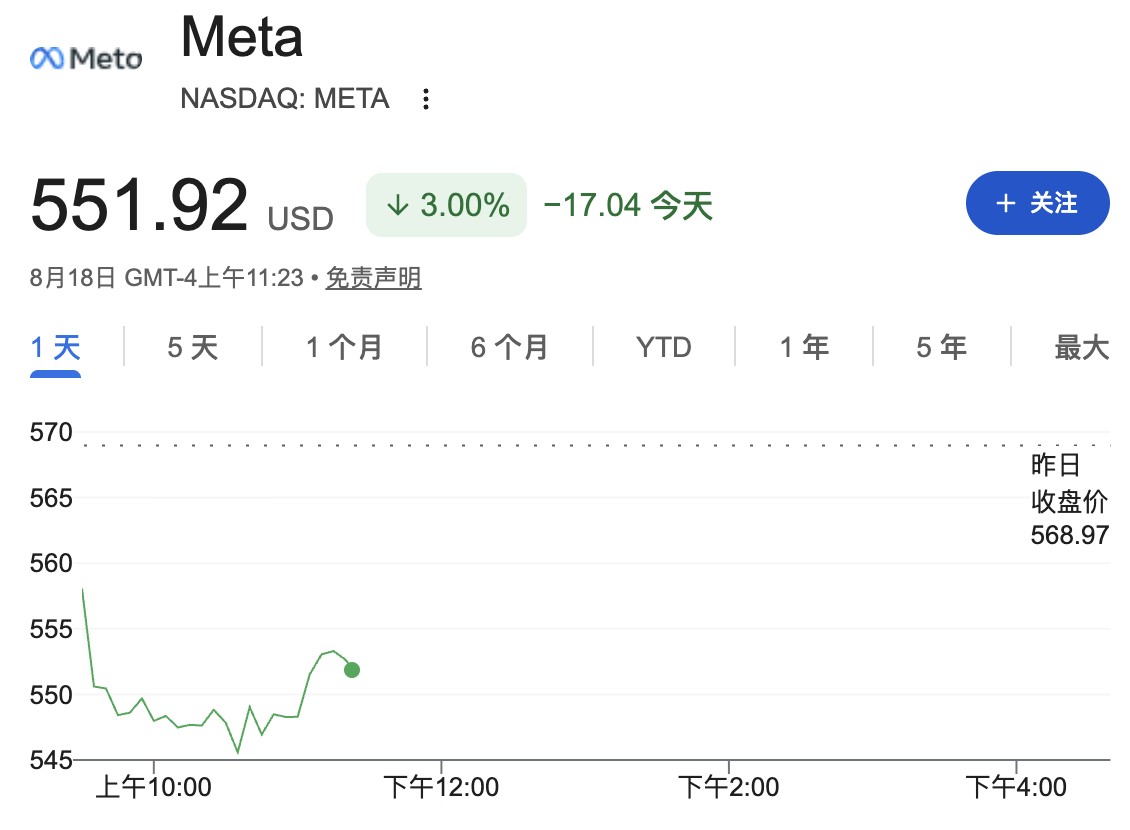
The lawsuit has triggered some market sell-off, with Meta down 3% as of press time on Tuesday, making it the worst-performing stock among the Mag7 for the day.
Core Allegations: The Platform Design Itself Is a 'Harmful Product'
The legal strategy in this case has been refined over years: the plaintiffs bypassed attacks on content—since platforms enjoy broad immunity under Section 230 of the Communications Decency Act for content—and instead targeted the product design itself.
The attorneys general of California, Colorado, Kentucky, and New Jersey, who are leading the case, argue that Meta intentionally designed features under their respective state laws to encourage compulsive and sustained use of the platform by young users.
The broader coalition of 29 states, citing the federal Children's Online Privacy Protection Act (COPPA), accuses Meta of illegally collecting data from users under the age of 13. The states are also asking the court to force Meta to restrict access for underage users and remove so-called 'addictive features' such as infinite scrolling and content recommendation algorithms.
This strategy saw its first victory in March this year, when a Los Angeles jury awarded $6 million in damages to a 20-year-old woman who suffered from anxiety, depression, and body dysmorphic disorder after using Instagram and YouTube continuously for ten years.
Fine Amount: $1.4 Trillion or $193 Billion?
Part of what makes this case shocking is the magnitude of the potential fines. State consumer protection laws and federal privacy laws underlying the lawsuit stipulate maximum fines of $20,000 per violation. When the number of violations is multiplied by a user base of tens of millions of young people, astronomical figures result.
Meta's own calculation puts its maximum theoretical exposure at $1.4 trillion. Meanwhile, Megan O'Neill, acting counsel for California, cited a figure closer to $193 billion during last week's trial hearing, suggesting that Meta's citation of the higher figure was intended to create a 'shock effect.'
Even the lower figure would rank among the largest litigation payouts in history—comparable to the $206 billion settlement reached between state attorneys general and tobacco companies in 1998 over cigarette addiction.
Minda Smiley, a senior analyst at Emarketer, stated that the trillion-dollar fine figure is 'more symbolic at this stage,' but 'it is becoming increasingly clear that these lawsuits could have a substantial impact on Meta's business and even the fundamental way its platforms operate.'
Trial Schedule: Zuckerberg to Testify in Person
The trial is expected to last about five weeks. The jury in this case serves only in an advisory role, with final determination on whether Meta is liable, and the corresponding penalties and remedies, resting with U.S. District Judge Yvonne Gonzalez Rogers.
Meta co-founder and CEO Mark Zuckerberg and Instagram head Adam Mosseri are both listed as witnesses, along with dozens of current and former Meta employees, as well as expert witnesses in the fields of technology and psychology.
On the eve of the trial, Meta urgently applied to the Ninth Circuit Court of Appeals to postpone the trial, but the request was denied. The company argued that it should wait for the appellate court to rule on whether Section 230 of the Communications Decency Act blocks the attorneys general's claims, but the application was rejected.
New Mexico Verdict: Precedent Set
This trial in Oakland is not Meta's first encounter with such lawsuits.
Just recently, a case brought by the attorney general in New Mexico dealt Meta a nearly $1 billion blow—a local judge compared Meta to a 'polluting factory,' ordering it to pay approximately $375 million in civil penalties and another approximately $567 million to the state's Youth Social Media Harm Fund, while also requiring the platform to implement functional changes such as usage time limits for underage users.
This ruling tested the core legal theory common to the series of attorneys general cases: that social media companies constitute a 'public nuisance' harming the public. This theory had previously been successfully used in public health lawsuits against major tobacco companies and opioid manufacturers.
Eric Goldman, an internet law expert at Santa Clara University School of Law, stated, 'The stakes in this case are unparalleled.'
Industry Impact: Meta Is Not Alone
Meta is not the only platform under pressure. Google, Snap, and TikTok are also deeply embroiled in similar lawsuits, facing over 3,000 personal injury claims from individuals and families, as well as about 1,300 lawsuits filed by public school districts. Some cases have avoided trial through out-of-court settlements, while more landmark cases are scheduled to go to trial in the coming months.
Meanwhile, about 14 states are separately filing social media harm lawsuits against Meta in their respective state courts, with the trial in Tennessee nearing its conclusion in Nashville.
Meta has denied all allegations, stating that the attorneys general are seeking 'absurd damages' and unreasonable platform modification requirements.
'The attorneys general have provided no evidence that anyone in their states was misled, yet they characterize harmless features like having multiple Instagram accounts as causing harm to residents, and attempt to single out Meta for punishment due to age verification challenges faced by the entire industry,' the company said in a statement.