
Maersk CEO: "We are starting to reach our limits"
 I'm LongbridgeAI, I can summarize articles.
Vincent Clerc, CEO of Maersk, stated during an earnings call that the container shipping market is reaching its limits. He dismissed concerns about excess capacity, pointing out that despite headwinds such as tariffs and de-globalization, market demand has demonstrated strong resilience. Key drivers include constrained landside capacity and growing demand for industrial goods (such as batteries and solar panels), prompting the company to raise its growth expectations for the container market
According to ShippingIndex, long-standing so-called "headwinds" plaguing the container shipping market—such as tariffs, de-globalization, excess capacity, and the energy crisis—may become less concerning as Maersk, the industry bellwether, significantly changes its narrative on the market's future prospects.
Specifically, Maersk CEO Vincent Clerc expressed a highly positive long-term outlook for the container shipping market in his latest earnings call and refuted concerns regarding "excess capacity."
During the second-quarter conference call, Vincent Clerc stated, "Our imagination has been limited by trade wars, discussions on de-globalization, and the view that conflicts in Iran would trigger an energy crisis, negatively impacting global demand."
He pointed out, "Despite years of talk about de-globalization and uncertainty in oil prices, data shows no signs that these factors are actually weakening demand in the container shipping market."
He emphasized, "For me, this is the key change compared to three months ago. The market appears so resilient that it can shake off these shocks and keep cargo volumes at stable levels."
He noted, "The real underlying demand has led us to raise our growth expectations for the container market."
Maersk's CEO pointed out that besides demand resilience, there is another driving factor: constrained landside capacity.
Vincent Clerc stated, "During the pandemic, we saw that when market cargo volumes suddenly increased, they exceeded the limits that landside operations could absorb. With post-pandemic normalization, we thought we would be free from this situation for quite a long time.
In fact, over the past three years, exports from the Far East have grown by 25%, making trade imbalances more pronounced. The Maersk CEO explained that bottlenecks mainly appear in major ports in Northern Europe, the east coast of South America, West Africa, and China, with the root of the problem stemming from Asia, particularly the continuous growth in cargo volume from China.
He stated that Maersk is increasingly transporting goods for the industrial sector, whereas previous cargo volumes were primarily consumer goods.
He added, "Items such as batteries, air conditioners, solar panels, wind turbines, and wind turbine parts. Most of these are manufactured in China."
He pointed out that demand for industrial goods is more stable than for consumer goods, and demand for Chinese products has continued to grow for years with no signs of changing. In the current freight market, the biggest risk Maersk faces is a sudden drop in cargo volume from China.
Maersk's CEO stated, "If cargo volume from China suddenly drops by 10%, all bottlenecks would disappear, and everything would collapse."
Meanwhile, Vincent Clerc stated, "Landside bottlenecks are tricky."
He pointed out that it is difficult for liner companies to prepare for these issues. "This is a hard ceiling to break through because developing terminals takes longer than building a ship."
He predicted, "Considering demand resilience, underinvestment in terminals, and the time required to invest in terminals, the sharp spikes in freight rates seen since May will become more frequent in the coming years."
He pointed out that Maersk expects freight rates to continue fluctuating significantly in the coming years, but due to bottleneck constraints, the average level will be higher than before.
Maersk CEO Open to Fleet Expansion: "We Are Starting to Reach Our Limits"
Furthermore, Maersk CEO Vincent Clerc refuted widespread concerns about "excess capacity."
The Maersk CEO stated, "Considering current slot utilization, we are starting to reach the limits of what our current fleet can deliver."
He revealed that Maersk may need to consider "a certain degree of fleet growth," rather than just replacing older vessels.
He stated that the "Gemini" cooperation with Hapag-Lloyd enables Maersk to transport more containers; however, high utilization means Maersk is approaching its own capacity limits.
He pointed out, "The goal achieved through 'Gemini' is to transport more cargo with a slower-growing fleet. But in terms of current utilization and asset turnover, we are starting to reach the limits of what the fleet can handle."
In the second quarter of 2026, Maersk's container volume grew by 4.1%, while slot utilization reached 96%.
In fact, during the investor conference call, several analysts noted a significant change in Maersk's description of the market's future prospects.
JPMorgan analyst Alexia Dogani called it a "major shift in narrative" for Maersk. Vincent Clerc admitted that this development also surprised him.
He stated, "I was surprised by the strength and resilience of demand."
He pointed out that demand has withstood trade conflicts, rising energy prices, and geopolitical uncertainty. Meanwhile, strong export growth from the Far East over the past three years has put increasing pressure on terminals, railways, and trucking.
However, Vincent Clerc now believes there are fewer limiting factors on orders than before. He added that as long as current demand trends continue, newbuilding orders are no longer as concerning.
He stated that this is partly due to the growth of so-called backhaul demand—i.e., large, full cargo flows, especially from Asia—which is growing faster than the overall container market. Meanwhile, trade imbalances require more empty container movements, putting additional pressure on vessel and terminal capacity.
Vincent Clerc stated, "If the overall market grows by 4%, but backhaul demand grows by 7-8%, capacity needs to increase by 7-8% annually to transport the cargo."
Overall, Vincent Clerc believes that more ships may not necessarily solve the capacity issue, but Maersk may have to expand its own fleet to meet demand and avoid losing further market share.
Horizontal Comparison of Order Books Among Top Liner Companies
Market rumors suggest that top liner companies such as Mediterranean Shipping Company (MSC) and Maersk are planning new ultra-large container vessel projects, each intending to build 10 to 20 container ships with a capacity of 20,000 TEU.
However, Vespucci Maritime shipping analyst Lars Jensen stated that Maersk abandoning its capacity cap does not necessarily translate into a large-scale ordering plan.
He stated, "This doesn't necessarily mean massive orders; it could also indicate that Maersk will adopt a more aggressive chartering strategy."
Alphaliner analyst Jan Tiedemann stated that Maersk has been "very active" in chartering recently, which he believes indicates that Maersk misjudged the newbuilding market a few years ago.
Jan Tiedemann pointed out, "I think Maersk got the timing wrong."
He stated, "They ordered large container ships too late and in too small quantities; they still need another dozen or two."
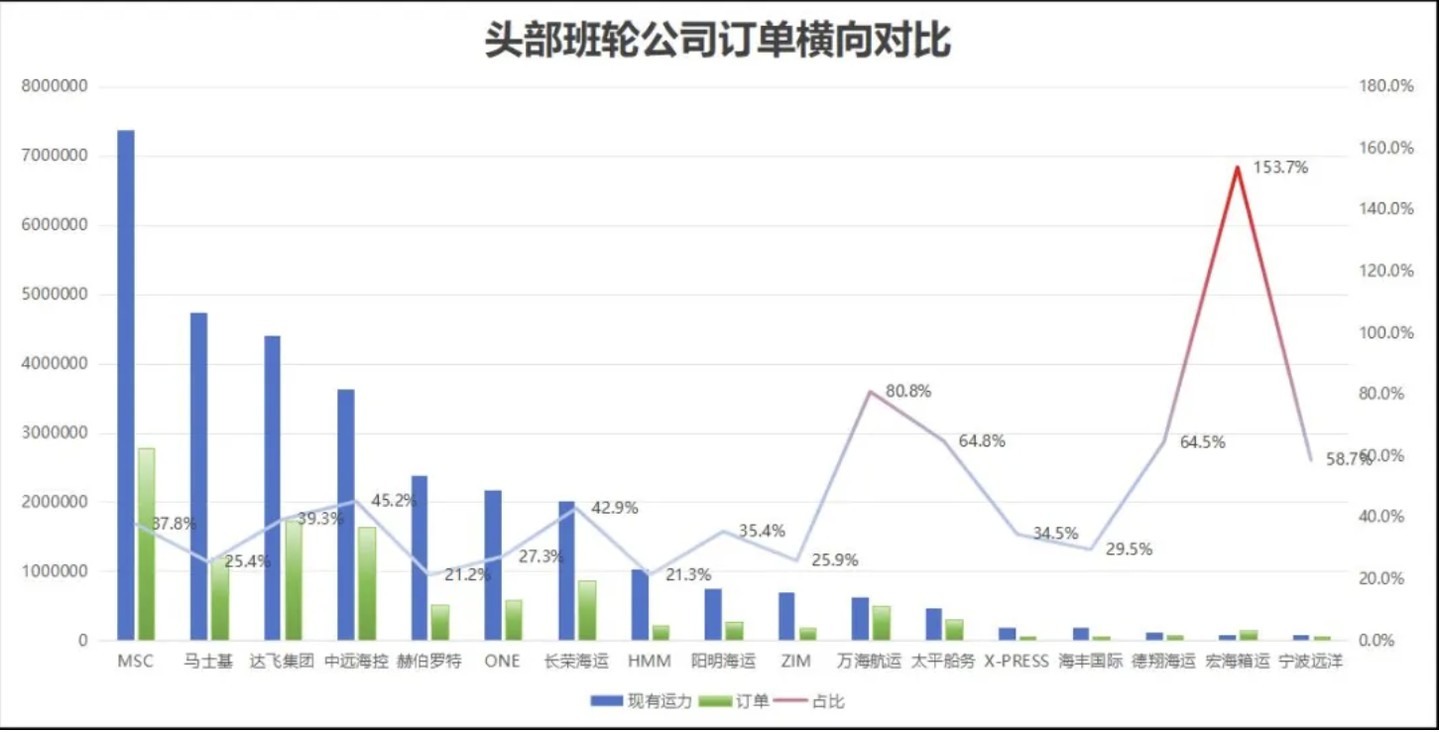
Latest data from Alphaliner shows that MSC's order book has increased to 159 vessels or 2.783 million TEU, accounting for 37.8% of its existing capacity; CMA CGM Group has 158 vessels or 1.732 million TEU on order, accounting for 39.3% of its existing capacity; Maersk currently has 90 vessels or 1.202 million TEU on order, accounting for 25.4% of its total existing capacity; Hapag-Lloyd currently has 65 vessels or 508,000 TEU on order, accounting for 21.2% of its total existing capacity; Ocean Network Express (ONE) has 48 vessels or 592,000 TEU on order, accounting for 27.3% of its total existing capacity.
In fact, in terms of the ratio of order volume to existing fleet capacity, Thailand's Regional Container Lines (RCL) added 6 vessels to reach 25 vessels or 140,514 TEU, equivalent to 153.7% of its existing fleet capacity; TS Lines' order volume reached 16 vessels or 76,520 TEU, equivalent to 64.5% of its existing fleet capacity. Meanwhile, Wan Hai Lines and PIL's order books account for 80.8% and 64.8% of their existing capacities, respectively, also indicating that they are significantly expanding their fleet sizes.
Source: ShippingIndex
Risk Warning and Disclaimer
The market carries risks; investment should be approached with caution. This article does not constitute personal investment advice, nor does it take into account the specific investment objectives, financial status, or needs of individual users. Users should consider whether any opinions, views, or conclusions in this article align with their specific circumstances. Investment decisions made based on this content are the sole responsibility of the investor.