
Bessent's "Rescue of US Treasuries" Equals "Abandoning the Dollar": Citigroup Strongly Bullish on Gold!
 I'm LongbridgeAI, I can summarize articles.
The US and Japan have formally allied to defend exchange rates, with Bessent personally endorsing joint purchases of yen and incorporating exchange rate policy into the national economic security framework. Citigroup reveals that the strength of the US dollar is being actively conceded in exchange for debt security, and the duration structure of US Treasuries will be reshaped, with 185-186 for EUR/JPY becoming a key warning line. At this historic moment when the credibility of the US dollar is being policy-diluted, gold has become the most direct beneficiary asset in the restructuring of the reserve system, prompting Citigroup to issue a "strong buy" rating
The US-Japan coordinated exchange rate policy promoted by US Treasury Secretary Bessent is placing "rescuing US Treasuries" and "conceding US dollar strength" within the same economic security framework. Citigroup believes that the willingness to actively devalue the US dollar has emerged at the policy level, further strengthening the revaluation logic for gold as a non-sovereign reserve asset.
According to Zhuifeng Trading Desk, Citigroup's Japan foreign exchange research report released on August 19 stated that the US Department of the Treasury and the Japanese Ministry of Finance are forming an informal "currency alliance," with the core action being joint intervention in the foreign exchange market to buy yen. Foreign exchange strategist Osamu Takashima wrote that the first act of the US-Japan "currency alliance" was the US Treasury's intervention to sell euros against the yen.
The market signal from this action is clear: the yen receives policy support, the strength of the US dollar is actively conceded, the euro against the yen becomes a new risk trigger, and the duration structure of US Treasuries may also be lengthened. For investors, the pricing of exchange rates, bonds, and reserve assets all face recalibration.
Under this framework, gold has become Citigroup's clearest bullish direction. The credibility of the US dollar is being policy-diluted, reducing the reserve system's reliance on a single sovereign currency, leading to a repricing of gold's non-sovereign attributes. Compared to the policy games involving the yen, euro, and US Treasuries, the logic for gold is more direct.
US and Japan Join Forces to Buy Yen; First Round Avoids Market Backlash
The report pointed out that after the recent US-Japan coordinated intervention, the bond and stock markets in the United States and Japan did not immediately show direct negative reactions. This has boosted the confidence of authorities on both sides to continue buying yen.
For Japan, maintaining the credibility of the yen has risen to the national level. Atsushi Mimura, Deputy Vice Minister of Finance for International Affairs at the Japanese Ministry of Finance, described this action as the culmination of the US-Japan "currency alliance." The personal endorsement by US Treasury Secretary Bessent has given this exchange rate defense action stronger political authority.
The fact that the first move was not quickly rejected by the market will lower the threshold for subsequent interventions. If the yen comes under pressure again, the possibility of further yen purchases by US and Japanese authorities remains.
"Abandoning Dollar Strength" in Exchange for US Treasury and Economic Security Framework
The core judgment is that Bessent is incorporating exchange rate policy into the US national economic security strategy. The US dollar is no longer just passively reflecting interest rate differentials and growth expectations but has also become a policy tool.
This framework is related to Japan's $550 billion strategic investment plan in the United States. According to the report, Japanese companies will invest capital into US projects through special purpose vehicles established by institutions such as the Japan Bank for International Cooperation. Cash flows will be shared by both the US and Japan, with each side holding 50% until debt repayment is completed, after which the US side will hold 90% and the Japanese side 10%.
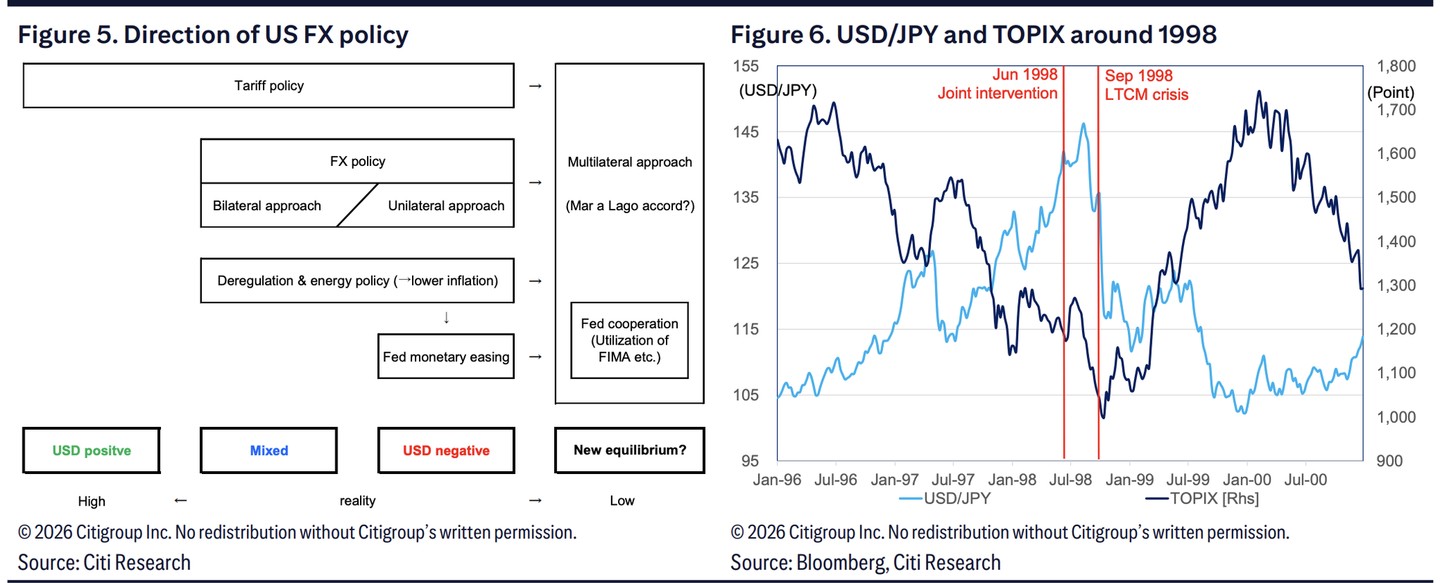
This arrangement distances itself from the Mar-a-Lago Accord proposed by Stephen Miran, but there is an intersection: using the FIMA facility to intervene by selling dollars, and encouraging countries holding US dollar reserves to increase the duration of their US Treasury holdings.
This is precisely the connection point between "rescuing US Treasuries" and "abandoning the dollar." If reserve countries are guided to lengthen the duration of US Treasuries, the structure of the US bond market will change; meanwhile, the strength of the US dollar is actively conceded in exchange for a more solid economic security alliance and financing arrangements, thereby increasing the volatility risk at the long end of US Treasuries.
Gold Becomes the Most Direct Beneficiary Asset
In asset judgments, gold is listed as "strongly bullish." Its core logic is not short-term safe-haven demand, but the revaluation of non-sovereign reserve assets against the backdrop of active dilution of US dollar credibility.
If the US dollar is policy-lowered, the long-term attractiveness of traditional US dollar assets will face repricing. US Treasuries will need longer-duration buying support, and exchange rate policy will serve broader economic security goals. In this environment, investors will place greater emphasis on assets that do not rely on single-sovereign credibility.
Gold is at the center of this logic. The yen is supported by intervention, the euro faces intervention risks regarding EUR/JPY, US Treasury volatility may intensify, and the US dollar is neutral to weak; in contrast, gold captures the main theme of reserve system rebalancing and the concession of US dollar credibility.
Citigroup's conclusion is straightforward: the willingness to actively devalue the US dollar has been confirmed by policy, and the bullish logic for gold is valid and strengthened.
EUR/JPY Becomes an Unexpected Battlefield, 185-186 is the Key Alert Zone
The most unusual aspect of this intervention is that the US Treasury started with the euro against the yen. The US Treasury's sale of EUR/JPY will change the composition of foreign currency assets held by the US Exchange Stabilization Fund, and can also be understood as a phased shift from the overvalued euro to the undervalued yen.
The key trigger range is 185 to 186 yen per euro. Last month's US intervention occurred when EUR/JPY rebounded to near 185. Authorities clearly find it difficult to tolerate further upward movement in the euro against the yen.
The Japanese Ministry of Finance may also follow suit with EUR/JPY intervention. If the scale of action is limited, Europe may remain tolerant. Christine Lagarde, President of the European Central Bank, experienced the role played by the Japanese Ministry of Finance during the European crisis in the 2010s while serving as IMF Managing Director, which may leave room for limited-scale intervention.
However, the main battlefield remains USD/JPY. If the situation escalates, US and Japanese authorities may use the FIMA facility to buy yen, with the phased goal perhaps being to push EUR/JPY back below its recent low of approximately 180 yen per euro.
TOPIX Determines Intervention Window, Stock Market Levels Become Exchange Rate Variables
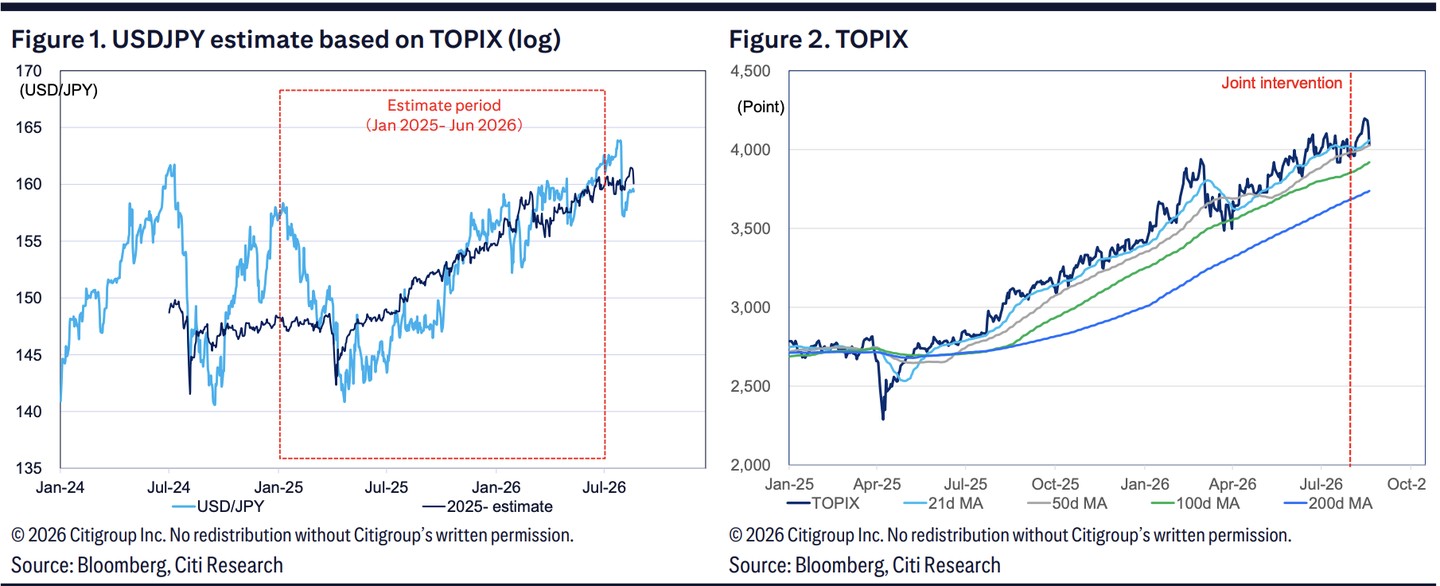
An important reason for the yen's depreciation this year is that domestic and foreign investors engaged in hedging operations by selling yen during the rise of the Japanese stock market. The stronger the rise in Japanese stocks, the easier it is for yen-selling hedges to continue, and the easier it is for the market to absorb the effects of yen-buying interventions.
Therefore, the intervention window is highly correlated with the position of the Japanese stock market. The most recent intervention occurred when the TOPIX fell below its 21-day moving average but still received support from its 100-day moving average. This state indicates that short-term momentum is cooling, but risk assets have not yet seen a comprehensive stampede.
If further intervention is needed in the future, similar technical conditions may again become the window for action. For investors, observing the yen requires looking not only at USD/JPY and EUR/JPY but also tracking whether the TOPIX re-enters this "sandwich zone."
Shadow of 1998 Strengthens Bessent's Motive for Early Action
The report cited Bessent's view that yen weakness was one of the causes of the Asian currency crisis in the latter half of the 1990s. Proactively preventing a recurrence of similar risks is an important background for US participation in coordinated intervention this time.
During the 1998 Japanese financial crisis, then-US Treasury Secretary Robert Rubin refused to participate in coordinated intervention. Subsequently, the Long-Term Capital Management crisis triggered severe market volatility, with USD/JPY falling from around 147 to near 108 within six months.
This history has strengthened Bessent's policy alertness. The report speculates that Bessent is likely the main driver of this joint intervention. Trump has described the coordinated intervention as a "signal of friendship" to Japan.
For the Japanese Takachi government, this is also a policy signal from the United States: reflationary policies need to converge, and the credibility of the yen cannot spiral out of control.
Next, the Market Watches Three Lines: Yen, Long-Term Bonds, Gold
In the short term, the market is focusing on two policy time points: the Jackson Hole Economic Symposium from August 27 to 29, and the G7 and G20 finance ministers and central bank governors' meetings held in Asheville from August 31 to September 1. Citigroup stated that it will pay closer attention to relevant information from US, Japanese, and European authorities.
At the trading level, the watch list is short: whether EUR/JPY tests the 185-186 range, whether USD/JPY continues to be the main battlefield for intervention, and whether the TOPIX falls below the 21-day moving average again while holding the 100-day moving average.
The asset implications are equally clear. The yen is supported by US-Japan joint intervention, the euro needs to guard against EUR/JPY intervention risks, the US dollar is neutral to weak, and the volatility risk of US long-term bonds is rising. Gold is on the benefiting end of this policy framework.
Against the backdrop of the active concession of US dollar strength, the rearrangement of US Treasury durations, and exchange rate policies serving economic security, the allocation value of gold has further increased. Citigroup's judgment of being "strongly bullish on gold" is a concentrated expression of this change.