
 I'm LongbridgeAI, I can summarize articles.
The Slovenian government has approved Tesla's FSD (Full Self-Driving) system for use on roads in the country, making it the sixth European country to approve the system after the Netherlands. Slovenian regulators stated that this is an example of new technology gradually integrating into the transportation system under regulation. Tesla CEO Elon Musk expressed concern over this news and noted that a vote for approval across the EU could take place as early as October 6. This move marks an acceleration of Tesla's physical AI blueprint in Europe
According to Zhitong Finance APP, American AI, robotics, autonomous driving, and automotive manufacturing giant Tesla (TSLA.US) has announced that the Slovenian government has approved its FSD (Full Self-Driving) system for use on roads in the country, becoming the sixth European country to approve the system before a potential EU-wide approval vote.
"The FSD supervision version has now been approved in Slovenia and will soon begin to be pushed out," Tesla stated on social media platform X on Monday, with CEO Elon Musk retweeting the news. Slovenia's Minister of Energy and Infrastructure, Jernej Vrtovec, also shared the announcement, adding the caption "Continuing to develop Slovenia."
Earlier in April, the Dutch government’s European road transport regulatory agency temporarily approved the software for use on Dutch roads, making the Netherlands the first EU country to allow the use of FSD. The system can fully control Tesla vehicles, but Tesla still requires drivers to maintain attention according to its guidelines.
Last week, Tesla publicly released its self-produced testing dataset for the European and North American markets, during which Musk stated that the EU-wide approval vote could be held as early as October 6.
Under Musk's leadership, Tesla is accelerating the simultaneous advancement of FSD technology upgrades, European FSD and Robotaxi access, automotive software monetization, and the accelerated mass production of robots, aiming to realize Musk's "physical AI super blueprint" for Tesla's growth prospects. The company's second-quarter update indicated that FSD v14 lite adapts the driving capabilities of the AI4 platform v14 series to earlier AI3 hardware through model distillation, improving scenarios such as lane changes, pedestrian interactions, and destination parking, and has begun pushing updates to users in the United States and South Korea.
According to Jensen Huang, CEO of NVIDIA, "physical AI" emphasizes enabling robots/automotive autonomous operating systems to perceive, reason, and complete a full set of actions in the real world, and an era of human civilization evolution assisted by "physical AI" is approaching. "Physical AI" emphasizes enabling robots/autonomous systems to perceive, reason, and complete a full set of actions in the real world, and these three capabilities are key components of the artificial intelligence toolchain that advances AI large language models from "only able to converse" to "able to work in the physical world."
The Slovenian Traffic Safety Agency confirmed via email that the traffic regulatory agency has approved the system, adding that while Slovenia seeks to maintain an open attitude towards innovation and technological development, new technologies must be introduced safely. The agency stated, "The temporary type approval of the FSD (supervised by humans) system is a concrete example of how new technologies can gradually integrate into the transport system under appropriate regulation and safety oversight."
In addition to the Netherlands and Slovenia, four other European countries have approved Tesla's driving assistance system, while Finland and Greece have indicated they are considering approval.
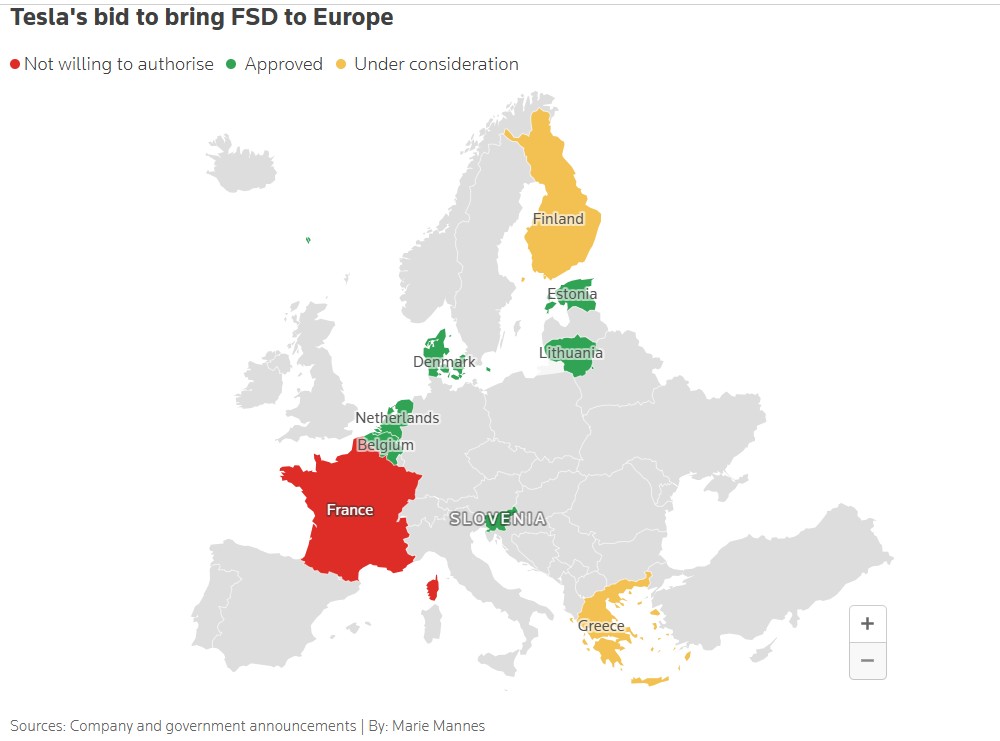 France had previously raised concerns about the potential approval of the autonomous driving system in July due to safety worries. Last week, France announced that it had begun testing two electric vehicles equipped with FSD following what the country's transport minister described as "constructive exchanges" with Musk.
Accelerated FSD Access in Europe, Cybercab Begins Road Phase
As of the end of the second quarter, the number of paid FSD users reached 1.48 million, a year-on-year increase of 56%, including one-time purchases and monthly subscription users; over 55% of new vehicle deliveries in North America included FSD subscriptions. Slovenia has become the sixth European country to approve the system, further expanding the potential paid market, although the approved system still requires continuous driver supervision.
Robotaxi has begun transitioning from retrofitting existing models to deploying dedicated autonomous vehicles for service. On September 3, Tesla's exclusive Robotaxi— the two-seater Cybercab, which has no steering wheel or pedals, began offering limited commercial ride services in certain areas of Austin. According to media reports, Tesla had registered 420 autonomous vehicles in Texas at that time, of which 45 were Cybercabs, but the registration number does not equate to all vehicles being in paid operation. For investors, this step is crucial for Tesla to establish a sustainable per-trip charging business, but the National Highway Traffic Safety Administration initiated an investigation into the self-certification of Cybercab's safety standards on September 4, and nationwide commercial expansion in the U.S. still needs to overcome relevant regulatory hurdles.
Musk's vision of "Physical AI" aims to connect autonomous driving, general robotics, and autonomous computing capabilities. At the G20 event on September 1, he predicted that the number of humanoid robots worldwide could exceed 1 billion in the next decade and envisioned robots participating in the manufacturing of robots, further accelerating expansion.
Tesla is accelerating the construction of the corresponding infrastructure—recently added AI training computing capacity for Cortex 1 and Cortex 2 exceeds 90 megawatts and 115 megawatts, respectively, with the latter supporting the full autonomy development and iterative updates for Cybercab, autonomous vehicles, and AI humanoid robots; the production line of the original Model S and Model X at Tesla's Fremont Gigafactory is being converted to the Optimus humanoid robot production line, with the first batch of mass-produced humanoid robots planned for large-scale use in training data collection and function development