
 I'm LongbridgeAI, I can summarize articles.
Oracle's stock has fallen over 50% from its high despite a $638 billion RPO, driven by massive capital expenditures for AI infrastructure that have turned free cash flow negative. Investors will focus on Q1 fiscal 2027 earnings, particularly OCI growth and RPO conversion, to assess if demand translates to revenue. Wall Street analysts set an average price target of $257, with a high of $400.
TradingKey - Oracle (ORCL) currently exhibits a seemingly paradoxical market contrast: while the company has signed future orders equivalent to nearly 9.5 times its previous fiscal year's revenue, its stock price has fallen more than 50% from its all-time high.
As of the close on September 8, Oracle traded at $162.52, down about 17% since the start of 2026 and off over 50% from its 52-week high of $345.
At the same time, however, the company's cloud infrastructure business maintains rapid growth, with remaining performance obligations (RPO) reaching $638 billion, equivalent to nearly 9.5 times its fiscal year 2026 revenue.
With AI demand continuing to grow and orders rapidly accumulating on one side, and sluggish stock performance on the other, this contrast has drawn intense focus to the first-quarter fiscal 2027 earnings report to be released after the market close on September 10.
What to Watch in Oracle's Earnings Report
FactSet expects Oracle's first-quarter revenue to be approximately $19.13 billion, representing a year-over-year increase of over 28%, with adjusted earnings per share expected at $1.74. These forecasts generally fall within the company's previously provided guidance range. Oracle projects total quarterly revenue growth of 27% to 29% and adjusted earnings per share between $1.72 and $1.76.
Therefore, merely meeting revenue and profit expectations may not be enough to significantly drive up Oracle's stock price. The most critical metric in the earnings report will be the growth rate of its cloud business, particularly the performance of Oracle Cloud Infrastructure (OCI).
In the previous quarter, Oracle's OCI revenue reached $5.8 billion, surging 93% year-over-year to become the company's fastest-growing core business. Management expects total cloud revenue in the first quarter to grow 58% to 64%. If actual results land near the top end of that range, it would indicate that demand for AI training, inference, and multi-cloud databases remains robust, while offering initial evidence that backlog orders are converting into actual revenue.
Another key figure to watch is the quarter-over-quarter change in RPO.
In the previous quarter, Oracle's RPO increased by $85 billion to reach $638 billion, up 363% year-over-year. As the year-over-year comparison base for this quarter has risen significantly, looking solely at the growth rate is becoming less meaningful. By contrast, the size of new contracts signed, the sequential increase in RPO, and the proportion of revenue to be recognized over the next 12 months will better reflect order quality.
Oracle expects approximately 12% of its RPO to be recognized as revenue over the next 12 months, equivalent to about $76.6 billion, while another 68% of orders will be recognized after three years. While this structure enhances long-term revenue visibility, it also means the company must build data centers well in advance, resulting in a relatively slower pace of revenue monetization.
Why Didn't a $638 Billion Order Boost the Stock Price?
The core factor weighing on Oracle's stock price is not a lack of demand, but rather the scale of capital required to meet that demand.
In fiscal year 2026, Oracle's operating cash flow grew 54% to $32 billion, but capital expenditures surged 162% year-over-year to $55.6 billion, driving free cash flow down to negative $23.7 billion. To fund this, the company raised $43 billion in debt and $5 billion in equity, and plans to raise approximately another $40 billion through debt and equity financing in fiscal year 2027.
Management expects fiscal year 2027 capital expenditures to reach $90 billion to $95 billion, primarily allocated toward constructing AI data centers and procuring related infrastructure. Although some major customers provide upfront funding or supply their own GPUs, Oracle still needs to bear the costs of land, power, networking, and data center construction.
This represents the largest timing mismatch in Oracle's current investment thesis: while orders will be gradually recognized as revenue over future years, the majority of construction expenditures must be incurred upfront.
If data center deliveries proceed smoothly, the massive RPO could translate into high growth sustained over several years; however, if projects face delays, financing costs rise, or customer demand shifts, cash flow pressure may materialize long before the revenue is realized.
Credit markets have already begun pricing in this risk, with S&P Global previously downgrading Oracle's long-term credit rating to BBB-, just one notch above speculative grade. For a company that requires continuous financing to expand its AI infrastructure, a credit rating downgrade not only increases interest expense but could also impair the profitability of future projects.
Wall Street Sets Highest Price Target of $400
According to TipRanks, in the past 3 months, a total of 31 Wall Street analysts offered 12-month price targets for Oracle, with an average price target of $257.36, a high of $400, and a low of $145. Based on Oracle's latest stock price of $162.52, the average price target represents a potential upside of approximately 58.35%.
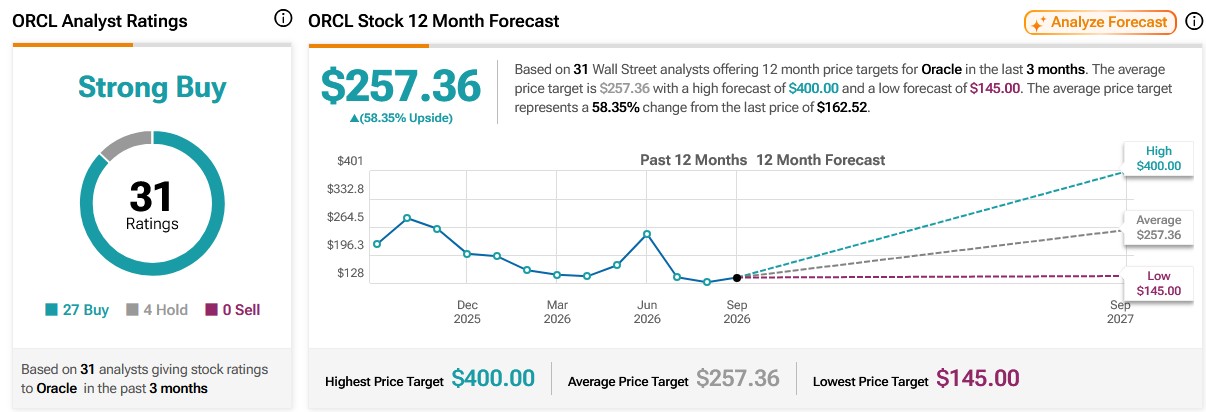
Source: TipRanks
However, institutional views vary significantly regarding OCI's growth prospects, capital expenditures, and cash flow pressures.
Morgan Stanley (MS) slightly raised its price target on Oracle from $207 to $210 while maintaining a "Hold" rating. The firm expects the GPU-as-a-Service business to continue driving cloud revenue growth, with first-fiscal-quarter cloud growth potentially near the upper end of the company's guidance range.
Bank of America (BAC) maintained a "Buy" rating and a $240 price target, believing OCI expansion and a massive backlog can support the company's medium-to-long-term growth.
Jefferies (JEF) lowered its price target from $320 to $290 while continuing to assign a "Buy" rating. The firm acknowledged that Oracle faces issues such as increased capex, rising debt, and free cash flow pressure, but believes those concerns are largely reflected in the current stock price.
TD Cowen also maintained a "Buy" rating but lowered its price target from $300 to $240, primarily considering the expanding scale of AI infrastructure investments and the longer timeframe required for these investments to generate returns.
In contrast, Guggenheim maintained its $400 price target, remaining one of the most optimistic firms on Wall Street, primarily bullish on the long-term growth potential of Oracle's AI cloud infrastructure business.
Find out more