
 I'm LongbridgeAI, I can summarize articles.
On July 27, 2026, CME launched Single Stock Futures, offering direct exposure to individual U.S. stocks like Nvidia and Apple without buying shares. The product includes Standard (100 shares) and Micro (10 shares) contracts, cash-settled with quarterly expirations. Key advantages over traditional stocks include nearly 23-hour daily trading windows and potentially more capital-efficient margin requirements.
On July 27, 2026, CME expanded its equity product lineup with a new offering: Single Stock Futures, futures contracts on individual stocks that provide direct exposure to a company’s share price without requiring traders to buy or short the underlying stock.
At launch, the offering included 55 Standard contracts and 22 Micro contracts covering more than 50 major U.S. companies. The available underlying stocks include some of the most actively traded names in the U.S. market, such as Nvidia, Tesla, Apple, Amazon, Alphabet, and Meta.
The basic mechanics are similar to those of other futures. Instead of purchasing shares of a company directly, a trader buys or sells a futures contract whose value tracks the underlying stock. The main difference compared with traditional equity index futures, such as the S&P 500 (ES) and Nasdaq (NQ), is the type of exposure: an S&P 500 futures contract provides exposure to the overall performance of a basket of companies, while a Single Stock Future allows traders to take a position directly on an individual company.
In this article, we’ll look at how CME Single Stock Futures work, how these new contracts are structured, and, most importantly, whether their characteristics could make them a viable alternative to trading stocks directly.
How CME Single Stock Futures Work
Like all futures, Single Stock Futures are standardized contracts. This means that their key specifications – including the amount of the underlying stock represented, minimum price fluctuation, expiration dates, and settlement method – are established by the exchange and are therefore the same for all market participants.
A Standard contract represents 100 shares of the underlying stock, while a Micro contract represents just 10 shares. As a result, the contract’s notional value depends directly on the price of the underlying stock. For example, assuming Nvidia futures are trading at $200:
- A Standard contract would have a notional value of $20,000 ($200 x 100).
- A Micro contract would have a notional value of $2,000 ($200 x 10).
The Micro contract is therefore one-tenth the size of the Standard contract, allowing traders to size their exposure more precisely – an important feature for those trading with smaller accounts. The monetary value of the minimum tick, corresponding to a $0.01 price movement, also varies depending on the contract size. For the Standard contract, the minimum price movement is worth $1.00 per contract, while for the Micro contract it is worth $0.10.
Unlike stocks, which can be held indefinitely, Single Stock Futures have predetermined expiration dates. CME lists quarterly contracts expiring in March, June, September, and December, just like the major equity index futures.
Another important feature is settlement, meaning how the contract is handled at expiration. Single Stock Futures are cash-settled, so there is no delivery of the underlying shares. Instead, the position is settled in cash based on the difference between the contract value and the final settlement price. For example, holding a long position in an Nvidia Single Stock Future through expiration would not result in 100 Nvidia shares being delivered to the trader’s account. The contract would simply be settled in cash.
Trading hours are another notable feature. As with CME equity index futures, the schedule is based on Chicago time (Central Time, CT). Single Stock Futures can be traded from 5:00 p.m. Sunday through 4:00 p.m. Friday, with a daily one-hour break from 4:00 p.m. to 5:00 p.m. In practice, this means the market is available for approximately 23 hours a day, five days a week.
| Feature | Standard Single Stock Future | Micro Single Stock Future |
| Shares represented | 100 | 10 |
| Minimum price movement | $0.01 | $0.01 |
| Tick value | $1.00 | $0.10 |
| Expirations | Mar, Jun, Sep, Dec | Mar, Jun, Sep, Dec |
Table 1. Key specifications of CME Standard and Micro Single Stock Futures. For further information: Single Stock Future – CME Group
Single Stock Futures vs. Stocks: What Are the Advantages?
Once we understand how Single Stock Futures are structured, the more interesting question is whether there are situations in which these futures on individual stocks could offer advantages over trading the underlying shares directly.
Two features stand out in particular: the ability to trade during many of the hours when the U.S. stock market is closed and potentially more capital-efficient margin requirements.
One of the clearest differences compared with stocks is the trading schedule. Because these contracts trade approximately 23 hours a day, traders can manage their positions during much of the U.S. overnight session rather than necessarily having to wait for the next regular stock market session to open. Of course, the ability to place an order does not mean it can always be executed under the same conditions available during regular trading hours. Spreads, volume, and order book depth can vary significantly throughout the day. Liquidity therefore deserves a separate analysis, which we will address later.
Another particularly interesting consideration is the amount of margin required to obtain a given level of market exposure. For a concrete comparison, we’ll use Interactive Brokers, which publishes separate margin requirements for U.S. stocks and Single Stock Futures. Before comparing the numbers, however, it is important to understand what margin actually represents.
The value of a position and the amount of capital required to maintain it are not necessarily the same. If a trader takes on $20,000 in market exposure, profits and losses are still calculated based on the full $20,000 exposure, even if the broker requires only a portion of that amount to be posted as margin. Margin therefore determines how much capital must be available to support the position – not the actual size of the market exposure. Consider a long position in a U.S. stock. Interactive Brokers indicates a 25% initial intraday margin requirement for U.S. stocks and a 50% margin requirement for a position held overnight.
Suppose, purely as an example, that we want $20,000 in exposure to Nvidia. During the trading day, applying a 25% requirement, the required margin would be:
- $20,000 x 25% = $5,000
If we decided to hold the position overnight, the margin requirement would rise to 50%:
- $20,000 x 50% = $10,000
This means the trader would not need to commit the full $20,000 notional value, but the margin requirement would increase significantly when moving from an intraday position to one held overnight.
For U.S. Single Stock Futures, Interactive Brokers publishes a different requirement. For a straightforward long or short position, IBKR indicates a margin requirement equal to 20% of the Single Stock Future’s market value.
Using a Single Stock Future with an equivalent $20,000 notional value, the approximate margin requirement would therefore be:
- $20,000 x 20% = $4,000 margin
The difference is relatively small when comparing the futures contract with an intraday stock position: $4,000 versus $5,000 in this example.
The advantage becomes much more significant when comparing positions held overnight. For the same $20,000 in market exposure, the stock position would require approximately $10,000 in margin, compared with roughly $4,000 for the Single Stock Future.
Lower margin requirements can therefore improve capital efficiency, but they also increase the amount of leverage potentially available to the trader. It is up to the trader to decide whether to use that greater capital efficiency to increase market exposure or simply to keep a larger portion of the account capital available.
For further information: IBKR – US Single Stock Future Margin Requirements
Single Stock Futures and Position Sizing: The Granularity Trade-Off
The standardized structure of futures also creates a disadvantage compared with trading stocks directly: traders cannot buy or sell a fraction of a futures contract.
A Standard Single Stock Future represents 100 shares of the underlying stock, while a Micro Single Stock Future represents 10 shares. Traders can therefore trade one, two, or three contracts, for example, but not 0.4 or 1.7 contracts. Stocks offer much greater granularity when sizing a position.
Suppose, for example, that our position-sizing model determines that the ideal exposure is equivalent to 37 shares. When trading the stock directly, we can buy exactly 37 shares.
With a Micro Single Stock Future, where each contract represents 10 shares, we would instead have to choose between:
- 3 Micro contracts, equivalent to 30 shares.
- 4 Micro contracts, equivalent to 40 shares.
Single Stock Futures Liquidity: Volumes Are Still Limited
The biggest limitation of Single Stock Futures, at least for now, is their relatively low liquidity. Figure 1 shows the Standard Nvidia contract using 5-minute bars. Despite being one of the more actively traded Single Stock Futures, price activity still appears highly fragmented. Many bars contain very few transactions, with volume concentrated in only certain periods of the trading day. This type of market structure can be particularly problematic for systematic trading strategies, where the ability to enter and exit positions efficiently is important.
However, it is worth remembering that these instruments were launched only on July 27, 2026. To see whether conditions are improving, Table 2 compares average daily volume during the first five trading days for several Standard contracts with the average volume recorded during the five most recent sessions available within the contracts’ first month of trading.
For the major underlying stocks, the trend is quite clear: volumes have not declined. Instead, they have increased significantly. Nvidia, for example, went from an average of just 68 contracts per day to approximately 372, while Tesla increased from 24 to nearly 78 contracts. Apple, Amazon, and Microsoft also recorded increases.
| Underlying Stock | Avg. First 5 Days | Avg. Most Recent 5 Days |
| Nvidia | 68.4 | 371.8 |
| Apple | 112.6 | 216.0 |
| Tesla | 23.6 | 77.6 |
| Amazon | 33.6 | 48.0 |
| Microsoft | 16.4 | 42.2 |
Table 2. Average daily volume for selected CME Single Stock Futures.
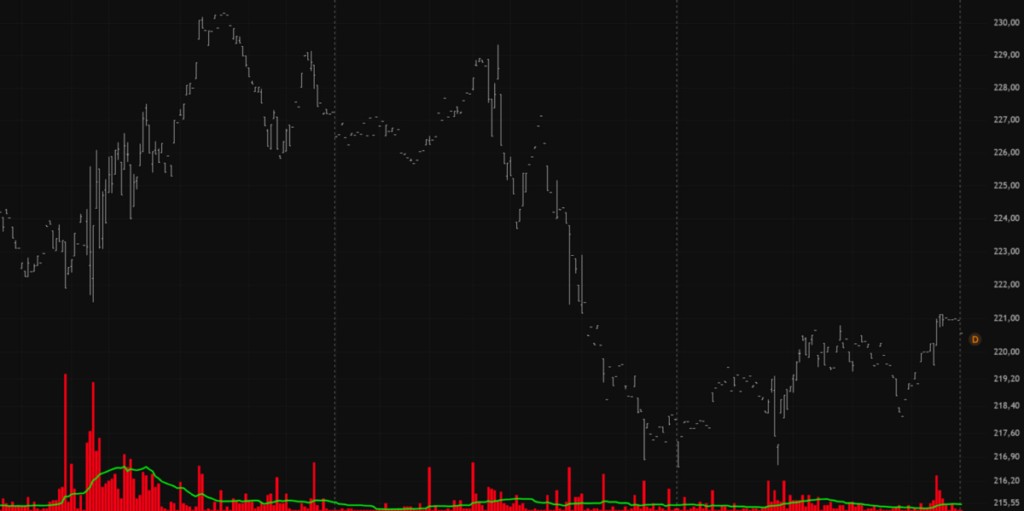
Figure 1. 5-minute chart of the Standard Nvidia (NVDA) Single Stock Future.
Single Stock Futures: A New Opportunity for Systematic Trading?
The new Single Stock Futures offer several interesting features and, at least on paper, could represent a viable alternative to trading stocks directly.
At the same time, however, this is still an extremely young market. The contracts were launched in late July, and as we have seen, current volumes are still too limited to trade them with the same confidence as much more liquid futures markets. The early data is encouraging, particularly for contracts based on the most widely traded and recognizable U.S. stocks.
For now, rather than instruments that can immediately be incorporated into a systematic trading portfolio, CME Single Stock Futures are primarily a market worth monitoring. If volumes continue to grow over the coming months and liquidity becomes more consistent throughout the trading day, their characteristics could make them particularly interesting instruments for systematic trading on individual stocks.
Until next time, happy trading!
image credit: Author
Benzinga Disclaimer: This article is from an unpaid external contributor. It does not represent Benzinga’s reporting and has not been edited for content or accuracy.