
 I'm LongbridgeAI, I can summarize articles.
Nvidia CEO Jensen Huang identifies cybersecurity as the next major AI market, citing its continuous, compute-intensive nature. CrowdStrike (CRWD), Nvidia's top security partner, is positioned to benefit from this shift. The company reported Q1 ARR of $5.5 billion, up 24% YoY, with expanding module adoption. Huang argues AI-driven attacks will drive demand for 24/7 defense solutions, increasing CrowdStrike's addressable market from $149 billion to $325 billion by 2030.
Most casual users of artificial intelligence (AI) experience the technology as a helper sitting on top of work they already do. AI can write code, summarize meetings, draft emails, and push through grunt work inside cloud computing workflows and daily operations. The first wave has already been enormous. According to PwC's "Sizing the Prize" report, AI could add $15.7 trillion to the global economy by 2030. This is an academic way of saying AI is not a niche cycle; rather, it is completely rewriting how businesses are run.
The next chapter may be even more urgent. Nvidia CEO Jensen Huang just proposed the idea that cybersecurity will become the next major use case for AI. His logic is simple: Once AI has the ability to write software at scale, it can also identify holes in the code, exploit them, and close them.
This is where CrowdStrike (CRWD -1.01%) comes in. The company's cloud-native platform is already embedded inside numerous corporate networks; it's developing a growing stack of modules and is considered Nvidia's top security partner by Huang. If AI is really about to turn security into a 24/7 scramble, CrowdStrike is one of the few companies already paid to fight the fight.
Why does Jensen Huang think cybersecurity is important?
Huang presented his cybersecurity pitch at a technology conference hosted by Goldman Sachs. He broke it down like this: Coding is one of the easiest applications for AI to learn because there is a binary outcome; software either works or it doesn't. A branch of coding is bug finding, and a derivative of that, and a much bigger market, Huang argues, is cybersecurity.
That last part is what matters most for a business model. A coding assistant simply answers prompts and then sits idly until the next query is input. A security system, however, does not clock out. Huang frames AI-powered cybersecurity as a continuous workload of probing teams, responders, and models running at all times. He also notes cyber defense will be "one of the most compute-intensive applications in AI."
Huang points out that creating problems is a great way to create demand for a new product. Think about it this way: AI-written code and AI-assisted cyber attacks compress the timeline between shipping a product and infiltrating the environment where that product lives. CrowdStrike appears to be aligned with this idea. The company's own threat research points to an 89% jump in AI-enabled attacks and a breakout time as low as 27 seconds.
What makes CrowdStrike unique?
Anthropic and OpenAI have both demonstrated how frontier models can be used in cybersecurity. Each company has built systems that hunt security vulnerabilities, reason through exploits, and, in controlled tests, have responded in ways that made even the labs themselves nervous. While this proves Huang's thesis, it does not prove that frontier labs will be the only ones to own enterprise security budgets.
CrowdStrike sits in a different seat. The company does not sell a general purpose chatbot that happens to be good at finding bugs, among a long list of other specialties. Instead, it sells Falcon, a cloud-first platform that began in endpoint protection and now stretches across a host of other markets, including cloud security, identity protection, next-gen SIEM, and threat intelligence.
By expanding its use cases, CrowdStrike is able to cross-sell new services to its customers after it lands the initial sale. At the end of the first quarter, 51% of customers used six or more modules, 35% used seven or more, and 25% used eight or more.
The numbers behind CrowdStrike are quite impressive. The company ended Q1 with annual recurring revenue (ARR) of $5.5 billion, up 24% year over year. Net new ARR reached $256 million during the quarter, up 32% year over year. Falcon Flex, which is the company's budget-style package, has grown to $1.9 billion in ARR, doubling in a year.
Layer AI on top of the company's existing installed base and CrowdStrike sees its opportunity increase from a $149 billion total addressable market (TAM) today to $325 billion by 2030. While a model from a lab can find bugs, CrowdStrike is already deploying the sensors, telemetry, and the renewal motion to charge for stopping the next outbreak.
NASDAQ: CRWD
CrowdStrike
Premium Feature
Moneyball Superscore
85/100
Today's Change
(-1.01%) $-2.12
Current Price
$206.74
Key Data Points
Market Cap
$212BMarket cap calculated using publicly traded shares outstanding only. Does not include unlisted, private, or dual-class non-traded shares. Implied market cap may vary.
Day's Range
$204.44 - $213.19
52wk Range
$85.68 - $233.88
Volume
6.6M
Avg Vol
9.7M
Gross Margin
75.12%
CrowdStrike stock is expensive, but the thesis is hard to ignore
Back in July, CrowdStrike executed a 4-for-1 stock split. As a refresher, stock splits do not make a business cheaper. Instead, they simply act as a means to broaden the investor base by making a full share more accessible to retail investors.
Valuation is the part that makes investors hesitate, and it should. On a trailing price-to-earnings (P/E) basis, CrowdStrike looks absurd. The reason is because the company just crossed into consistent profitability. In most cases, the cleaner look would be to use the forward P/E ratio. However, CrowdStrike still trades at roughly 164 times forward earnings. That is undoubtedly expensive even for a company growing at CrowdStrike's pace.
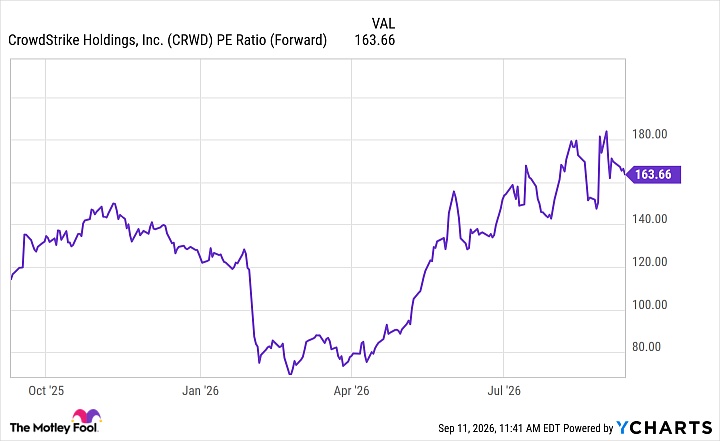
CRWD PE Ratio (Forward) data by YCharts.
If cybersecurity really is AI's next big market, CrowdStrike is already established and built to compound, while frontier labs still demo their models. The case for buying and holding CrowdStrike is not that the multiple suddenly becomes a bargain tomorrow. It is that AI is only just beginning to transform the cybersecurity landscape, and CrowdStrike is already collecting rent at the intersection Huang just pointed out.