

China Index Academy: As of August 2025, 20 distressed real estate companies have received approval for debt restructuring and reorganization, with debt relief exceeding 1.2 trillion yuan
 I'm LongbridgeAI, I can summarize articles.
As of August 2025, the debt restructuring and reorganization of 20 distressed real estate companies have been approved, with a total debt relief scale exceeding 1.2 trillion yuan. Since 2020, more than 70 real estate companies have experienced debt defaults, and 27 listed real estate companies have been forced to delist, with some companies choosing to divest their real estate development businesses to cope with market shocks
According to statistics from the China Index Academy, as of August 2025, 20 distressed real estate companies have had their debt restructuring and reorganization approved, with a total debt relief scale exceeding 1.2 trillion yuan. The market has been deeply impacted, significantly affecting the operations of real estate companies. Since 2022, 27 listed real estate companies have been passively delisted, and several others have been privatized and delisted. Due to the need for proactive transformation and passive shell protection, many listed companies have divested their real estate development businesses, exiting the real estate sector or transforming into light asset models.
- Some distressed real estate companies' debt restructuring and reorganization approved
According to statistics, as of August 2025, companies that have completed domestic and overseas debt restructuring include Sunac, R&F, Aoyuan, Yuanyang, Times China, and Longfor. Companies that have completed overseas debt restructuring include Zhongliang and Contemporary. Companies that have had their overseas debt restructuring approved include CIFI, Kaisa, Jinlun Tiandi, Yuzhou Properties, Shimao, Greenland, and Country Garden.
In June 2025, Xinhua Union completed its reorganization. Hohhot Coal Longxing Real Estate Company’s reorganization has been approved. Jinke and Xiexin Yuanchuang are undergoing reorganization, which has been approved by the court and is currently in the execution phase. As of now, 20 distressed real estate companies have had their debt restructuring and reorganization approved, with a total debt relief scale exceeding 1.2 trillion yuan.
Table: Status of Debt Restructuring or Reorganization Approved for Distressed Real Estate Companies
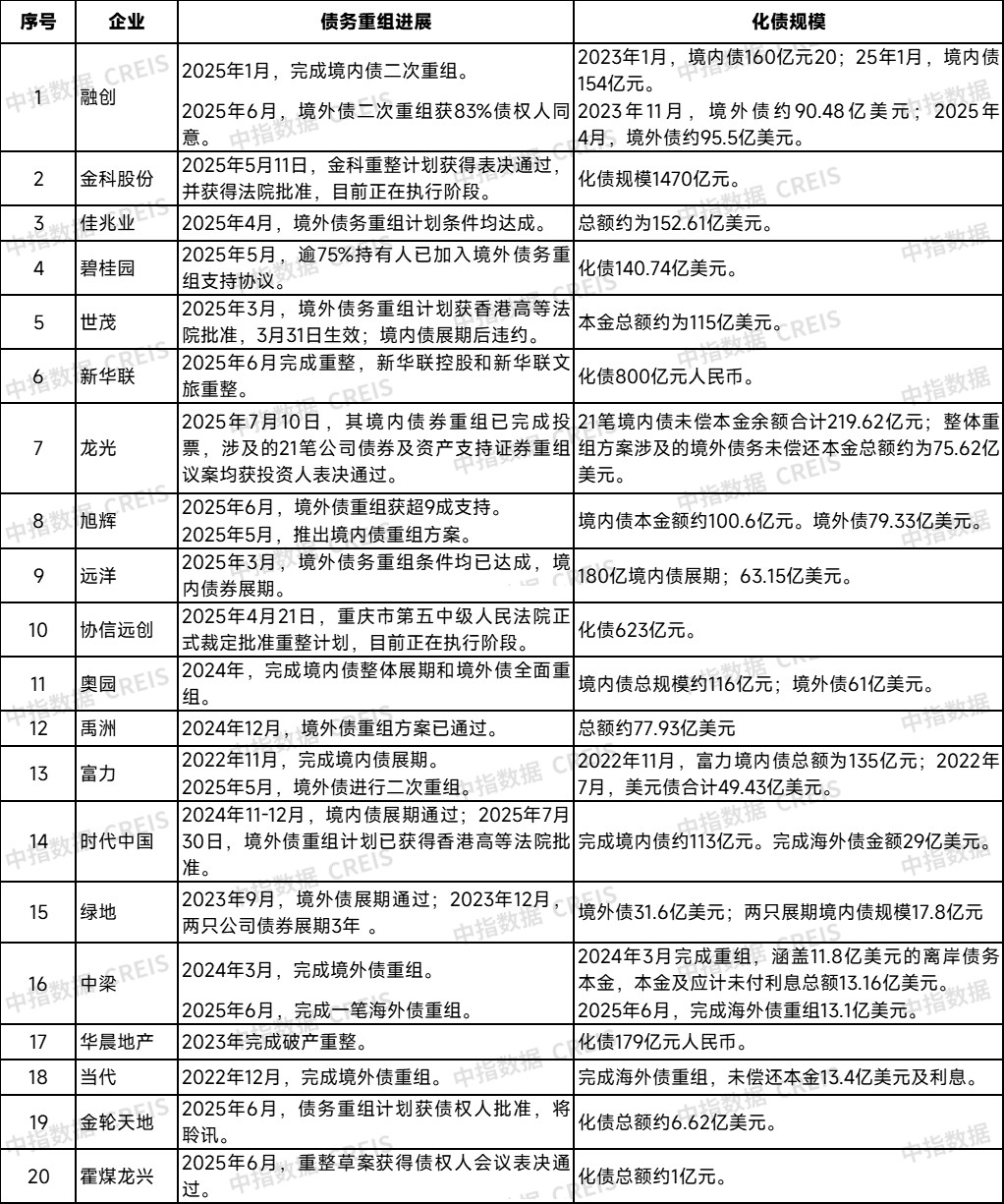
Source: Compiled from public information
- 30 listed real estate companies delisted, many divesting real estate development businesses
From 2020 to 2025, over 70 real estate companies have experienced debt defaults. Debt defaults began to appear in real estate companies in 2020, with the number of defaults significantly increasing to 16 in 2021, and intensively erupting to 44 in 2022. According to statistics, as of August 2025, a total of 77 real estate companies have experienced debt defaults.
The deep market impact and multiple debt defaults have significantly affected the operations of real estate companies. Since 2022, 27 listed real estate companies have been passively delisted, including 14 from the A-share market due to face value delisting and continuous losses; and 13 from the H-share market due to difficulties in issuing financial reports and failing to meet resumption guidelines, resulting in a suspension of trading for over 18 months. Additionally, a few listed real estate companies have been privatized and delisted.
In recent years, due to the need for proactive transformation and passive shell protection, many listed companies have divested their real estate development businesses, such as Lushang Development, Zhuhai Mian Group, and Guancheng New Materials, which have exited the real estate sector or transformed into light asset models.
Table: A+H Passive Delisted Real Estate Companies from 2022 to August 2025
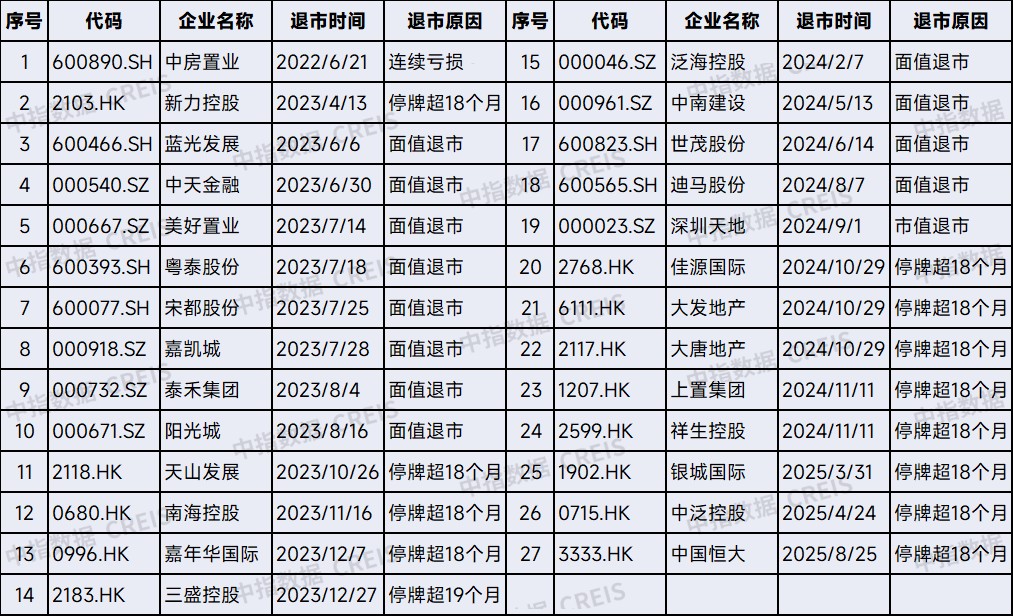
Source: Compiled from public information Three, Over 60% of Listed Real Estate Companies Expected to Report Losses in the First Half of 2025
As of August 20, among the listed real estate companies in Shanghai and Shenzhen, 71 have released their performance forecasts for the first half of 2025, with 45 companies expected to report losses, accounting for 63.4%. This is an increase of 1.1 percentage points compared to the same period last year. The performance of listed real estate companies is generally poor, with some companies expected to incur losses exceeding 10 billion yuan.
The main reasons for the performance losses of listed real estate companies include: a significant decline in project settlement scale, low gross profit margins; new provisions for asset impairment; some large asset transactions and equity transaction prices being lower than book value; and an increase in interest expenses on interest-bearing liabilities.
Figure: Proportion of Performance Forecast Types for Listed Real Estate Companies in Shanghai and Shenzhen from 2021 to 2025
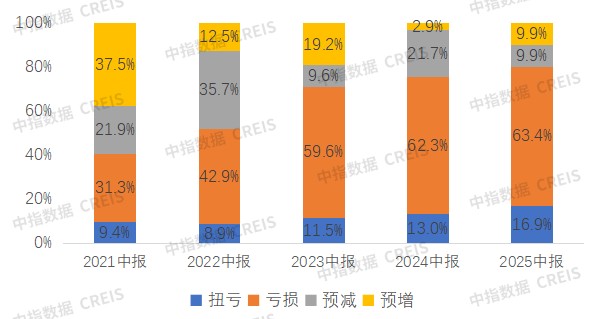
Data Source: China Index Academy CREIS