

The Semiconductor Equipment ETF China Merchants (561980) rose over 6%! Chief Yan Fan: Equipment materials are entering a prosperous cycle of both volume and price increases
 I'm LongbridgeAI, I can summarize articles.
On June 9th, driven by the surge in U.S. tech stocks and a series of positive news, the A-share semiconductor equipment and materials sector saw a significant rise. Yan Fan, Chief Analyst at China Merchants Securities, pointed out that the industry has entered a prosperous cycle of both volume and price increases. NAURA and others have achieved technological breakthroughs, Changxin Storage has increased its procurement of domestic equipment, and UBS has raised its target price. On the overseas front, SK Hynix is expanding production, NVIDIA is urging further expansion, and SEMI data shows that global semiconductor equipment shipments have reached a record high, with AI-driven capacity continuing to expand
Semiconductor Equipment ETF China Merchants (561980) rises over 6%! Chief Analyst Yan Fan: Equipment materials enter a prosperous cycle of both volume and price increase.
On June 9th, driven by the strong performance of U.S. tech stocks overnight, Japanese and Korean chip stocks surged significantly, with SK Hynix rising nearly 16% and Samsung Electronics up nearly 9%. In the A-share market, multiple semiconductor equipment and material stocks hit the daily limit, with Shanghai Silicon Industry, Jing Sheng Co., and Fu Chuang Precision all hitting the limit at 20%, while Zhongjing Technology and Li Ang Micro hit the limit at 10%. Zhongwei Company, NAURA, Tuo Jing Technology, and Nanda Optoelectronics also saw collective gains.
In terms of ETFs, by the close, Semiconductor Equipment ETF China Merchants (561980) rose 6.71%, and China Merchants Sci-Tech Innovation 50 ETF (588300) rose 4.67%. On the index level, the Shanghai Composite Index reclaimed 4000 points, with the Sci-Tech Innovation 50 Index and ChiNext Index rising 4.17% and 3.93%, respectively.
With news catalysts intensifying, NAURA and Huahai Qingshi made significant breakthroughs in panel-level packaging de-bonding equipment and fully automated board-level CMP mass production equipment, respectively; domestic Changxin Storage's equipment procurement demand in the second quarter reached USD 5-6 billion, planning to prioritize the purchase of domestic equipment; UBS significantly raised the target prices for NAURA, Zhongwei Company, and Shengmei Shanghai by 34%-48%.
On the overseas front, SK Hynix is doubling its production capacity over five years, NVIDIA urges further expansion, and storage shortages are expected to continue until 2030; TSMC is facing insufficient capacity, Google has placed orders for over 3 million TPUs with Intel, and NVIDIA is also evaluating its 18A process; Musk stated that "the real bottleneck is in chip manufacturing capacity."
In terms of industry data, WSTS expects global semiconductor growth to reach 90% by 2026, reaching USD 1.5 trillion, primarily driven by memory chips, with a year-on-year increase of 250%. SEMI data shows that global semiconductor equipment shipments in Q1 2026 are expected to reach USD 36.55 billion, a year-on-year increase of 14%, with quarterly sales hitting a record high, driven by capacity expansion and technological upgrades in AI-related advanced logic chips, DRAM, and advanced packaging.
Market attention to semiconductor materials and equipment continues to rise. In early June, during the China Merchants Fund roadshow titled "Chief Connection: How to View the Semiconductor Market After the Tau τ Law Breaks the Chip Situation?", Yan Fan, Chief Analyst of the Electronics Industry at China Merchants Securities, systematically explained the industrial logic of the current semiconductor equipment sector.
【Roadshow Highlights】
1. What is the core driving force behind the chip sector leading the market? How does the industrial chain transmit?
Yan Fan pointed out that the core driving force behind the chip sector leading the market in 2026 mainly comes from the resonance of three main lines:
First, the demand for AI computing power continues to exceed expectations, as the global AI industry extends from model training to inference, with cloud vendors continuously increasing capital expenditures, directly driving the demand for GPUs, ASICs, and high-end memory chips;
Second, memory chips are entering a super cycle of price increases, with NAND Flash contract prices estimated to increase by 58-63% quarter-on-quarter in the second quarter, as leading manufacturers continue to raise quotes, and the supply shortage and price increase trend spreads layer by layer from memory to the entire industrial chain The third point is that domestic substitution combined with the IPO of the two storage companies forms a capital catalyst. The two leading storage companies have achieved capacity expansion through large-scale financing, directly driving an increase in orders for upstream equipment, materials, and packaging and testing.
In terms of transmission rhythm: the mismatch between supply and demand combined with the IPO of the two storage companies catalyzes, storage takes the lead as the "starting gun"; subsequently, it transmits to packaging and testing, where advanced packaging capacity is in short supply, and major manufacturers begin to raise prices; next, it spreads to equipment and materials, with storage manufacturers expanding production and the construction of advanced logic production lines advancing simultaneously, and finally, the strategic value of wafer foundry is undergoing a systematic reassessment.
2. Behind the accelerated IPO of Changxin and Changchuan, what differences does this round of storage cycle reflect?
The accelerated IPO of the two storage companies is a strategic positioning in the context of a paradigm reconstruction in the global storage industry. Compared to previous cycles, this round of storage cycle has three major differences:
First, the demand side has shifted from consumer electronics to AI-driven structural long-term growth, with downstream companies focusing on long-term contracts to secure supply, raising the price center and reducing volatility; storage is evolving from a strong cyclical industry to a growth industry with cyclical characteristics.
Second, HBM is reshaping capacity allocation, with the three major manufacturers actively shifting advanced capacity towards HBM and DDR5, providing a development window for domestic storage manufacturers.
Third, geopolitical dual-track dynamics, domestic storage enjoys structural protection in the domestic market, which is a completely new industrial environment that did not exist in previous cycles.
According to Apacer data, this year the DRAM supply-demand gap is around 8%, and the NAND supply-demand gap is around 5%. The current industry supply-demand tightness may continue until 2027. In the global landscape, for DRAM, in Q1 2026, Samsung/Hynix/Micron's shares were 38%/29%/22% respectively, with HBM dominated by SK Hynix exceeding 50%. Changxin Technology's global share has risen to about 8% and is breaking through 10%; for NAND, Samsung/Kioxia/Hynix/SanDisk/Micron's shares were 30%/18%/15%/14%/12%, with Yangtze Memory's global share expected to be around 10%.
3. How will the expansion of the two storage companies drive demand for equipment/materials?
First, the expansion of the two storage companies is very certain. Changxin has passed the meeting on May 27, planning to raise 29.5 billion yuan, of which 7.5 billion yuan will be invested in the upgrade and transformation of production line technology, 13 billion yuan in DRAM technology upgrade projects, and 9 billion yuan in forward-looking research and development; Changchuan completed its IPO counseling filing on May 19. This means that both companies will enter a "operating cash flow + capital market financing" dual-drive phase, significantly enhancing the certainty of capacity expansion.
It is predicted that the current round of expansion will drive demand for equipment and materials not only from capacity expansion but also from the increase in unit investment brought about by technological upgrades. Whether it is the evolution from DDR4 to DDR5, the advancement of HBM, or the promotion of high-layer 3D NAND, equipment manufacturers can obtain higher value amounts under the same scale of capacity expansion, simultaneously benefiting from both "volume" and "price" increases. ** This also gives equipment manufacturers stronger performance elasticity and profit improvement space in the future storage expansion cycle.
4. What is the current level of domestic production rate for semiconductor materials and equipment?
According to the sales revenue of semiconductor equipment in China and the revenue estimates of major equipment manufacturers, the overall domestic production rate of equipment has increased from 9% in 2021 to 21% in 2025. In terms of the potential for domestic production improvement, the current overall domestic production rate of domestic wafer fabs is still at a relatively low level: cleaning 50%, CMP 40%, thermal treatment 40%, etching 30%, thin film deposition 30%, while coating and developing is about 5%, and inspection and measurement is below 10%, indicating significant room for future substitution. Overall, the growth logic of domestic equipment comes not only from the increase in domestic share but also from the growth in equipment value driven by the complexity of processes, which still has continuous expansion space under the background of domestic storage and advanced process expansion.
In terms of semiconductor materials, domestic production has entered the stage of 1→10 from the initial stage of 0→1, with breakthroughs in several sub-segments such as CMP polishing liquids/pads, target materials, photomasks, and silicon components for etching, entering a chain of verification—repeat orders—share increase, although the overall industry caliber has not yet fully reflected this.
From the perspective of future improvement logic, the space for material domestic production mainly comes from three aspects: first, the domestic logic, with continuous expansion of storage and advanced packaging production lines, directly increasing the total material consumption; second, process upgrades, higher levels of 3D NAND, HBM, and advanced packaging volume driving the increase in unit wafer material value; third, the heightened requirements for supply chain security make wafer fabs more willing to allocate shares for verified domestic materials.
5. What impact do overseas restrictions and the exit of the first and second phases of the big fund have on the sector, and what about the third phase?
The impact of overseas restrictions can be viewed in two layers: short-term shock and long-term catalyst. In the short term, export controls impact the capital expenditure and verification cycle of wafer fabs, but in the medium to long term, they can force domestic substitution from "optional" to "necessary," accelerating wafer fabs' adoption of domestic equipment and materials, especially benefiting mature process equipment, components, and electronic materials.
Regarding the big fund, the exit of the first and second phases should not be simply understood as a bearish outlook on the industry, but rather as a normal part of the investment recovery of industrial funds. The scale of the third phase is further expanded, introducing long-term funds such as state-owned banks, central finance, and local state-owned assets into the shareholder structure, with the strategic direction shifting from purely supporting capacity expansion to tackling "bottleneck" areas such as equipment, materials, core components, and computing power chips, of which about 70% is directed towards domestic equipment and material production and 30% towards advanced packaging and AI storage, with forward-looking layouts in AI chips and embodied intelligence, expected to support the domestic substitution process through long-term funding support and industrial resource tilt.
6. Is the 80 times PE of domestic equipment a "bubble" or "growth discount"?
The valuation of leading domestic equipment companies needs to be understood from two lines. First, the expansion of domestic wafer fabs is still ongoing, and mainland China remains the largest semiconductor equipment market in the world, maintaining a global sales share of 30%-40%, with the construction of storage, logic, and mature process production lines continuing to drive equipment demand Second, domestic equipment companies have also gained market share due to the increase in localization rates, with revenue coming not only from industry expansion but also from import substitution.
Currently, domestic equipment companies are still in a phase of high R&D investment, and profit margins have not yet fully stabilized, making static PE appear relatively high. In the future, as customer validation increases, product platformization progresses, and economies of scale are realized, expense ratios are expected to decline, and profitability will gradually materialize. Therefore, the key to valuation digestion is not simply relying on stock price declines, but rather digesting through order growth, revenue expansion, and margin improvement.
7. Recently, semiconductor equipment has experienced high volatility; how to distinguish between "trend corrections" and "phase peaks"?
Yan Fan believes that ordinary investors should focus on whether there has been a substantial change in the fundamental logic of the industry when judging the nature of the current adjustment in the semiconductor sector. If the mainline logic, such as the advancement of the localization process, the implementation of relevant policies, and the expansion of capital expenditures by wafer fabs, has not shown significant changes, the nature of the short-term correction is relatively mild.
For future participation, it is recommended to avoid chasing prices during phases of obvious exuberance in the sector, and consider maintaining a basic position and participating in batches; for investors with limited individual stock research capabilities, moderate participation through semiconductor-related ETFs can help diversify the concentrated risks of individual stocks; investors with in-depth research capabilities should focus on leading companies in niche areas with technological barriers and strong order certainty.
The following content organizes the semiconductor equipment ETF China Merchants (561980) and invites Yan Fan, Chief Analyst of the Electronics Industry at China Merchants Securities, to present a live roadshow on June 3 titled "Chief Connection: How to Break the Chip Dilemma with Tao's Law, and What to Expect in the Semiconductor Market?"
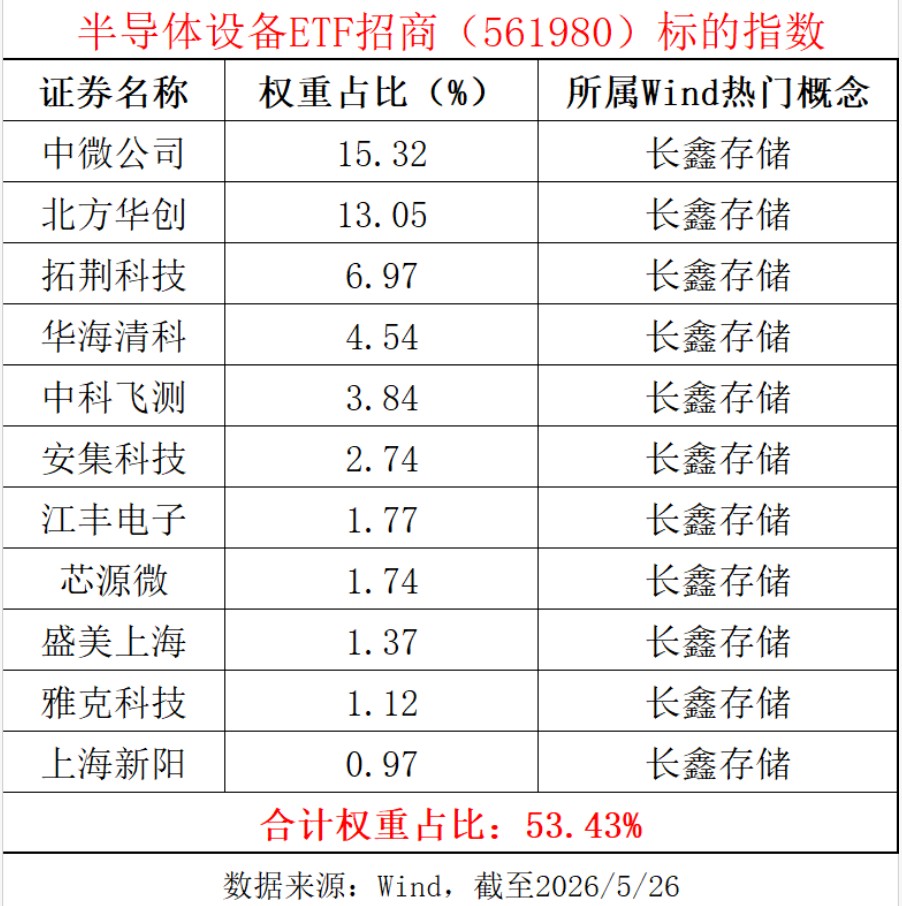
According to data from the China Securities Index official website, the semiconductor equipment ETF China Merchants (561980) tracks the China Securities Semiconductor Industry Index, covering core equipment companies such as Zhongwei Company, NAURA, and Tuojing Technology, as well as leading materials companies like Nanda Optoelectronics and China Shipbuilding Special Gas, and leading chip design/manufacturing companies like Cambrian, Haiguang Information, and SMIC, with a top ten concentration of 75%. The component stock "Changxin Storage" accounts for about 53%, benefiting significantly from the large cycle of storage expansion.
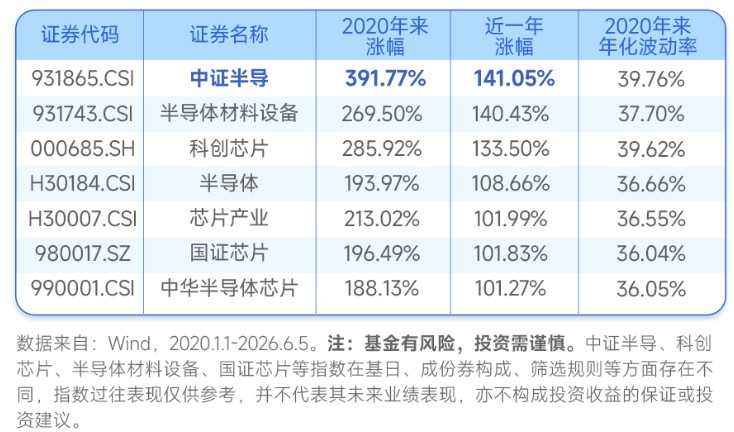
Data shows that as of June 5, this index has increased by over 390% since 2020 and over 140% in the past year, ranking first among similar indices such as sci-tech chips and semiconductor materials and equipment, showing a higher rebound sharpness.
Risk Warning: Funds carry risks, and investments should be made cautiously. The above views, opinions, and ideas are based on the current situation and may change in the future. No substantial guarantee or commitment is made regarding the authenticity, completeness, and accuracy of the views or information quoted from securities companies and other external institutions This material is for promotional purposes only and does not constitute any legal documents. Fund performance is subject to volatility risk, past performance does not indicate future results, nor does it constitute a guarantee of investment returns or investment advice. The performance of other funds managed by the fund manager does not guarantee the performance of this fund. Please read the "Fund Contract" and "Prospectus" and other legal documents of the fund carefully before investing, fully understand the risk-return characteristics of the fund products, and make independent decisions on fund investments based on your own risk tolerance, investment horizon, and investment objectives, after understanding the product situation and listening to the suitability opinions of the sales institution, and choose suitable fund products. The fund products are issued and managed by China Merchants Fund, and the distribution institutions do not bear the responsibility for investment, redemption, and risk management of the products. Specific risks of this product are detailed in the risk disclosure section of the fund's "Prospectus" in the announcement section on the company's official website https://www.cmfchina.com. Investors can check their fund transactions, holdings, and returns through the mobile client, official website, and other channels provided by the fund manager or distribution institutions.