The first batch of "gift givers" has already hit a mine
 I'm LongbridgeAI, I can summarize articles.
As e-commerce platforms have successively launched the "gift-giving" feature, the market response has been less than expected. Although the number of gift orders via WeChat red envelopes saw a significant increase during the Spring Festival, user feedback has mostly been negative, primarily focusing on after-sales issues and cultural adaptability. Many consumers expressed disappointment after trying it, believing that the gift-giving feature has turned into a "money-for-lessons" experience, and frequently reminded others to "avoid pitfalls" on social media
In 2025, the first rapidly "unexpected" feature is likely to be "gift giving."
Since WeChat's mini-store launched the "gift giving" feature last December, e-commerce platforms such as Douyin, Taobao, JD.com, and Meituan have all followed suit, hastily introducing their own gift-giving functions. From Christmas to New Year's Eve, and then to the Spring Festival, it seems that every occasion is providing an opportunity for this feature to gain popularity. However, despite the hype, it has not generated significant waves.
Although some data shows that during the Spring Festival, the order volume for WeChat blue packet book categories increased by over 10,000% compared to the previous period, and WeChat mini-store's sales reached nearly one million yuan in just two days, a look at major social media platforms reveals a more realistic picture: some are curious to try but find it difficult to resolve after-sales issues; some are just looking to "take advantage" by gifting themselves; and many others, constrained by the profound gift-giving culture, do not choose this method of gifting.
Ten years ago, WeChat carved out a path in the payment sector with "red envelopes," but this time, the trend sparked by WeChat's "blue packets" seems to be limited to interactions among vendors.
Gift Giving Becomes "Paying for Lessons"
"Definitely do not use the WeChat mini-store gift giving feature."
"Never click the gift button on Taobao."
"Avoid the gift giving feature."
……
Perhaps the major e-commerce platforms did not anticipate that, nearly three months after the launch of the "gift giving" feature, the most common keywords in related feedback on social media are "avoid" and "discourage."
Before New Year's Day, a netizen named "Yuyu," with a mindset of giving it a try, used the WeChat mini-store's gift giving feature to send a box of chocolates to a friend, "equivalent to sending a small New Year's red envelope."
However, Yuyu did not expect that this gift-giving experience would turn into a source of frustration for himself. He posted on social media stating, "The details page said 48 hours for delivery, but it has now dragged on for 6 days. I contacted the seller with no results, couldn't get a shipping time, and they just closed the conversation. When I asked again, they said, 'You can go for a refund,' but only the recipient can initiate the refund for gift giving, so I have to ask the recipient to handle the refund. The official customer service of the WeChat mini-store couldn't solve the problem either; everyone should definitely avoid this."
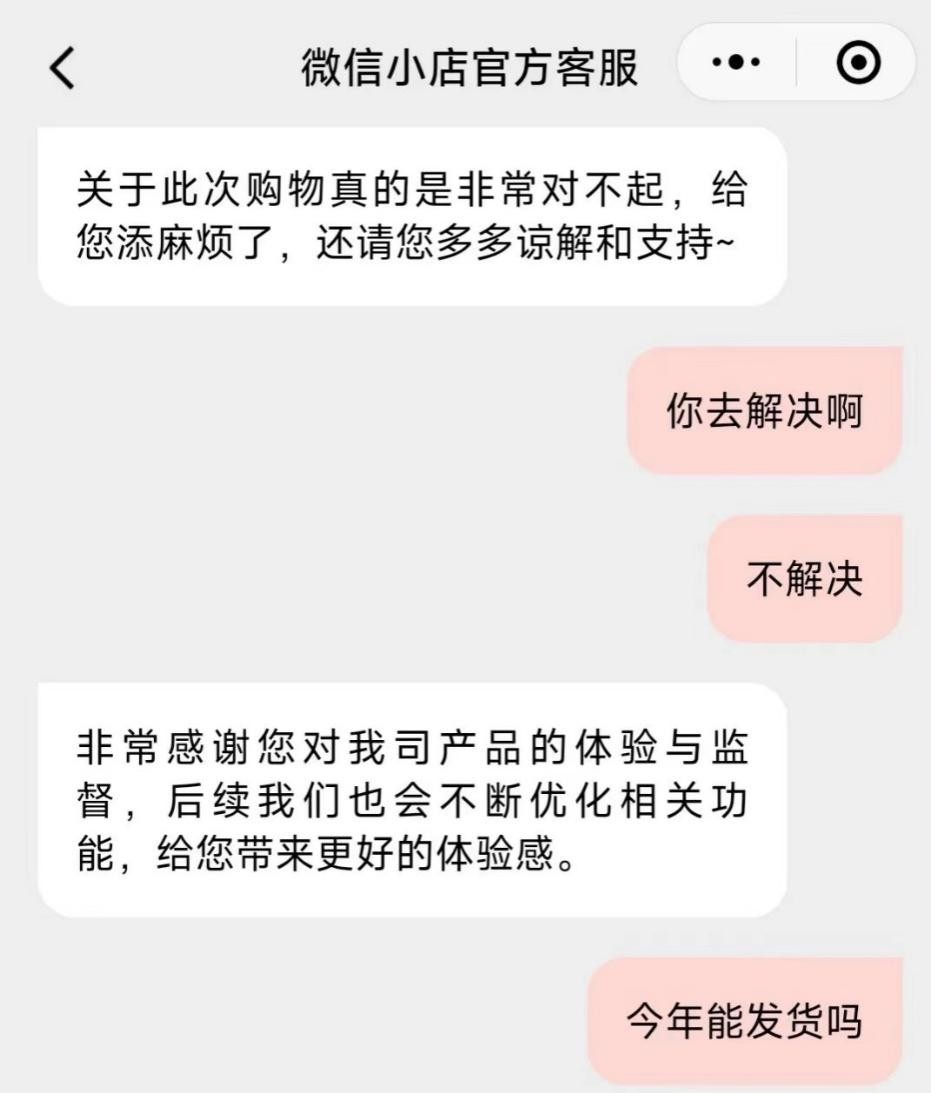 WeChat mini-store customer service response
Image source: WeChat mini-store screenshot
Under this post, many shared similar experiences. Some netizens mentioned, "The birthday gift for my partner is no longer available in the mini-store, and I can't see the logistics," "The gift I bought took a long time to ship, and when it arrived, it was the wrong color," "They returned my package halfway through delivery, and the customer service for gift delivery didn't respond," "I bought something for a friend for the Spring Festival, and he bought something for me too, but the seller said it would ship by February 6 at the latest. When I asked the seller why it hasn't shipped yet, they just ignored me"...
This is not just a problem unique to the WeChat mini-store. At the end of January, Jin Xin (pseudonym) discovered while browsing Taobao that many products were marked "supports gift giving" and offered "15% off," so he tried to order a pair of socks. "Unexpectedly, it was only ten yuan, but I ended up in a difficult refund situation."
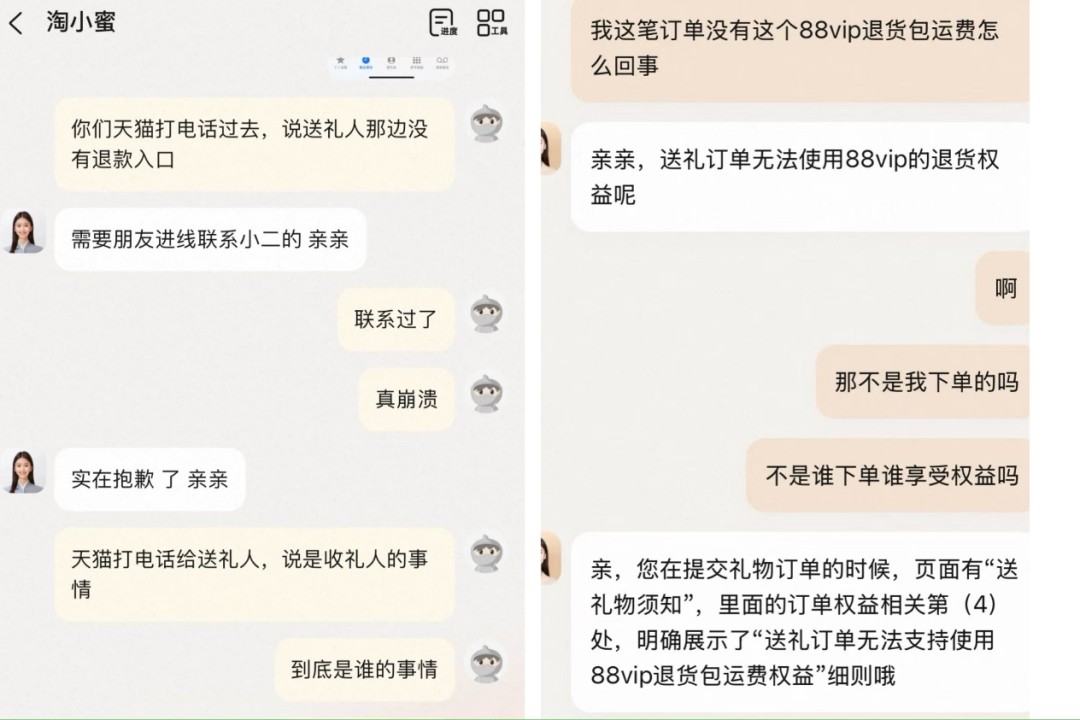 Refund difficulties with the gift-giving feature
Image source: Taobao
Jin Xin discovered after placing an order that the seller had falsely shipped the item, and the logistics information had not been updated. When she contacted Taobao customer service, they stated that the recipient needed to apply for a refund. However, after the recipient applied for a refund, the merchant immediately rejected it. When the recipient contacted Taobao platform customer service, they received a response saying, "The gift giver needs to contact us." Thus, "the Taobao assistants on both sides were just passing the buck, while the store's after-sales service was silent." The only thing Jin Xin was relieved about was, "Fortunately, it was a cheap item; if it were an expensive one, I don't know how frustrating it would be."
This is not an isolated case. On Xiaohongshu, some users also mentioned, "I also used this feature, wanted to return the item I bought, but there was no operation entry for returns and refunds." "I used this twice; once the seller stopped the logistics, and when I found out, the seller said they would resend it. The other time, they just didn't ship it, and despite my repeated prompts, they still didn't send it."
In addition to difficulties with returns and exchanges and delays in shipping, some consumers have encountered some mix-ups, such as "the item I bought was picked up by someone else (a stranger)..."
In fact, after-sales issues have indeed deterred many "first batch of consumers." Jin Xin stated, "Currently, as long as you use this gift-giving feature, once there is an after-sales issue, it becomes very troublesome to resolve. It feels like this feature was launched without any training for the customer service system."
The end is still about taking advantage and exploiting
Some may wonder, why would you need to return a gift? In fact, compared to heartfelt gift-giving, many people are using the excuse of giving gifts to take advantage.
Since many products on Taobao support "gift-giving, enjoy an 8.7% discount," many consumers place orders with their main accounts and send them to their secondary accounts, effectively buying for themselves at a discounted price. Some users also mentioned, "You can send it to a friend and have them fill in your address." On social media platforms like Weibo and Xiaohongshu, many notes related to "Taobao gift-giving" are linked to "taking advantage," with one titled "No need to meet the minimum for discounts" stating, "This new gift-giving feature directly offers a painless 15% discount, which has now changed to a 10% discount, but it is still very suitable for those who only want to buy one item, no need to worry about meeting the minimum for discounts... I just fill in my own address, and the main and secondary accounts send to each other."
Additionally, since Taobao previously offered a "free shipping privilege" for gift orders for a limited time, many people took the opportunity to save on shipping costs. "A store I wanted to buy from previously didn't offer free shipping, but I suddenly found out that gift-giving could be free shipping, so I quickly placed an order," one user mentioned.
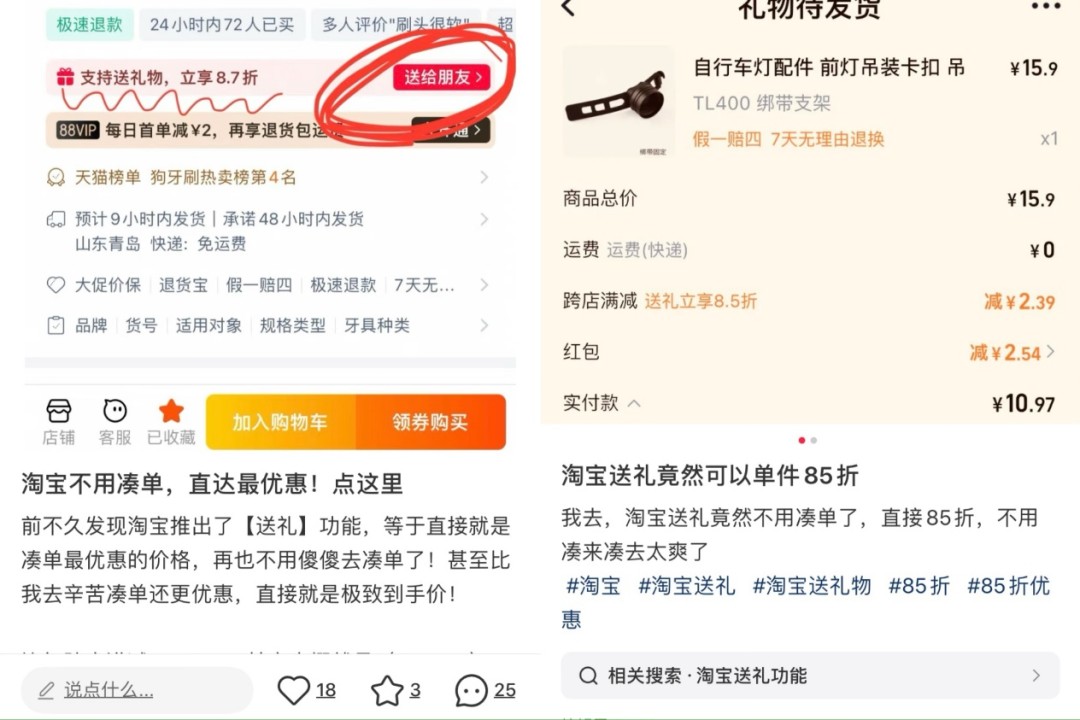 Image source: Xiaohongshu
This is actually a microcosm: Nielsen Aico's survey shows that self-gifting has surpassed gifting to partners and parents, becoming the primary purpose of gift-giving. Undoubtedly, self-indulgent consumption is on the rise, which runs counter to the social function that "gift-giving" aims to expand.
Image source: Xiaohongshu
This is actually a microcosm: Nielsen Aico's survey shows that self-gifting has surpassed gifting to partners and parents, becoming the primary purpose of gift-giving. Undoubtedly, self-indulgent consumption is on the rise, which runs counter to the social function that "gift-giving" aims to expand.
Even so, some netizens summarized that "this function seems very convenient, but there are traps everywhere." She mentioned, "Gift orders cannot be exchanged, and the gift giver cannot see the logistics information; gift discounts are the same as Taobao's full reduction, and there is no discount; gift orders cannot use 88vip to refund shipping fees; gift orders do not support price difference refunds... In summary, it's better to just meet the full reduction."
However, not all platforms' "gift-giving" has become a way to "take advantage." On the contrary, some merchants in WeChat stores are using this to "harvest leeks." According to media reports, many WeChat gifts in WeChat stores actually come from Pinduoduo, and merchants profit from the price difference.
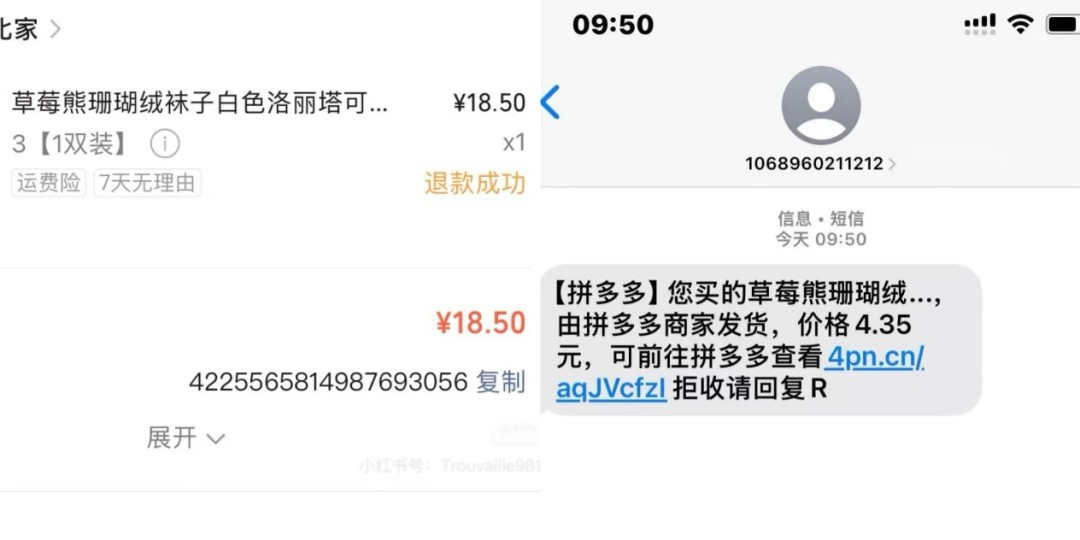 1 Placing an order in a WeChat store but receiving shipping information from Pinduoduo
Image source: Pinduoduo screenshot
For example, a netizen received a WeChat gift sent from "Little Beaver Loopy Wallet," and she received a shipping message from Pinduoduo showing a price of 4.58 yuan, while her friend purchased it for 19.9 yuan; another netizen sent a 15.8 yuan AD calcium milk to a friend, but the shipping message from Pinduoduo showed a price of 13.2 yuan; yet another netizen bought coral fleece socks for a friend priced at 18.5 yuan, but the shipping information from Pinduoduo showed a price of 4.35 yuan...
E-commerce Does Not Understand Gift-Giving Culture
However, the "gift-giving" function's "cold reception" may be mainly due to the difficulty in cultivating this consumption habit. After all, China's gift-giving culture is profound.
Firstly, the gift-giving functions launched by major platforms mostly require the recipient to fill in their address for privacy protection reasons. The steps are relatively cumbersome. For example, on Taobao, users open the app, select products marked with "support gift-giving," click the "send gift" button at the bottom of the product page, complete the order payment, and directly click "send to a friend," which generates a Taobao code, QR code, and other sharing options to share the gift through multiple social methods. The recipient copies the shared link into the Taobao app, opens the gift, fills in the shipping address and a 4-digit security code, and can then receive the gift. The gift must be claimed within 24 hours, or it will automatically expire.
"When you genuinely want to give someone a gift, you generally want to surprise them, but with this method of gift-giving, the recipient can see the product information, which takes away some of the mystery. Moreover, the steps to claim the gift are quite cumbersome; it would be easier for the gift giver to fill in the address directly." As one netizen commented, "After all, if it's a gift for someone close, you definitely know their address."
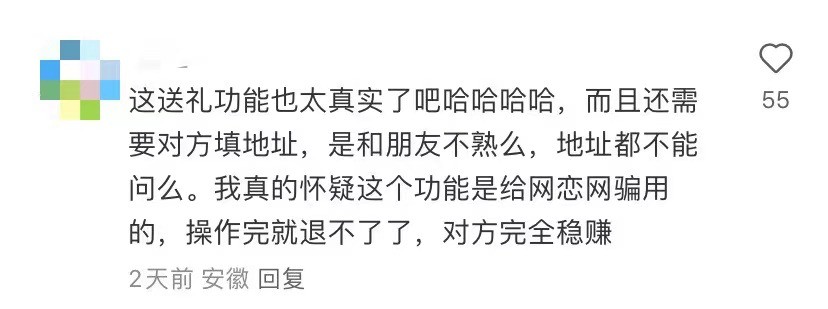 Complaints from netizens on Xiaohongshu
Image source: Xiaohongshu
Secondly, the scenarios applicable for this gifting method are very limited. Some netizens sharply commented: “Business gifting scenario: Now that anti-corruption and integrity are emphasized, if gifts are to be sent, they should be directly sent to the company address of the client, and in bulk, this function is not useful” “This cannot be used for gifting to leaders, because WeChat leaves a trace”... What about gifting between close relationships? Another netizen mentioned, “The quality of gifts cannot be guaranteed, which can easily backfire” “When pursuing others, the most important thing about gifting is to meet in person; sending gifts without meeting will greatly reduce the effect”...
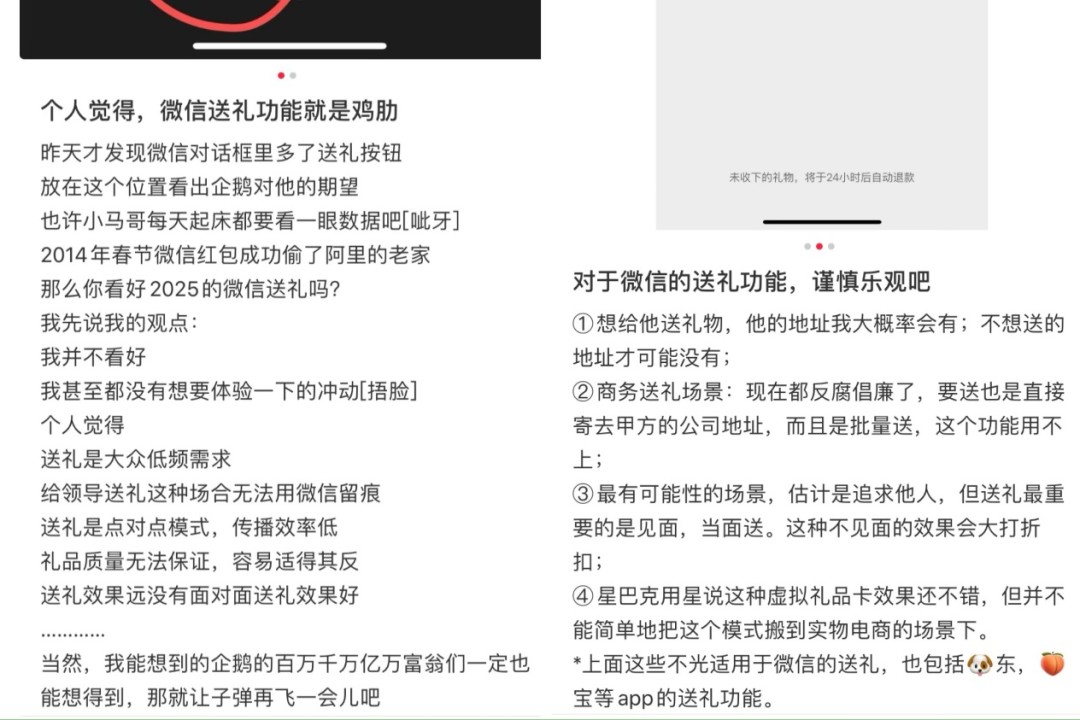 Image source: Xiaohongshu
Thus, although from WeChat's official data, during the Spring Festival, the order volume for leisure snacks, candies/chocolates, plush/fabric items, and similar products was strong, and books, such as classic works and parenting encyclopedias, saw a more than 10,000% month-on-month increase in gifting orders.
However, according to “Most Talk FunTalk,” a merchant in Shanghai mentioned that in their small shop, the proportion of “gifting orders” that were accepted was about 68%. A video account MCN operator reported on their WeChat public account that a WeChat small shop had 1,013 gifting orders during the New Year period, with 469 orders for accepted gifts, and half of the gifts were returned.
At the 2025 WeChat Open Class PRO, WeChat explained the gifting function: on one hand, it utilizes the spread and endorsement of social relationships to create a chain reaction, promoting gifts and products. This method reduces the cold start costs for merchants and provides more survival opportunities for small businesses; on the other hand, through a socialized consumption model, it innovates the driving force of shopping, which is expected to have an immeasurable market impact.
However, from the current perspective, if the gifting function wants to create a new wave, it may first need to understand the nuances of the gifting culture among Chinese people.
This article is reproduced from Zinc Scale (ID: znkedu) with authorization, copyright belongs to Zinc Scale, and translation or reproduction without permission is prohibited.
The "2023 China Consumer Brand Growth Power White Paper" is now on sale for 398 yuan with free shipping to your home!
2023 is the year of consumption recovery in China and also the year of rebooting for Chinese consumer brands under the overall recovery trend. Although the impact of the pandemic is gradually fading, the challenges posed by the times to brands have not diminished in the slightest. The “visiting China wave” of foreign executives in the first half of 2023 once again confirms the attractiveness and importance of the Chinese market, which also means that Chinese consumer enterprises have entered a new stage of comprehensive competition How should Chinese consumer brands understand the challenges and risks brought by environmental changes? How to identify and capture the signals released by various factors? And how to achieve resilient growth through cautious adaptation?
After more than 130 days of effort, CBNData has released the "2023 China Consumer Brand Growth White Paper" (hereinafter referred to as the "White Paper"), totaling over 200,000 words, and it is currently on hot sale! Click here or the image below to purchase, with free shipping to your home!