

Tencent reduces its stake in KUAISHOU: a capital "rebalancing" or a prelude to exit?
 I'm LongbridgeAI, I can summarize articles.
On July 6, 2026, Tencent sold approximately 273 million shares of KUAISHOU through an over-the-counter block trade, reducing its stake from 15.68% to 9.37%, officially exiting the ranks of major shareholders. Based on the closing price, this is estimated to cash out around HKD 12.556 billion. Following the announcement, KUAISHOU's stock price plummeted by 11.48%. This move is seen as an adjustment in Tencent's investment strategy, and the market is concerned whether it is a prelude to an exit
On July 6, 2026, KUAISHOU (01024.HK)'s announcement disturbed market sentiment. The announcement revealed that its major shareholder Tencent (00700.HK) sold approximately 273 million Class B shares of KUAISHOU through an off-market block trade after the trading session on July 6, reducing its stake from approximately 15.68% to 9.37%, officially exiting the ranks of KUAISHOU's major shareholders. Based on the closing price of HKD 46.00 on that day, Tencent's reduction may have cashed out approximately HKD 12.556 billion.
After the news was released, KUAISHOU's stock price immediately fell, currently down 11.48%, which may reflect the market's attitude towards Tencent's reduction. Behind this reduction, is it a routine adjustment of Tencent's investment strategy, or a signal that KUAISHOU's long-term value is being re-evaluated?
From "Major Shareholder" to "Minor Shareholder": Tencent's Decade-long Relationship with KUAISHOU
Tencent's connection with KUAISHOU dates back to 2017. At that time, Tencent led KUAISHOU's Series D financing with USD 350 million, officially becoming an important shareholder. In the following years, Tencent continued to increase its stake in KUAISHOU through Series E, F, and multiple rounds of strategic investments, becoming the largest institutional shareholder before the IPO. KUAISHOU's prospectus shows that before the IPO, Tencent held a total of 21.567% of shares, and after KUAISHOU went public on the Hong Kong Stock Exchange in 2021, Tencent remained the top external institutional investor even after the issuance of new shares diluted its stake.
Since 2023, Tencent's shareholding has entered a continuous downward cycle: In April 2023, Tencent's managed fund distributed approximately 51.15 million shares of KUAISHOU to external partners without compensation, reducing its disclosed holding from 20.46% to 19.02%, but this change was not an active cash-out reduction by Tencent; in 2024, Tencent began multiple rounds of small-scale sales in the secondary market, culminating in this off-market block trade that reduced its stake by 6.31 percentage points, dropping its holding below the 10% major shareholder threshold on the Hong Kong Stock Exchange.
Comparison of Complete Exit: Lessons from JD.com and Meituan
Tencent's reduction in KUAISHOU inevitably brings to mind its handling of JD.com (09618.HK) and Meituan (03690.HK). Tencent's exit from JD.com and Meituan was through a "dividend-style reduction"—distributing its shares in kind to shareholders, nearly clearing its holdings and exiting the board.
At the end of 2021, Tencent announced that it would distribute approximately 460 million shares of JD.com as a mid-term dividend to shareholders, reducing its stake from 17% to 2.3%, effectively exiting JD.com and no longer being a major shareholder.
In November 2022, Tencent used the same method to distribute approximately 958 million shares of Meituan (about 90.9% of Tencent's holdings) to shareholders, causing its stake to plummet from 17% to less than 2%; Tencent's president, Liu Chiping, also resigned as a non-executive director of Meituan, similarly exiting the ranks of major shareholders.
In contrast, Tencent retained 9.37% of its shares in KUAISHOU, not reaching the "complete exit" stage. However, what the capital market is concerned about is—could this just be the first step? This is likely a significant reason for KUAISHOU's stock price pressure following the announcement Kuaishou AI: Infusing Blood While Drawing Blood?
Just four days before the reduction, on July 2, Kuaishou announced a restructuring, introducing an initial investment of RMB 13.8236 billion in cash capital into its wholly-owned Beijing KuaLing. After the transaction, its equity in Beijing KuaLing will be diluted from 100% to 68.33%. Based on this calculation, the valuation of Beijing KuaLing may be RMB 122.658 billion, approximately USD 18.054 billion. Among them, Tencent may subscribe RMB 681.57 million through Shanghai Qishan Investment and Parallel Mars, totaling RMB 1.363 billion, accounting for 1.12% equity and about 0.88% voting rights, slightly higher than Alibaba's (09988.HK) 1.11% equity and 0.87% voting rights, which also participated in the investment.
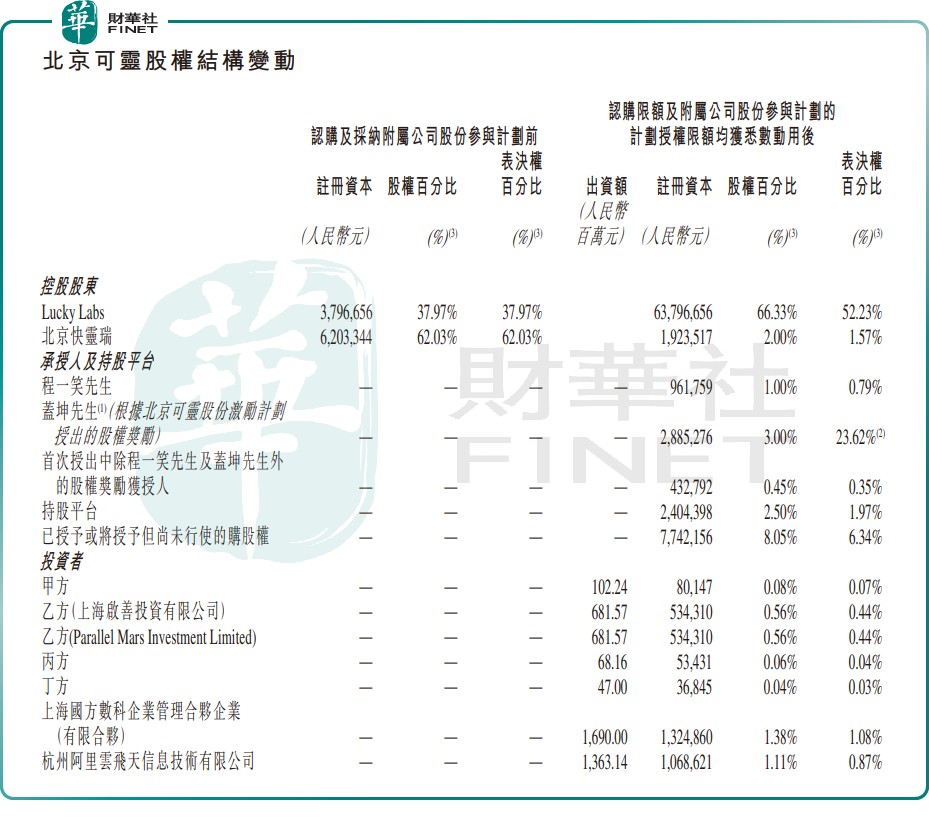
Beijing KuaLing is primarily engaged in the development and operation of the video generation large model KuaLing AI. Since the release of KuaLing AI 1.0 in June 2024, it has undergone more than 30 major version updates.
From a business structure perspective, Kuaishou is currently experiencing the growing pains of transitioning from old to new momentum. Its Q1 2026 performance shows that traditional main business live streaming revenue declined by 13.47% year-on-year to RMB 8.492 billion, while online marketing service revenue grew by 9.27% year-on-year to RMB 19.643 billion. Other service revenue benefited from the strong growth of KuaLing AI, with quarterly revenue increasing by 15.86% year-on-year to RMB 5.581 billion. KuaLing AI is regarded as a second growth curve, with Q1 revenue exceeding RMB 650 million, a year-on-year increase of more than three times. Kuaishou also revealed that in March 2026, KuaLing AI's annualized revenue run rate (ARR) was nearly USD 500 million. However, according to the data disclosed in the restructuring announcement, the AI business's losses are still expanding, with Beijing KuaLing's unaudited net losses for 2024 and 2025 being RMB 500 million and RMB 1.9 billion, respectively.
By restructuring to spin off KuaLing AI for independent financing, Kuaishou still indirectly holds about 68.33% equity and continues to consolidate its financial statements, which will not have a significant impact on its overall business performance. However, it can open up independent financing channels for its AI business, allowing external capital injection to share the R&D costs of AI and reduce the financial loss pressure on the parent company. At the same time, introducing other external investors may bring new resources, such as Tencent, Alibaba, and Baidu (09998.HK), which can provide possibilities for traffic, technology, and channel synergy for KuaLing.
Market Sentiment: Uncertainty Dominated by the "Sword of Damocles" Since the beginning of this year, KUAISHOU's stock price has fallen by more than 35%, and at the current price of HKD 40.72, its market value has shrunk to HKD 176.3 billion; after the announcement of this reduction, KUAISHOU's stock price plummeted by more than 11%. We believe that what truly frightens the market may be Tencent's potential further reduction actions. Based on Tencent's complete divestment from Meituan and JD.com, as long as the timing is right (for example, if the invested companies can independently finance and have reasonable valuations), a complete divestment from KUAISHOU is only a matter of time. The fact that Tencent only reduced its stake without fully exiting KUAISHOU may be due to the valuation not being attractive enough.
Conclusion
For KUAISHOU, losing the "Tencent system" halo may not necessarily be a bad thing, but what the capital market is truly worried about is the signal conveyed by Tencent's reduction without a complete exit—if KUAISHOU's valuation is attractive enough, why would Tencent stop at 9.37%, given its past approach to JD.com and Meituan? It is this sense of "incompleteness" that keeps investors' doubts lingering: Tencent's inaction regarding KUAISHOU may not be due to a lack of desire to exit, but rather waiting for a better price.
KUAISHOU's fundamentals remain solid—413 million daily active users and 772 million monthly active users, making its position in the short video landscape difficult to shake in the short term. However, as the growth rate of its main business slows and the path of its AI business "burning money for growth" remains unclear, with its former largest institutional shareholder now retreating, KUAISHOU needs to prove to the market that it can stand on its own without the "Tencent system" tree