

SunwayWorld AI Application Case: Intelligent Leap in After-sales Quality Management of a Heavy Truck Company
 I'm LongbridgeAI, I can summarize articles.
SunwayWorld has built an after-sales quality management AI system based on ontology and knowledge graph for a leading heavy truck enterprise. By cleaning 8 years of fault data to establish a knowledge base, it achieves intelligent fault diagnosis, root cause identification, and automatic generation of 8D reports. This system addresses challenges such as the difficulty in assigning responsibility for recurring issues, supports quality closure and self-evolution of knowledge, and reduces the training period for new employees from one year to three months, significantly improving after-sales efficiency and quality control levels
1. Dilemma: The "Three Mountains" of After-Sales Quality Management
A leading domestic heavy truck company sells over 100,000 units annually, with an after-sales service system covering the entire country. However, as the ownership increases, the quality management team faces three major dilemmas:
Diagnosis is difficult, with recurring issues happening repeatedly;
Collaboration is difficult, with repeated finger-pointing over problem accountability;
Retention is difficult, as valuable experiences fade away when people leave.
2. Breakthrough: Intelligent Fault Diagnosis System Based on Ontology + Knowledge Graph
SunwayWorld, centered on the SW-Foundry ontology management platform, deeply integrates large models and knowledge graph technology to build an AI brain for after-sales quality management for enterprises.
Step 1: Build a Knowledge Asset Foundation
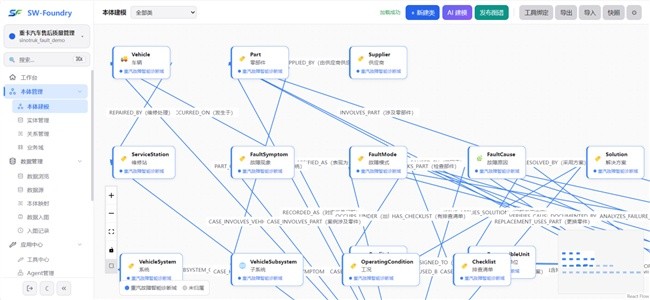
Clean and label 26,000 fault reports, repair cases, and three-package data from the past 8 years, forming a DFMEA structured failure mode library (including failure modes, causes, impacts, and measures). At the same time, construct an ontology model and knowledge graph in the after-sales domain, defining entity relationships such as products, components, fault phenomena, root causes, and repair plans, with a total of 150,000 entity nodes and 400,000 relationship edges.
Step 2: Full Process of Intelligent Fault Diagnosis
When frontline service station engineers encounter complex faults, they only need to upload a fault description (text + images), and the system automatically executes:
-
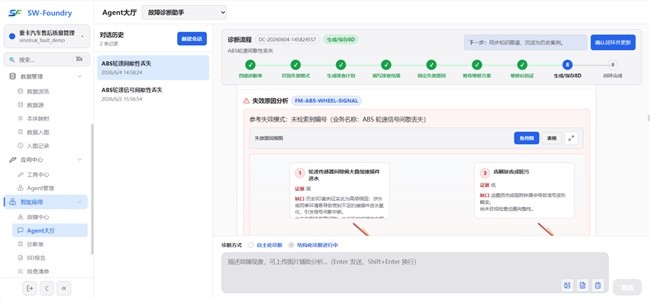
Identify failure modes: Through multimodal reasoning with images and text, match the same or similar failure modes and provide a ranking of symptom similarity.
-
Generate inspection plans: Recommend inspection steps, required tools, and safety requirements by priority.
-
Lock in root causes: After the service station inspects according to the plan and provides online feedback, the system gives a root cause location with a confidence level ≥95% based on the reasoning chain and traces the complete evidence chain.
-
Recommend repair plans: Push detailed repair steps, replacement part lists, and verification plans.
-
Automatically generate 8D reports: After summarizing the information throughout the process, generate an 8D report that meets the OEM standards with one click, without manual organization.
Step 3: Quality Closed Loop and Knowledge Self-Evolution
Each diagnostic result is automatically updated in the knowledge graph with confidence weights after verification. When the same issue occurs abnormally frequently, the system proactively alerts and pushes it to the research institute for design review or process improvement. New employees can directly access historical similar cases through the "After-Sales Training Assistant," reducing the training period from one year to three months.
3. Key Technical Advantages: Ontology + Knowledge Graph
Compared to traditional RAG solutions, SunwayWorld's ontology + knowledge graph approach has four major advantages: clear and traceable reasoning paths, bidding farewell to "black box" decision-making; a structured knowledge base constrains generated content, greatly suppressing hallucinations; supports multi-hop reasoning, allowing precise location of complex faults along relationship paths; Support for incremental updates of localized knowledge without the need for full reconstruction.
IV. Application Effectiveness: From "Passive Firefighting" to "Proactive Prevention"
After 12 months of system operation, the enterprise's fault diagnosis accuracy improved from 65% to 92%, the average diagnosis time was reduced from 4.5 days to 1.2 days, the cost of three guarantees claims decreased by 31% year-on-year, the recurrence rate of repeated issues dropped by 58%, and the number of historical fault case calls increased fourfold.
V. Outlook: Extending AI from After-sales to the Entire Value Chain
Based on this successful practice, SunwayWorld is collaborating with the enterprise to expand more AI application scenarios:
Intelligent Experiment Design: Automatically recommend the optimal experimental parameter combinations based on historical experimental data.
Predictive Maintenance of Equipment: Analyze vibration and temperature data from test benches to provide a 14-day early warning of faults.
Supply Chain Quality Collaboration: Open the failure mode library to core suppliers to achieve proactive control of incoming material quality.
From the intelligent leap in after-sales diagnosis to the proactive transformation of quality management, SunwayWorld is leveraging solid AI implementation cases to assist China's automotive industry in transitioning from a "manufacturing powerhouse" to a "quality powerhouse."