With regulations continuing to tighten, where will the 200 billion yuan in cross-border investment demand go?
 I'm LongbridgeAI, I can summarize articles.
Amidst tightening cross-border investment regulations, including new State Council rules and CSRC penalties on illegal brokerages, approximately HK$200-250 billion in affected assets face redirection. Investors are shifting toward legal channels like Stock Connect and QDII. Consequently, QDII funds have implemented purchase restrictions, leading to high premiums and suspended trading for popular products such as the Huatai-PineBridge China-Korea Semiconductor ETF. Meanwhile, Hong Kong Stock Connect is emerging as a preferred alternative due to its advantages in settlement and lack of quota constraints.
Cross-border investment regulation is continuously tightening.
On June 1st, the "Regulations of the State Council on Outward Investment" were released. It mentions that illegal income from overseas investments prohibited by the state will be confiscated, and the involved entities and relevant responsible persons will also face fines. On May 22nd, the China Securities Regulatory Commission (CSRC) and eight other departments jointly issued the "Implementation Plan for Comprehensive Rectification of Illegal Cross-border Securities, Futures and Fund Operations," imposing fines totaling over 2.2 billion yuan on three overseas brokerages—Futu, Tiger Brokers, and Changqiao—and specifying that all illegal domestic businesses must be completely phased out within two years.
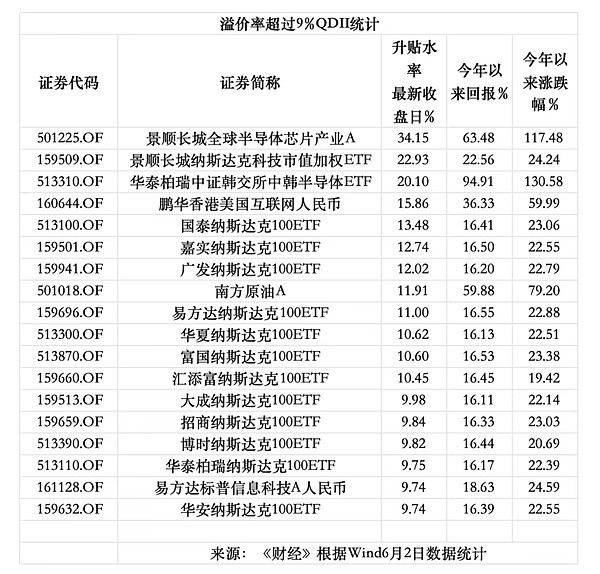
According to statistics from Wind, as of June 2nd, over 60% of QDII funds in the market had implemented purchase restrictions or suspended subscriptions. Several cross-border listed funds issued premium risk warnings. The premium rates of the Huatai-PineBridge China-Korea Semiconductor ETF and the Invesco Nasdaq Technology ETF were both around 20%, forcing them to suspend trading consecutively to warn of risks. Furthermore, to address the difficulties in checking QDII quotas and the lack of transparency, several fund distribution platforms launched inquiry services. On June 2nd, several distribution channels, including Tencent Wealth Management, JD Finance, and China Merchants Bank, launched QDII quota inquiry tools to facilitate investors' real-time tracking of changes in overseas fund subscription quotas. QDII funds are a major channel for individuals to allocate overseas assets and a major force in receiving repatriated funds. However, in the QDII (Qualified Domestic Institutional Investor) sector, investors have long faced two major challenges: firstly, due to foreign exchange quota controls, products frequently suspend subscriptions, leading to persistently high premiums for popular funds; secondly, the complexity and diversification of information in overseas markets make it difficult for ordinary investors to select high-quality QDII funds. According to Wind data compiled by Caijing, among the QDII funds still available for subscription, 36 funds have achieved returns exceeding 50% this year, but due to QDII quota limitations, all are currently suspending large-amount subscriptions, with the lowest daily subscription limit as low as 10 yuan. Looking at the geographical distribution of these fund holdings, the proportion of US stock holdings varies widely, ranging from as low as 30% to as high as 80%. Some funds hold a relatively high proportion of A-shares, including several products such as Tianhong Global High-End Manufacturing and E Fund Global Growth, where A-share holdings exceed 30%. Some products also diversify their portfolios with Hong Kong stocks, Taiwan stocks, and South Korean stocks. "I thought I bought a cross-border product, but it's still A-shares." Recently, many investors have complained on Xiaohongshu about the low purity of some QDII funds in US stocks. Large-scale subscriptions for popular products are now severely restricted, further amplifying the premium in the secondary market. Wind data shows that as of June 2, 18 QDII funds had a premium rate exceeding 9%, tracking stocks including Nasdaq, crude oil, Hong Kong and US internet, and semiconductors.