

The breeding sow inventory has been adjusted to 37.5 million heads, and the capacity reduction is accelerating! The "Pig Farming ETF" has become a left-side layout tool, with a 58% increase in shares this year, ranking first among peers
 I'm LongbridgeAI, I can summarize articles.
According to the latest data, the national breeding sow inventory has been adjusted to 37.5 million heads, and the pig industry is facing deep losses, with pork prices falling to the lowest level in nearly a decade. Despite the continued weakness of pork stocks, the China Merchants CSI Animal Husbandry ETF (516670) has attracted funds during this low period, with a 58% increase in shares this year. Changes in industry cycle characteristics are expected to affect the future trend of pork prices
On May 25th, pork stocks continued to weaken, with the China Merchants CSI Animal Husbandry ETF (516670) tracking the CSI Animal Husbandry Index down over 11% year-to-date. Luo Niushan has cumulatively dropped over 30% this year, while major stocks like Muyuan Foods, Wens Foodstuff Group, and Haida Group have also seen declines around 20%.
Behind the continuous decline of the index is the long-term slump in the pig industry. According to data from the National Bureau of Statistics, on May 20, 2026, the national average price of live pigs (external three yuan) was 9.5 yuan/kg, down nearly 19% compared to the beginning of the year; the pig-to-grain ratio fell to 4:1, setting a new historical low, and the industry has fallen into comprehensive losses.
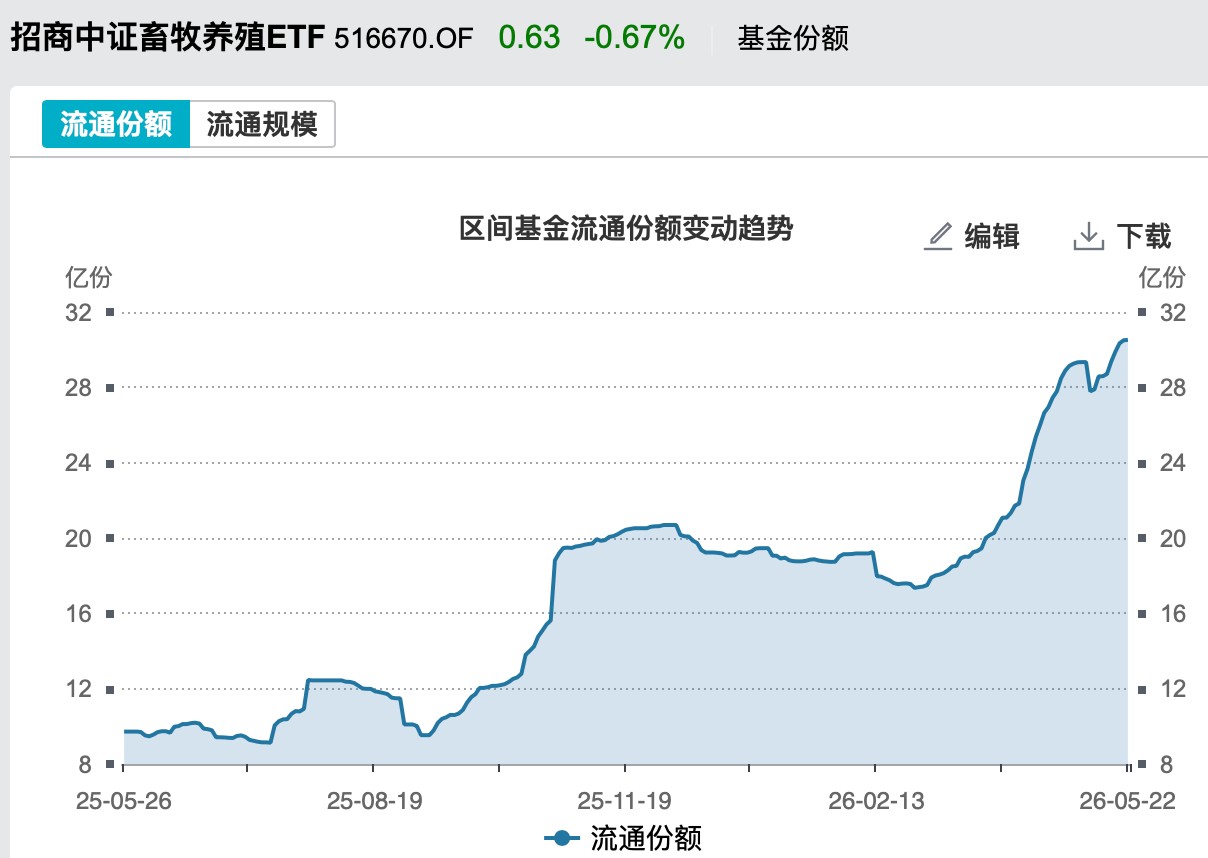
However, it is noteworthy that funds have begun to actively position themselves at the cyclical low. As of May 22, the China Merchants CSI Animal Husbandry ETF (516670) has seen a net inflow of 180 million yuan for nine consecutive trading days.
Current Situation of the Pig Cycle: Multiple Signals Point to "Ice Point Moment"
The essence of the pig cycle is the temporal mismatch of supply and demand. Its operational logic is clear and classic: rising pig prices lead to profits, prompting farmers to replenish breeding sows and expand production capacity; about 10 months later, live pigs are concentrated for sale, leading to oversupply and a decline in pig prices; when prices fall below the cost line, the industry falls into deep losses, forcing farmers to eliminate inefficient breeding sows and contract production capacity; after the capacity is cleared, supply becomes insufficient, and pig prices rise again, starting a new cycle.
This closed loop of "price increase—expansion—decline—reduction—price increase" constitutes a complete pig cycle, which historically completes a round every 3 to 4 years. It is worth noting that the current cycle, which began in 2022, no longer presents a significant "single peak" pattern, but instead has two peaks appearing in October 2022 and September 2024, while low pig prices have persisted for a longer duration and the degree of losses has deepened.
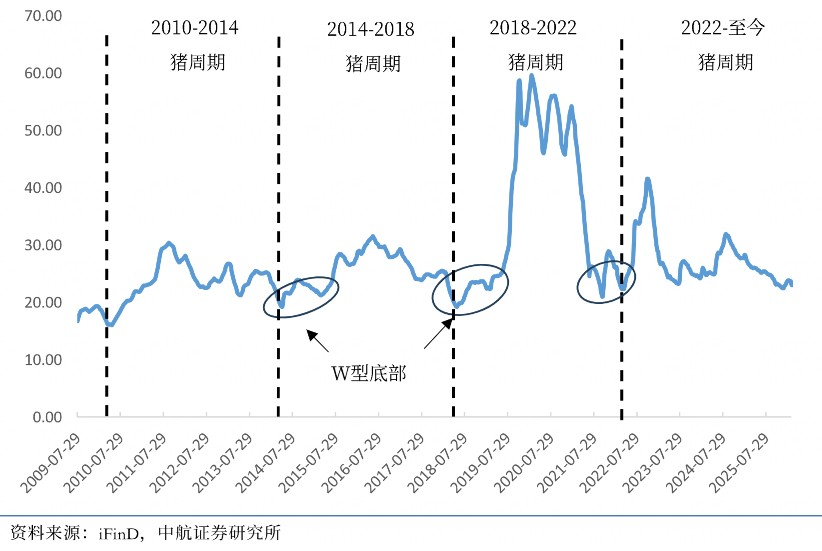
Industry insiders believe that this new characteristic indicates a slower and more thorough industry clearing, laying the foundation for the elasticity of the next cycle.
First is the pig price, with the national average price of live pigs (external three yuan) falling below 10 yuan/kg, reaching the lowest level in nearly a decade.
Under low pig prices, the industry is facing comprehensive losses. The core indicator measuring farming profitability—the pig-to-grain ratio—has remained below the first warning line of 5:1 for several consecutive weeks, with the latest data dropping to around 4:1, breaking the historical lowest record, and the industry has entered a deep loss zone.
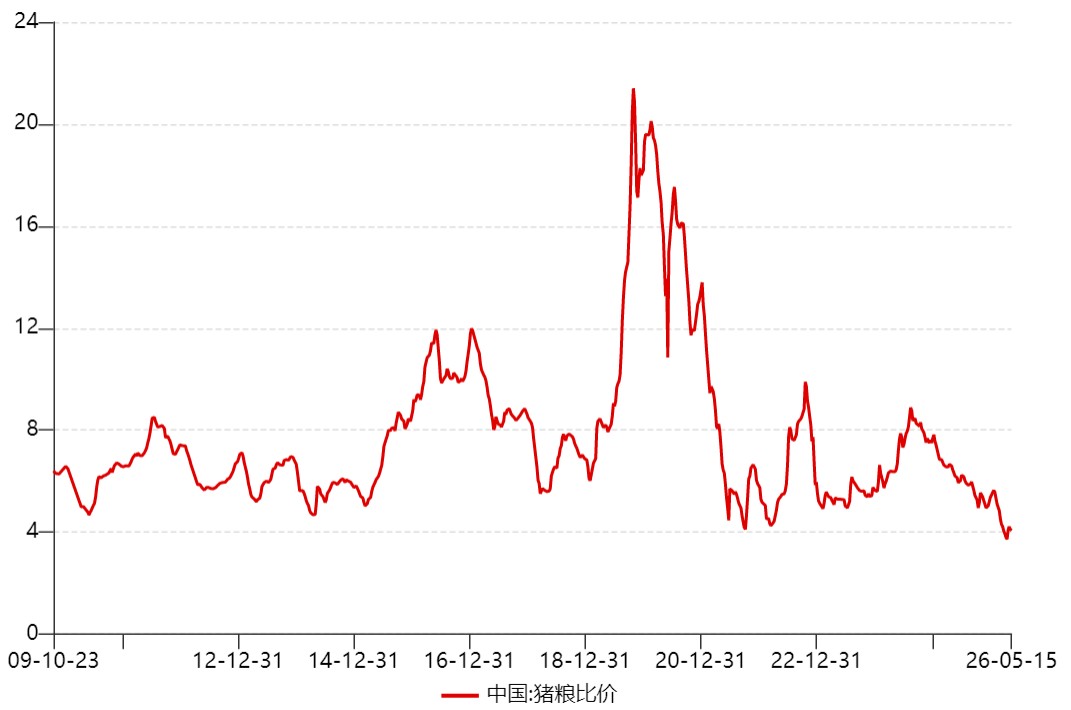 From the data of listed companies, the net profit attributable to the parent company of pig farming enterprises is expected to decline by 49.12% year-on-year in 2025, and by the first quarter of 2026, the decline further expands to 182.67%, with an industry net profit of -6.54 billion yuan. The average gross profit margin of pig farming enterprises in the first quarter is only 3.37%, and the return on equity (ROE) is as low as -8.12%.
Small and medium-sized farmers are suffering even more, as of May 15, 2026, the profit from self-breeding and self-raising pigs is -343.24 yuan per head, while the profit from purchasing piglets is -213.54 yuan per head. The industry has shifted from profit to loss in self-breeding and self-raising since September 2025, and has been continuously losing money for over 8 months. The total cost of listed pig companies is generally above 12 yuan per kilogram, while market prices have long been significantly below this level.
Kaiyuan Securities pointed out in its mid-term strategy report that the industry has reached a freezing point, and a turnaround can be expected. The industry's losses may accelerate the elimination of small and scattered farmers, and the reduction of breeding sows is expected to accelerate, with conditions for an industry turning point gradually accumulating.
Is the power of cyclical reversal accumulating?
Although the breeding industry is deeply trapped in a freezing point, the essence of the cycle has not changed, and the elasticity of future pig prices is also accumulating.
Recently, the Ministry of Agriculture and Rural Affairs has lowered the normal stock of breeding sows to 37.5 million heads, and the upper limit of the capacity control green zone has also been narrowed from the original plan of 105% to 103%, which means that the intervention threshold has been triggered in advance, and capacity reduction may further accelerate under policy guidance. In addition, the plan has for the first time included large group enterprises with a total stock of breeding sows exceeding 100,000 heads in the monitoring list, implementing annual production filing management and strengthening the counter-cyclical adjustment mechanism.
Moreover, although the slaughter volume of eliminated sows has rebounded from a low level, the ratio of the price of eliminated sows to the price of commercial pigs has risen to 76.8%, indicating that there has not yet been a panic elimination in the industry, and capacity clearing is still proceeding "gently." This gradual reduction, although painful in the short term, can lay a more solid foundation for future cyclical reversal.
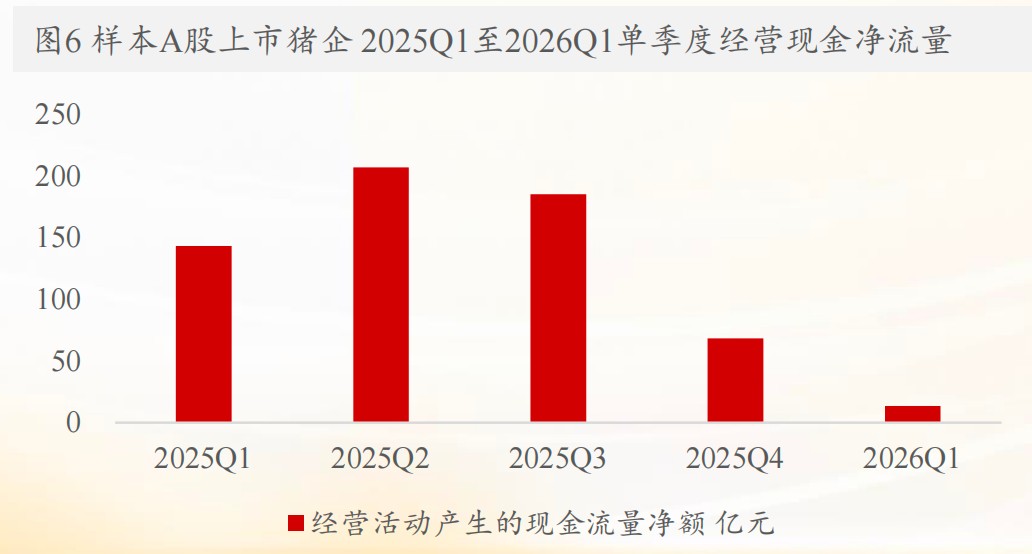
At the same time, the net operating cash flow of listed pig companies has plummeted by over 90% year-on-year, and some companies have begun to make provisions for asset impairment and eliminate high-cost capacity. The industry as a whole has entered a difficult stage of "cost reduction and efficiency enhancement + capacity reduction." The tight cash flow will force companies to accelerate the elimination of inefficient capacity, and the trend of reduction has become irreversible.
Since the beginning of this year, the livestock farming sector has been weak due to the decline in pig prices. According to Wind data, as of May 22, the SW Agriculture, Forestry, Animal Husbandry and Fishery Industry Index has accumulated a decline of 13.97% this year, underperforming the Shanghai and Shenzhen 300 Index by 18.62 percentage points.
Changjiang Securities pointed out that looking back at history, the best buying point for the breeding sector is when pig prices are bottoming out, the entire industry is in deep losses, and capacity is accelerating reduction, which further implies a reversal in future pig price expectations During this critical window period, China Merchants CSI Animal Husbandry ETF (516670) has become a convenient tool for investors to position themselves on the left side of the pig farming industry chain, thanks to its high "pig content" (over 60% related to pig farming) and low fee rate. As of May 22, China Merchants CSI Animal Husbandry ETF (516670) has seen a net inflow of 180 million yuan for 9 consecutive trading days; its share increase of 58% year-to-date ranks first among similar ETFs.
For ordinary investors, focusing on index tools and gradually positioning during the cyclical low, or seizing better solutions for the future cyclical recovery, is advisable