

China Index Academy 2024 Real Estate Enterprise Financing Review: Continuing Downward Trend with Some Recovery Since September
 I'm LongbridgeAI, I can summarize articles.
The China Index Academy released a report stating that the Chinese real estate market will continue to adjust in 2024, with financing scale decreasing by 18.4% year-on-year. Although policy support is expected to drive a recovery in expectations, the market faces challenges in its recovery, and financing policies will remain loose. Since September, the core city markets have shown some signs of recovery, and bond financing has slightly rebounded, but the overall financing environment has not significantly improved. From January to November 2024, the funds in place for real estate development enterprises amounted to 9.66 trillion yuan, a year-on-year decrease of 18.0%
According to the Zhitong Finance APP, on February 3rd, the China Index Academy published an article stating that in 2024, the overall real estate market in China will still show a trend of adjustment. The Politburo meeting on September 26 proposed that "we should promote the stabilization of the real estate market," releasing the strongest signal for stability. Relevant departments and localities are actively implementing policies, and since the fourth quarter, the core city market has shown significant warming. Financing support policies for real estate companies continue to be relaxed, financing tools are becoming more diverse, and the scale of bond financing continues to decline, with credit bonds and ABS becoming the absolute main force.
Looking ahead to 2025, increased policy support is expected to drive the restoration of expectations, but the recovery of the real estate market still faces many challenges. Financing policies are expected to remain relaxed, but the scale of financing will still be affected by market recovery.
Financing Scale: Decreased by 18.4% year-on-year, continuing the downward trend
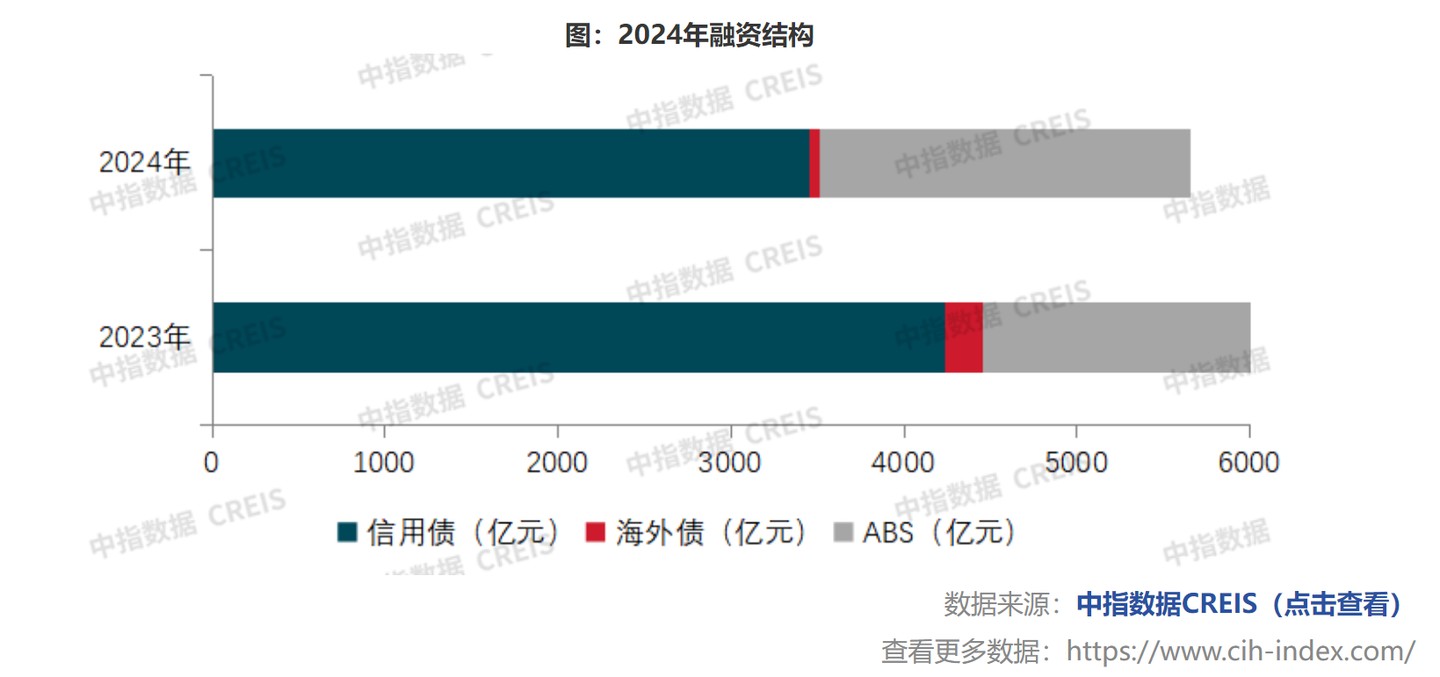
In 2024, the real estate industry achieved a total bond financing of 565.31 billion yuan, a year-on-year decrease of 18.4%. The industry began to enter a downward cycle in the second half of 2021, with a significant decline in financing scale, and 2024 continued this downward trend, with a larger decline than the previous year. Among them, credit bonds decreased by 18.5% year-on-year, overseas bonds decreased by 69.5% year-on-year, and ABS decreased by 13.6% year-on-year. Overseas bonds continued to decline at a low level, with credit bonds becoming the absolute main force in financing, and ABS financing accounting for more than one-third. From a monthly perspective, since September, under the influence of last year's low base, the total bond financing amount has shown a year-on-year positive change for several consecutive months, with a slight warming in financing for real estate companies, although its sustainability remains to be observed.
In terms of funds in place for real estate development enterprises, the scale continues the downward trend since 2022, and the actual financing environment has not significantly improved. Among them, driven by financing policies such as the "white list" of urban financing coordination mechanisms, operational property loans, and the 16 financial measures, the proportion of domestic loans and self-raised funds has increased. The decline in sales has had an adverse impact on the funding situation of real estate companies, with the proportion of deposits and advance payments, as well as personal mortgage loans, significantly decreasing.
From January to November 2024, the funds in place for real estate development enterprises amounted to 9.66 trillion yuan, a year-on-year decrease of 18.0%, narrowing by 1.2 percentage points compared to January to October. Among them, domestic loans amounted to 1.35 trillion yuan, a year-on-year decrease of 6.2%, with the decline narrowing by 0.2 percentage points compared to January to October; the proportion was 14.0%, an increase of 1.8 percentage points compared to the same period last year. Self-raised funds amounted to 3.47 trillion yuan, a year-on-year decrease of 11.0%, with the decline widening by 0.5 percentage points compared to January to October; the proportion was 35.9%, an increase of 3.0 percentage points compared to the same period last year. Deposits and advance payments amounted to 2.96 trillion yuan, a year-on-year decrease of 25.2%, with the decline narrowing by 2.5 percentage points compared to January to October; the proportion was 30.7%, a decrease of 3.1 percentage points compared to the same period last year. Personal mortgage loans amounted to 1.39 trillion yuan, a year-on-year decrease of 30.4%, with the decline narrowing by 2.4 percentage points compared to January to October; The proportion is 14.4%, a decrease of 2.7 percentage points compared to the same period last year.
Financing Structure: Credit bonds are the main financing force, and the proportion of ABS issuance has increased
Credit Bonds: Monthly issuance scale rebounded at year-end, with central and state-owned enterprises as the absolute main issuers
In 2024, the issuance scale of credit bonds in the real estate industry was 344.85 billion yuan, a year-on-year decrease of 18.5%, accounting for 61.0% of the total financing scale, which is basically flat compared to the previous year. The average issuance term is 3.16 years, with 45.7% of the bonds having a term of more than 3 years, an increase of 3.7 percentage points from the previous year, indicating an extension of the term. Among them, the issuance term of credit bonds for mixed-ownership and private real estate enterprises has been extended, with the total issuance of bonds over 3 years significantly increasing. New City, New Hope, Jinhui, Excellence, and MIDEA REAL EST have all successfully issued 5-year medium-term notes, providing favorable conditions for improving their debt maturity structure.
From a monthly perspective, the overall issuance of credit bonds showed a downward trend in the first nine months, with the issuance scale in September dropping to less than 20 billion yuan; since October, the issuance scale has continuously rebounded, with October and December showing positive year-on-year growth due to last year's low base, resulting in a year-end tail effect.
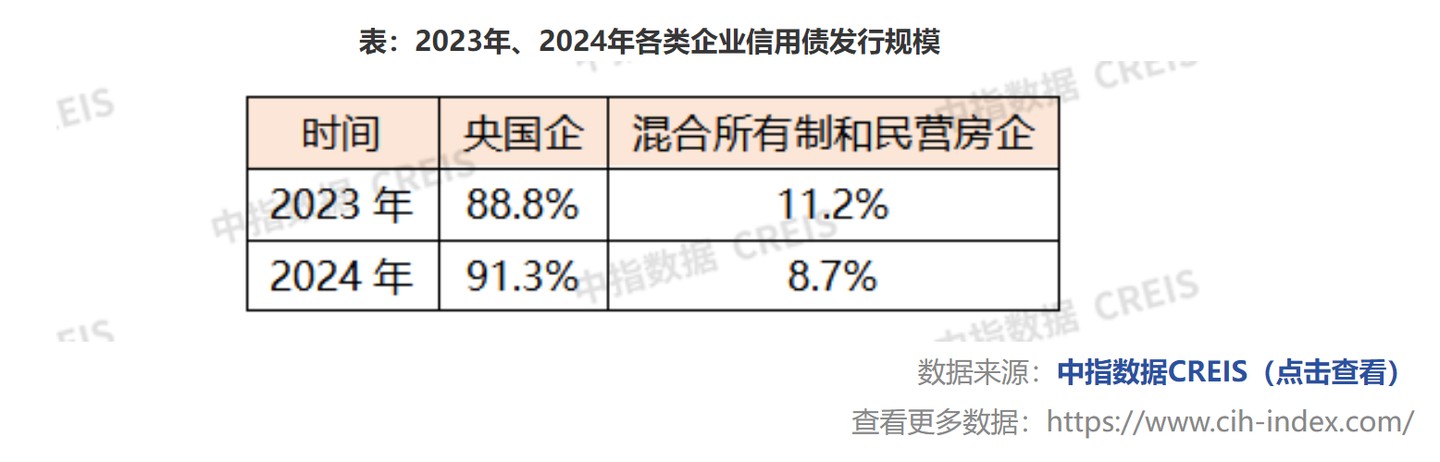
In terms of issuance structure, the main issuers of credit bonds are central enterprises and local state-owned enterprises, with the proportion of issuance by central and state-owned enterprises exceeding 90% this year, an increase of 2.5 percentage points from the previous year; the proportion of issuance by private enterprises and mixed-ownership enterprises has decreased. In 2024, private enterprises' bond issuance remains at a low level, with only 8 private and mixed-ownership enterprises issuing bonds, a decrease from the previous year, primarily consisting of larger enterprises that have not encountered risks, making it difficult to benefit most private enterprises facing tight funding.
Currently, the issuance channels for credit bonds are still open to high-quality real estate enterprises, but the overall number of benefiting enterprises is relatively limited. In September, the central bank announced that the "16 Financial Measures" policy would be extended from the end of 2024 to the end of 2026. Support for private real estate enterprises to issue bonds for financing will continue to be implemented, helping enterprises enrich their financing channels, especially as the real estate market stabilizes, some real estate enterprises focusing on core cities and operating steadily may benefit first, thus obtaining richer financial support.
Overseas Bonds: Continuing to decline from a low level, with shorter terms
In 2024, the issuance scale of overseas bonds was only 6.9 billion yuan, a year-on-year decrease of 69.5%, accounting for 1.2% of the total financing scale, a decrease of 2.0 percentage points from the previous year; the average issuance term is 2.50 years, with all issuance terms being under 3 years, indicating a short term, making it difficult for real estate enterprises to obtain long-term funding support from abroad. From a monthly perspective, there were no new bonds issued from August to December, and the overseas bond channel is nearly closed, with only a few high-quality enterprises capable of issuing overseas bonds in other months, primarily consisting of central and state-owned enterprises such as Yuexiu and Wukuang ABS: The proportion of financing scale has increased, with CMBS/CMBN and REIT-like products supported by underlying assets accounting for over 60%
In 2024, the ABS financing scale was 213.76 billion yuan, a year-on-year decrease of 13.6%, accounting for 37.8% of the total financing scale, an increase of 2.1 percentage points from the previous year; the average issuance term was 9.85 years, significantly extended. From a monthly perspective, in the first half of the year, the average monthly issuance scale of ABS was only about 15 billion yuan, while in the second half, ABS issuance returned to normal, with an average monthly issuance scale of over 20 billion yuan. The issuance scale slightly declined in October, but rebounded again at the end of the year.
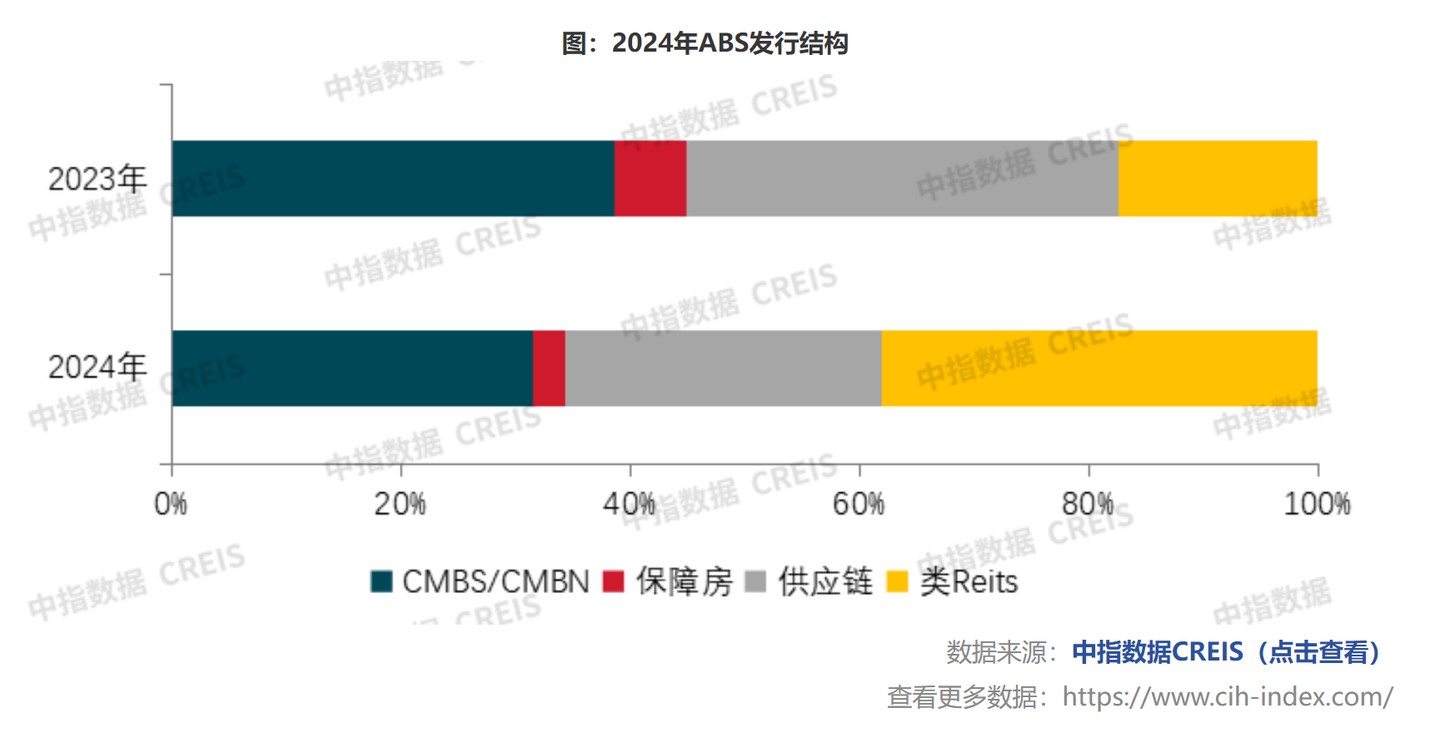
From the issuance structure, REIT-like products and CMBS/CMBN became the main types of issuance, accounting for 38.1% and 31.5% respectively, with the proportion of REIT-like products rapidly increasing, rising by 20.7 percentage points. Overall, ABS products this year are still mainly supported by high-quality underlying assets, and the ABS channel has always been open to enterprises holding quality held assets.
In terms of public REITs, since the policy window opened, a total of 7 consumer infrastructure REIT products have been listed, issued by Jinmao, Wumart, China Resources, Invesco, Bailian, Shouchuang, and Grandjoy, covering different types of ownership enterprises. Public REITs for industrial parks continue to expand, and in November, the first public REIT for private enterprise parks in China was issued, with a net subscription amount of 1.617 billion yuan for the CICC Lian Dong Science and Technology REIT. Public REITs have also opened the door to asset securitization for many private enterprise parks, helping these companies reduce financing costs, broaden financing channels, and revitalize existing assets. This year, new affordable housing REITs were launched, with the China Merchants Fund's China Merchants Shekou rental housing REIT completing issuance with a scale of 1.364 billion yuan. In July, the types of assets for infrastructure public REITs increased to include elderly care facilities. After more than three years of development, the public REITs market has entered a normalized issuance phase, with a stable upward trend. On January 3, 2025, the National Development and Reform Commission stated at a press conference that it would support the expansion and capacity of the infrastructure REITs market with greater efforts, and public REITs will become an important financial tool for real estate companies to revitalize existing assets and transition to new development models.
This year, the Shanghai Stock Exchange and Shenzhen Stock Exchange have promoted the accelerated landing of holding-type real estate ABS products, which is another financial tool to revitalize existing assets. In November, the CITIC Securities-Yuexiu Commercial Holding Real Estate Asset-Backed Special Plan completed issuance, marking the market's first commercial property holding-type real estate ABS, with a project issuance scale of 1.413 billion yuan.
Currently, financial tools such as infrastructure REITs and holding-type real estate ABS continue to be implemented, providing valuable exit channels for properties such as shopping centers, long-term rental apartments, and industrial parks, further improving the financial closed loop for the entire cycle of property development and operation. Holding-type properties have become an important means for real estate companies to revitalize assets and supplement funds during the industry's downturn, while real estate companies can also benefit from diversified operations, gradually changing their business models and transitioning to new development models
In the year, listed real estate companies such as China Communications Construction Real Estate and Lujiazui completed A-share private placements, raising net funds of 438 million yuan and 1.797 billion yuan respectively; Sunac allocated 489 million shares to CICC International, with a total financing amount of approximately HKD 1.205 billion. The private placement plan of Waigaoqiao has not yet been implemented. The policy supporting equity financing for real estate companies will continue to be implemented. With the arrival of the policy bottom and market bottom, the capital market's confidence in the real estate sector is expected to recover, which will also open up channels for targeted issuance by real estate companies. Poly Development plans to issue convertible bonds, with a total fundraising amount not exceeding 9.5 billion yuan; Huafa plans to issue no more than 5.5 billion convertible bonds. Convertible bonds combine the characteristics of fixed income and equity investment, making them a viable tool during the current downturn in the real estate sector and the market bottoming phase.
Financing Rates: Significant Decrease in Funding Costs
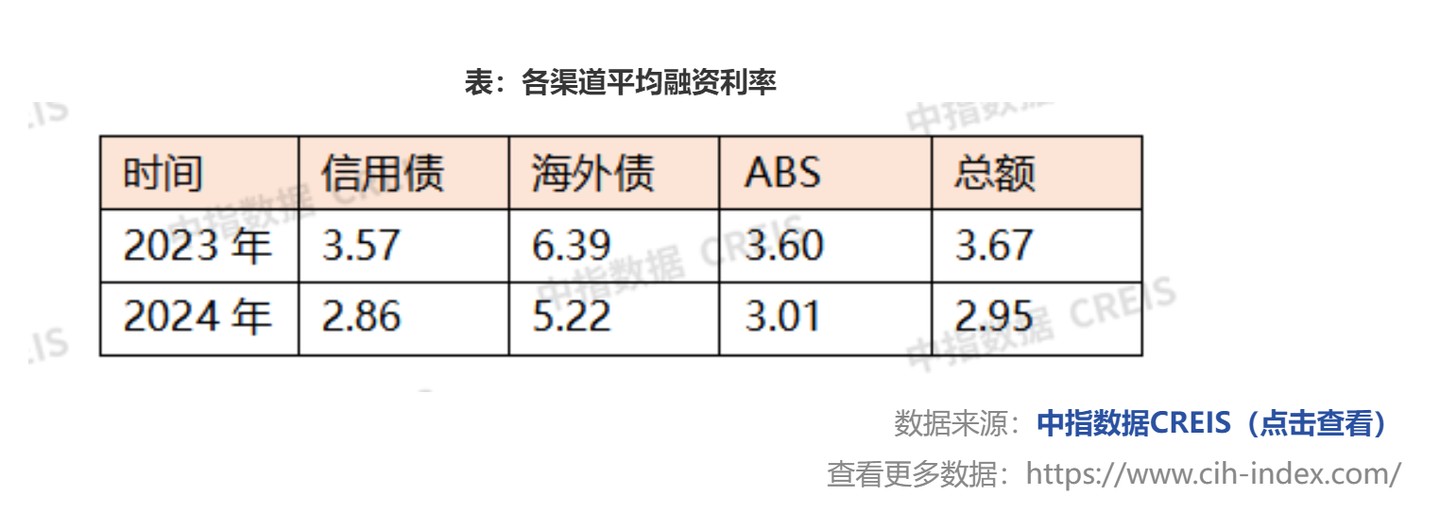
The average industry bond interest rate for 2024 is 2.95%, a year-on-year decrease of 0.72 percentage points. Influenced by this year's continuous interest rate cuts, changes in the structure of financing enterprises and products, the average financing cost of industry bonds has significantly decreased. Among them, the average interest rate for credit bonds is 2.86%, a year-on-year decrease of 0.71 percentage points; the average interest rate for overseas bonds is 5.22%, a year-on-year decrease of 1.17 percentage points; the average interest rate for ABS is 3.01%, a year-on-year decrease of 0.59 percentage points.
Conclusion
In 2024, financing policies will remain accommodative, but the scale of bond financing is still on a downward trend. The uncertainty of market recovery has increased investors' doubts about the real estate industry, leading companies to adopt a cautious attitude towards new financing, and the scale of financing continues to shrink.
The real estate market still faces many challenges in recovering next year. Companies should plan their cash flow in advance and fully utilize various financing policies to increase capital inflow. Actively utilizing project "white list" mechanisms, operational property loans, supporting real estate companies in issuing bonds, private placements, public REITs, and holding real estate ABS, among other financing policies, to expand financing cash inflow through multiple channels, may allow for the extension of existing debt and refinancing