

Where is the central valuation of housing prices?
 I'm LongbridgeAI, I can summarize articles.
Founder Securities pointed out that the reasonable valuation center of housing prices is currently in a reconstruction phase, and investors should adopt a multi-dimensional analysis framework. Key signals include rental yield in core cities, residents' income confidence index, and commercial banks' net interest margin. Traditional valuation indicators have become ineffective in the current cycle and need to be repriced based on low growth expectations. Housing price valuation is constrained by supply and demand, interest rates, and financial risks, and the current market is facing downward pressure
Founder Securities believes that the reasonable valuation center of housing prices is currently in a reconstruction phase. Investors need to abandon single indicator judgments and shift to a multi-dimensional analysis framework of "growth expectations + supply-demand pattern + interest rate environment + financial risks."
For market participants, key signals include: whether the rental yield in core cities can approach mortgage rates, whether the resident income confidence index can rebound above 50, and whether the net interest margin of commercial banks can stop declining.
Structural Failure of Traditional Valuation Indicators
The Wang Song team at Founder Securities stated that the housing price-to-income ratio and rental yield are commonly used indicators in the market, but they lack explanatory power in the current cycle.
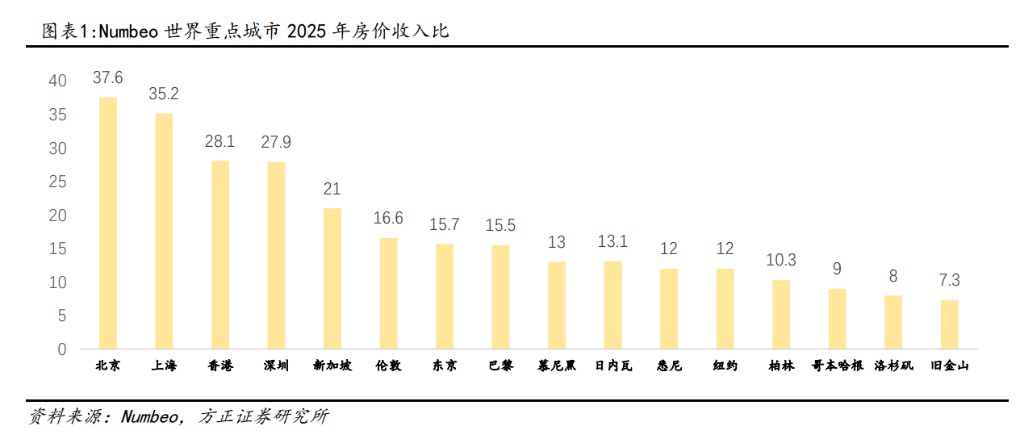
From cross-national data, Numbeo statistics show that the housing price-to-income ratios in Beijing and Shanghai are 37.6 and 35.2, respectively, far exceeding New York's 12 and Berlin's 10.3. However, this difference partly stems from China's use of "construction area" statistics (including shared area) rather than usable area, along with differences in income statistical standards, which significantly undermine the effectiveness of cross-national comparisons.
Although rental yield can reflect income attributes, it does not account for holding costs.
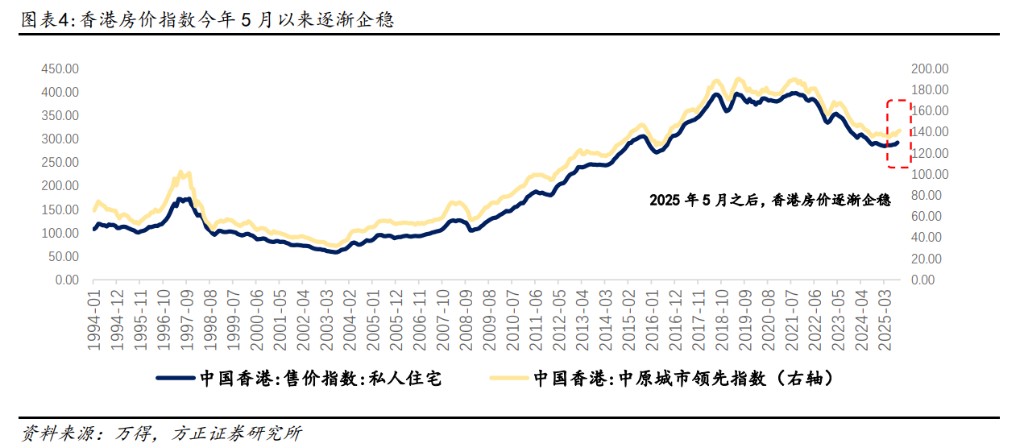
However, the importance of this indicator has increased in the current low-expectation environment—since May this year, mortgage rates in Hong Kong have fallen below 3.5%, while rental yields have remained around 3.6%, leading to a stabilization in housing prices. This confirms the logic of interest rate pricing. Currently, the rental yields in Beijing, Shanghai, and Shenzhen are in the range of 1.6%-2.0%, which has surpassed the one-year government bond yield, but still lags behind the first mortgage rate.
More critically, the three major growth expectations that past valuations relied on—urbanization and population growth, monetary issuance efficiency, and resident income expectations—have all undergone structural changes since 2021. The urbanization rate growth has slowed to 66.16%, and negative total population growth has weakened demand support; although M2 has increased to 335.38 trillion yuan, its correlation with housing prices has decreased; the central bank's depositor survey shows a weakening income confidence index and a decline in residents' willingness to purchase homes. This means that the valuation center needs to be repriced based on "low growth expectations."
Repair Path Requires Triple Condition Resonance
Founder Securities believes that the current housing price valuation center is constrained by three factors: supply-demand, interest rates, and financial risks.
The supply-demand side is forming a downward spiral: from January to September 2025, the sales area of commercial housing decreased by 5.5% year-on-year, the unsold area increased by 3.6% year-on-year, and new home prices in 70 cities decreased by 2.7% year-on-year. In terms of the interest rate environment, the rental yield in Shanghai has exceeded the one-year and ten-year government bond yields, but there is still a gap compared to mortgage rates. On the financial risk front, the net interest margin of banks has dropped to 1.42%, and the decline in collateral value constrains the lower limit of valuations Analysts believe that the restoration of the valuation center for housing prices requires three major conditions:
Improvement in residents' income and employment expectations is the fundamental premise, with the "future income confidence index" in the central bank's depositor survey continuously rising above 50 as a potential leading indicator;
Interest rate policies need to be accurately transmitted, promoting the expansion of the spread between mortgage rates and overall loan rates, bringing rental yields closer to the mortgage rates for first-time homebuyers.
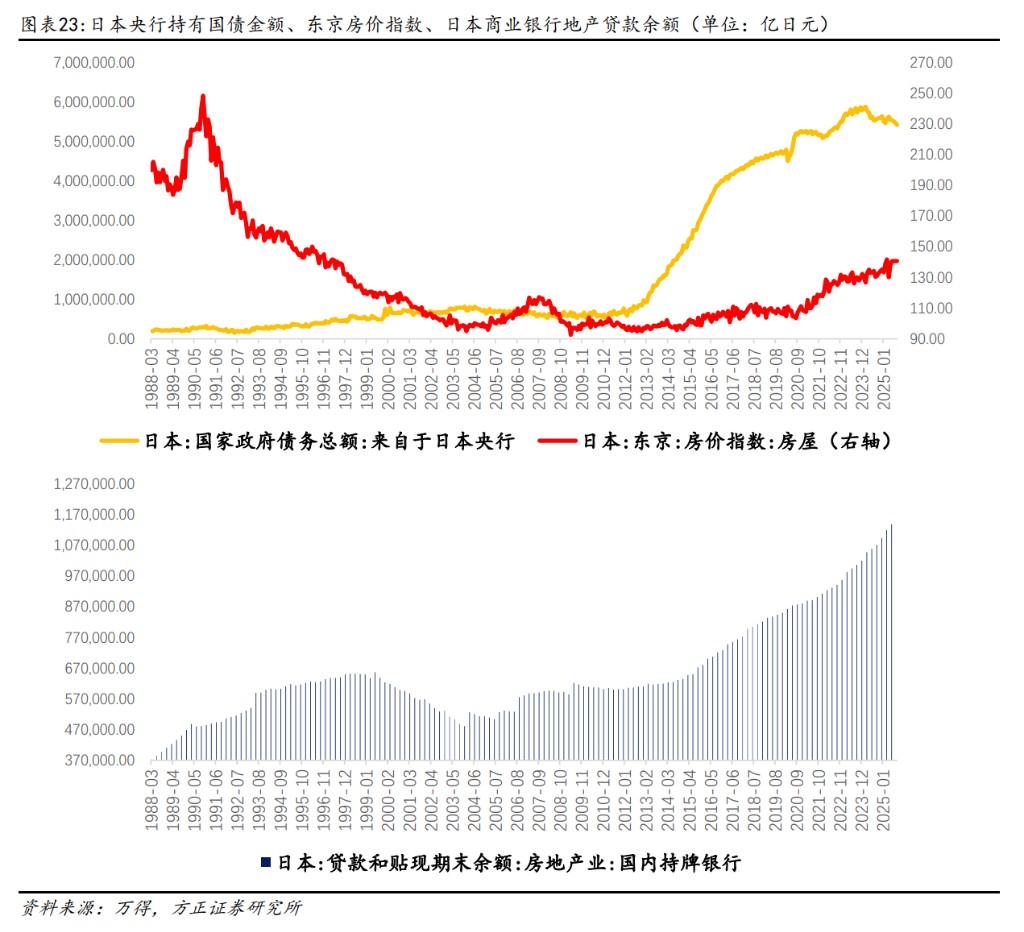
Macroeconomic policies need to work in tandem, referencing Japan's "monetary easing + fiscal stimulus" combination after 2012, with domestic support potentially provided through the construction of affordable housing and support for urbanization development.
Analysts suggest that investors focus on three types of indicators: the core cities' second-hand housing transaction volume on the demand side has increased year-on-year for three consecutive months, and the year-on-year growth rate of residents' medium- to long-term loans has turned positive; on the interest rate side, the spread between mortgage rates and overall loan rates has expanded, and rental yields in core cities are approaching the mortgage rates for first-time homebuyers; on the financial side, the net interest margin of commercial banks has stopped declining and is recovering, while the growth rate of non-performing loans in real estate is slowing.
Risk warning and disclaimer
The market has risks, and investment should be cautious. This article does not constitute personal investment advice and does not take into account the specific investment goals, financial conditions, or needs of individual users. Users should consider whether any opinions, views, or conclusions in this article align with their specific circumstances. Investing based on this is at one's own risk