

The lifeline of Russian oil is ignited again! The Baltic oil export chain is attacked, adding fuel to the global oil price surge
 I'm LongbridgeAI, I can summarize articles.
The Russian Baltic oil ports of Primorsk and Ust-Luga caught fire again after drone attacks, increasing the risk of a rise in global oil prices. According to NASA satellite data, the fires affected oil loading and could lead to Brent crude futures prices exceeding $200. The escalation of geopolitical conflicts in the Middle East is driving demand for Russian oil from China and India. The Russian oil pipeline transportation company has not responded to this incident
According to satellite data from the National Aeronautics and Space Administration (NASA), Russia's critical Baltic oil ports—Primorsk and Ust-Luga—have caught fire again following a large-scale drone attack at night. The already tense global crude oil supply system, exacerbated by the Middle East conflict, now faces an additional risk premium from "disruptions to Russian westward exports," which undoubtedly means that the upward driving force behind the international oil price benchmark—Brent crude futures—will be stronger, increasing the tail risk of breaking through the historical high of 2008 and even surpassing the $200 level warned by Macquarie.
According to the latest satellite images from NASA's Fire Information for Resource Management System (FIRMS), new fire incidents have been detected between 3 to 12 hours prior to the fire points identified on Friday morning local time. The fires are also forcing these two large infrastructures to temporarily halt large-scale oil loading, impacting the substantial profits that the Moscow financial system derives from Russian oil exports. As geopolitical conflicts in the Middle East continue to escalate, energy-hungry nations like China and India are expanding their demand for Russian oil.
Transneft PJSC, the Russian oil pipeline operator that owns these two port oil terminals, did not immediately respond to media requests for comment. The Ukrainian General Staff, which had previously launched attacks on these ports, declined to comment.
Alexander Drozdenko, the governor of the Leningrad region in Russia, stated in a Telegram announcement that a total of 36 drones were intercepted at night, but did not mention any losses.
Ukraine's Frenzied Wave of Drone Attacks
Since the shocking "Operation Spiderweb" in June 2025, Ukraine's drone swarm attacks on Russia have become increasingly frequent. From June 1 to 2, 2025, Ukrainian intelligence launched multiple waves of drone attacks named "Operation Spiderweb," using pre-infiltrated "container-truck" launch platforms to simultaneously strike at least four air bases deep within Russian territory, including bases in Bryansk, Engels, Shaykovka, and Soltsy.
At that time, Ukraine claimed to have destroyed or severely damaged 41 Russian strategic/long-range aircraft during "Operation Spiderweb," including Tu-95MS "Bear" strategic bombers, Tu-22M3 "Backfire" long-range bombers, and rare A-50 early warning aircraft, which accounted for more than one-third of the active fleet of these aircraft types in Russia, marking one of the most destructive deep strikes by Ukrainian forces since the outbreak of the Russo-Ukrainian war.
The Ukrainian command headquarters in Kyiv has been targeting large infrastructures related to Russia's Baltic oil industry almost daily this week, aiming to cut off the energy revenues that provide significant financial support for the Kremlin's war against Ukraine. Earlier on Monday, a swarm of Ukrainian drones accidentally ignited the Primorsk port, followed by an attack on Ust-Luga on Wednesday A set of images from NASA FIRMS dated March 26 shows new fire incidents in Primorsk, while Ustyug still has residual hotspots, likely a result of the drone attack on Wednesday.
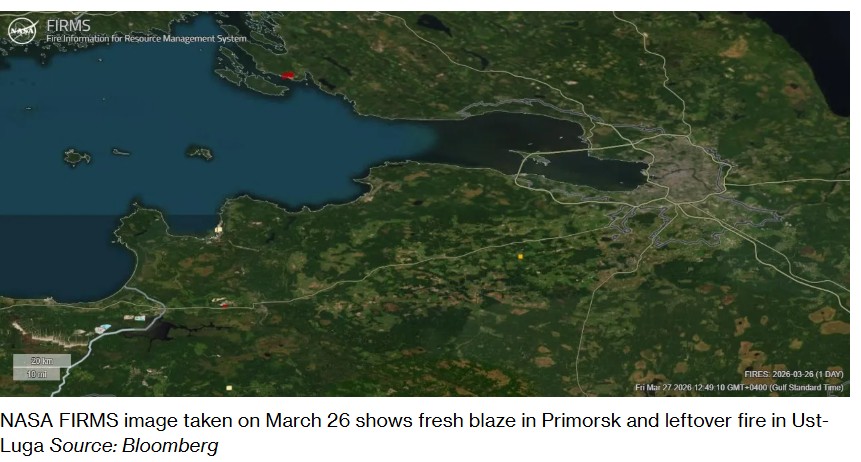
As shown in the image above, NASA FIRMS images taken on March 26 indicate new fire incidents in Primorsk, with residual hotspots still present in Ustyug.
The fires caused by these drone swarm attacks have forced two large infrastructures to temporarily halt oil shipments, although shipping data indicates that Primorsk has resumed some operational capacity by Thursday.
Drone swarm attacks have played a significant role on the Russia-Ukraine battlefield, and with the recent escalation of geopolitical conflicts in the Middle East, Iranian military drones have also performed prominently. Recently, market attention towards "AI + military systems" and drone swarm military concepts has significantly increased, catalyzing a dramatic surge in the stock price of Swarmer Inc. (SWMR.US), a technology provider focused on AI drone software and edge AI solutions, which skyrocketed by 1000% in just two days.
Russian oil lifeline faces massive drone attacks, global oil supply risks escalate
As Baltic shipping is suspended, market concerns over global oil shortages have intensified, primarily due to the new round of Middle Eastern conflict that has nearly halted oil flows through the Strait of Hormuz. Analysts from the international financial giant Macquarie stated in a report that if the Middle Eastern conflict continues until the end of the second quarter, oil prices could rise to $200 per barrel.
The Iranian military has effectively "quasi-blockaded" the Strait of Hormuz, meaning that about 20% of global energy flows are completely obstructed, accompanied by tanker attacks and shipping disruptions. A recent report from the International Energy Agency (IEA) indicates that military actions by the U.S. and Israel against Iran at the end of February triggered the largest supply disruption in the history of the global oil market; meanwhile, the U.S. government is considering military measures (including potential ground or quasi-ground control of Khark Island) to restore shipping routes and fully control the Strait of Hormuz.
Brent crude has been hovering and increasingly stabilizing around $110 per barrel, no longer just a brief wild surge—indicating that high oil prices may pose a sustained significant threat, which investors, central bank policymakers, and business leaders must confront.
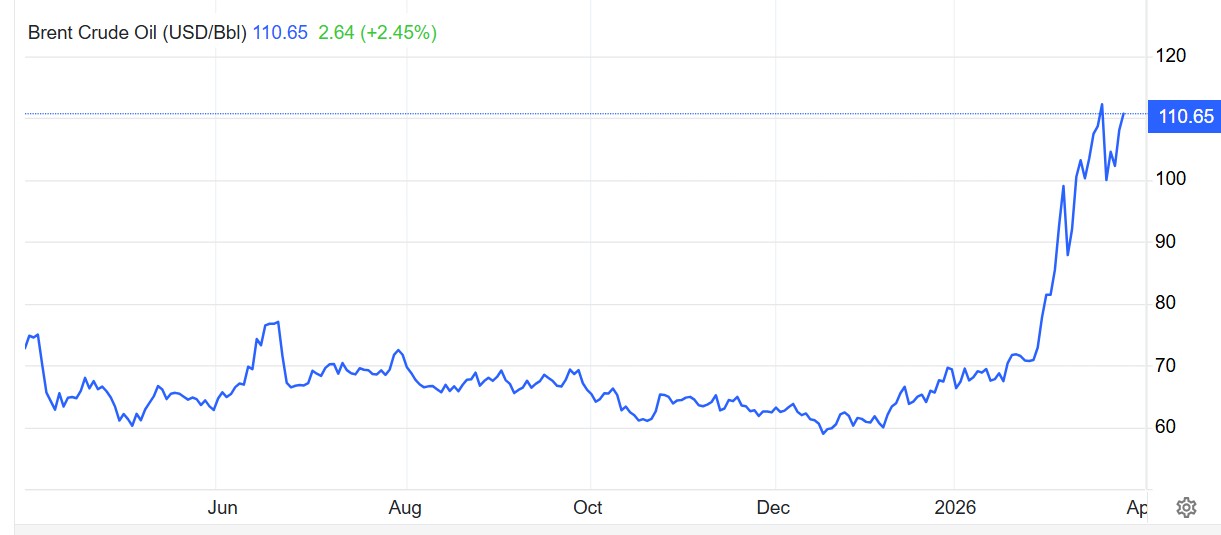 The large-scale disruptions in Baltic shipping have begun to significantly impact the unexpected fiscal revenues Moscow gained from the geopolitical conflicts in the Middle East; this conflict has stimulated demand for Russian oil from major energy-consuming countries globally and pushed international oil benchmark prices to near four-year highs.
At current price levels, prior to the recent drone attack initiated by Ukraine, Primorsk and Ust-Luga accounted for approximately 45% of Russia's maritime oil exports; if crude oil continues to be shipped from these two locations, it is conservatively estimated that Russia could earn about $150 million per day.
After disruptions in the Strait of Hormuz and limitations on Gulf oil exports, global buyers are increasingly competing for "alternative barrels that can still reliably arrive," causing Russian crude oil to rapidly shift from a previously discounted substitute to a scarce, deliverable resource. Russia is not merely benefiting from rising oil prices; it has also regained bargaining power in the Asian market, particularly in India, against the backdrop of a damaged supply chain in the Middle East. If the geopolitical crisis in the Middle East continues to escalate, Russia may rise from being a "sanctioned marginal energy supplier" to a key beneficiary in the global energy rebalancing, but this benefit remains constrained by the sustainability of U.S. sanctions relief, the scale of production capacity constraints faced by Gulf oil-producing countries due to the blockade of the Strait of Hormuz, and the duration of the war.
Since the outbreak of this round of Middle Eastern conflict on February 28, Brent crude oil has cumulatively risen by over 50%; even if the U.S. temporarily refrains from striking Iranian energy facilities, Brent remains near the historical high of $110 per barrel, with the core market logic still revolving around "whether the conflict will further prolong" rather than daily news headlines related to negotiations.
Meanwhile, disturbances in the Strait of Hormuz have already removed at least 11 million barrels per day from the market; if key Russian Baltic export ports experience repeated fires now, it would add another non-Middle Eastern supply vulnerability to the global oil market. Therefore, the ongoing drone strikes on the Primorsk and Ust-Luga ports will undoubtedly raise market concerns about the continuity of Russian oil exports, thereby continuously pushing up Brent crude oil prices. In this "dual supply risk" framework, as long as the geopolitical situation in the Middle East does not show clear signs of cooling and disruptions at Russian ports continue, international oil prices are more likely to maintain a high volatility and strong pattern, potentially breaking through the historical peak of $147.5 per barrel set in 2008 in the first half of the year, and may even continue to approach the extreme scenario of $200 warned by Macquarie