Silicon Industry Association: This week, the linkage between industrial silicon futures and spot prices led to a slight increase in prices, but weak demand has not improved
 I'm LongbridgeAI, I can summarize articles.
This week, the industrial silicon market saw a slight increase in both futures and spot prices under the support of supply contraction and cost support, but the weak demand has not improved. The closing price of the main contract 2601 rose by 130 yuan/ton, and the comprehensive price increased by 33 yuan/ton. Production cuts in the southwest and rising costs in Xinjiang support prices, but the recovery of downstream demand is the key variable. The domestic spot market has low transaction activity, with firm quotations. The reduction in supply and rising costs are driving price increases
According to the Zhitong Finance APP, the Silicon Industry Association stated that this week, industrial silicon saw a slight increase in both spot and futures prices due to supply contraction and cost support, but the weak demand has not improved, leading to insufficient upward momentum. In the short term, production cuts in the southwest and rising costs in Xinjiang will continue to support prices, while the pace of recovery in downstream demand is a key variable for future trends.
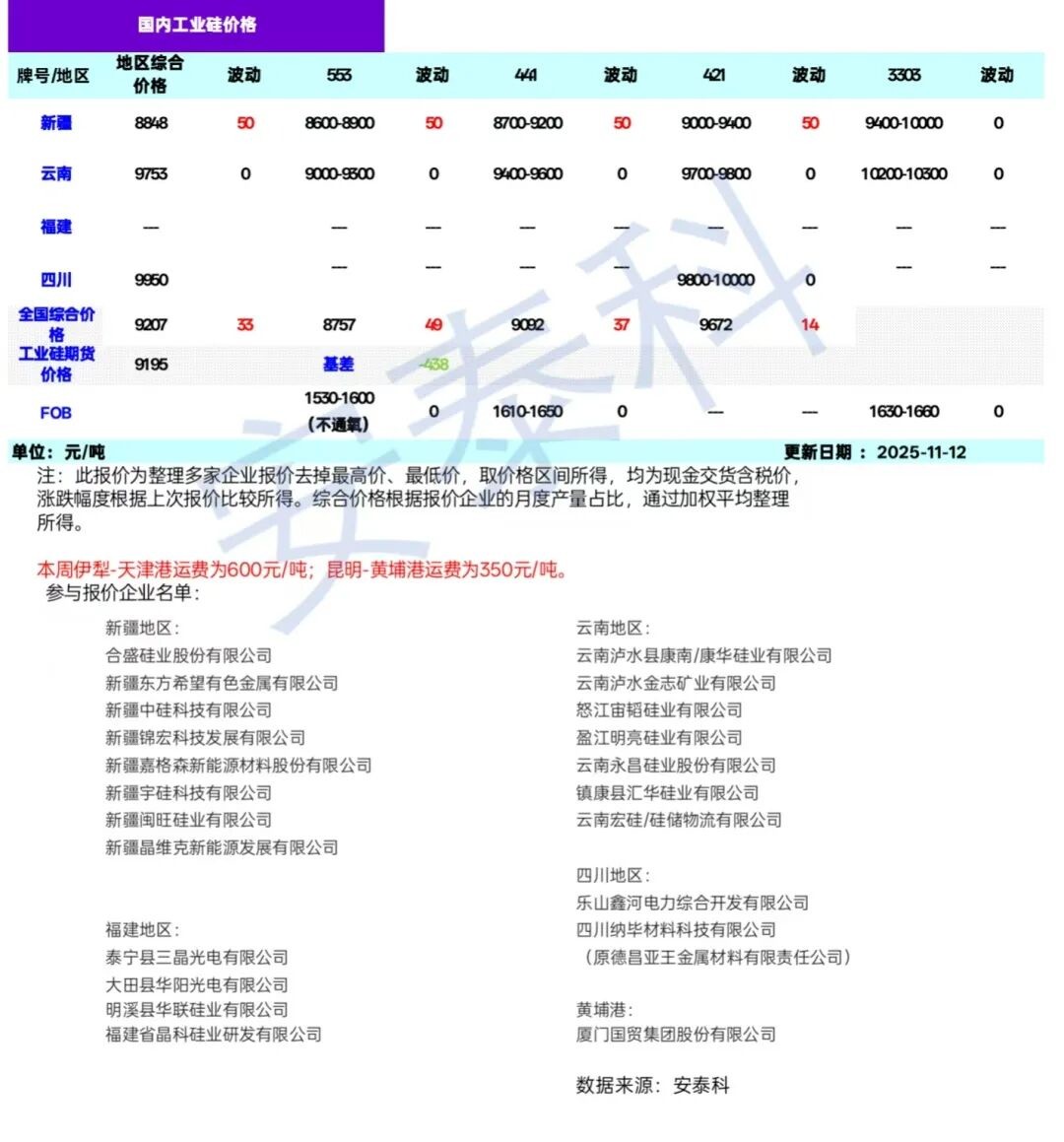
This week, the market price of industrial silicon rose slightly due to the linkage between spot and futures prices, showing a consistent trend. From November 6 to November 12, the closing price of the main contract 2601 increased from 9,065 yuan/ton to 9,195 yuan/ton, an increase of 130 yuan/ton. According to Antaike's price collection statistics, the national comprehensive price of industrial silicon on November 12 was 9,207 yuan/ton, up 33 yuan/ton. By grade, the price of 553# industrial silicon was 8,757 yuan/ton, up 49 yuan/ton; the price of 441# industrial silicon was 9,092 yuan/ton, up 37 yuan/ton; and the price of 421# industrial silicon was 9,672 yuan/ton, up 14 yuan/ton. By region, the comprehensive prices in Xinjiang, Yunnan, and Sichuan were 8,848 yuan/ton, 9,753 yuan/ton, and 9,950 yuan/ton, respectively; the export FOB price remained unchanged from last week.
This week, the domestic industrial silicon spot market had low transaction activity, but price support was strong. From the supply side, industrial silicon companies in the southwest continued to reduce production, leading to tighter spot market transactions, with firm quotations from companies providing support for spot prices. Although industrial silicon companies in Inner Mongolia maintained stable output, they showed a willingness to raise prices due to tight raw material supply. In Gansu, industrial silicon companies slightly reduced production due to a minor increase in costs, which also supported prices. In Xinjiang, prices were pushed up by multiple factors: on one hand, core production costs such as electricity prices, silicon coal, and electrodes have all increased to varying degrees, raising the cost line for companies; on the other hand, weather conditions in the region have increased transportation costs. The combination of supply-side constraints and rising futures market prices has improved market sentiment, driving quotations higher.
From the perspective of downstream demand for industrial silicon, the three core consumption areas showed a divergence. The price in the organic silicon sector rose from 11,000 yuan/ton to 11,200 yuan/ton, with companies showing a clear willingness to maintain prices, and pre-sale orders providing some support for prices, but the overall industry is reducing production, leading to decreased actual procurement demand for industrial silicon. In the polysilicon sector, prices remained weak and stable overall, with companies still expecting to reduce production, which constrains demand for industrial silicon. In the aluminum alloy sector, futures prices rose from 21,095 yuan/ton to 21,135 yuan/ton, benefiting from the continued improvement in the automotive manufacturing industry and other end-use markets, with steady growth in the industry's essential procurement of industrial silicon, becoming one of the few bright spots in downstream demand. Overall, the uneven downstream demand still lacks sufficient driving force for industrial silicon prices.