

Micron 512GB DDR5 RDIMM Enters AMD and Intel Validation: Can It Become the Next Growth Driver After HBM?
 I'm LongbridgeAI, I can summarize articles.
Micron announced its 512GB DDR5 RDIMM has demonstrated 9200 MT/s speeds on multiple platforms, with AMD and Intel currently validating compatibility. Mass production is targeted for H2 2027. This high-capacity memory reduces power consumption by over 60% compared to lower-capacity alternatives, targeting large language models and in-memory databases. While it complements rather than replaces HBM, it aims to boost Micron's high-capacity server DRAM sales. Short-term revenue impact is limited as the product remains in validation.
TradingKey - On September 15 ET, Micron Technology (MU) announced that it has successfully demonstrated 512GB DDR5 RDIMM on multiple server platforms. The product achieves a maximum transfer rate of 9200 MT/s. AMD (AMD) and Intel (INTC) are currently conducting platform validation, and Micron plans to start mass production in the second half of 2027 based on customer demand.
While 512GB DDR5 RDIMM is unlikely to replicate HBM's revenue contribution in the short term, it is expected to boost sales of Micron's high-capacity server DRAM.
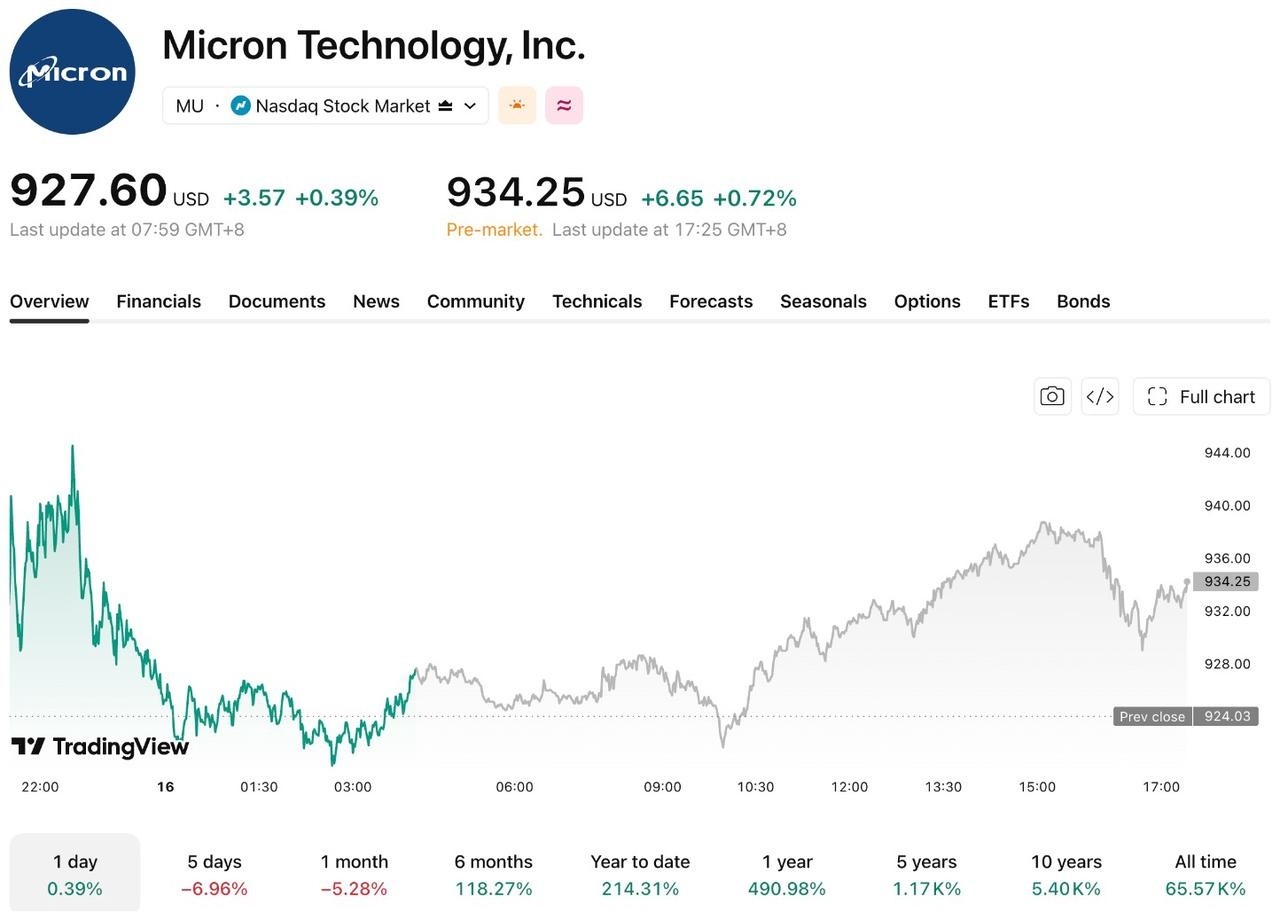
On September 15, Micron's stock price rose by about 1.1% at one point in early trading and closed up 0.39% at $927.6. Over the same period, the S&P 500 Index fell 0.45%, and the Nasdaq Composite Index fell about 0.8%. As of press time, Micron rose 0.72% in pre-market trading on September 16.
[Source: TradingView]
What Are the Advantages of 512GB DDR5 RDIMM?
Micron's 512GB DDR5 RDIMM utilizes vertical interconnect packaging, connecting multiple DRAM dies through through-silicon vias to expand server memory capacity without increasing slot counts. A dual-socket server configured with 24 slots can support up to 12TB of DDR5 memory.
Larger main memory allows more model data and database content to reside in memory, reducing access to slower storage devices, primarily targeting workloads such as large language models, real-time inference, and in-memory databases.
A single 512GB RDIMM has an operating power consumption of approximately 16 watts, representing a reduction of over 60% compared to a total of about 44.2 watts for four 128GB RDIMMs. In Spark Support Vector Machine data analytics tests conducted by Micron, the product's performance reached up to 1.4 times that of a 256GB DDR5 configuration.
When Will AMD and Intel Platform Validation Translate into Orders?
AMD and Intel are validating Micron's 512GB DDR5 RDIMM on next-generation server platforms, testing its compatibility, stability, and performance. Micron has not yet disclosed product pricing, initial customers, or projected shipment volumes.
Mass production is scheduled for the second half of 2027, and post-mass-production order volumes will be determined by validation results, adoption by server manufacturers, and Micron's supply capabilities. As commercial shipments have not yet begun, the product will not make a significant contribution to Micron's revenue in the short term.
Will 512GB DDR5 RDIMM Replace HBM?
The 512GB DDR5 RDIMM is positioned as a complement to, rather than a replacement for, HBM. HBM serves the high-bandwidth requirements of AI accelerators, while RDIMMs target system memory expansion on the CPU side.
The direct value of this product lies in allowing a dual-socket server to achieve 12TB of memory capacity across 24 slots. While providing the same capacity, a single 512GB module reduces power consumption by over 60% compared to operating four 128GB modules in parallel.
The targeted use cases are in-memory databases, large-scale inference, and simulation computing—applications with high capacity requirements but lower bandwidth demands than HBM. In AI servers, HBM determines the accelerator's data processing speed, whereas DDR5 RDIMM capacity determines the scale of data the system can simultaneously access.
From a product lineup perspective, the 512GB DDR5 RDIMM is expected to increase Micron's revenue in the high-capacity server DRAM market. However, the product is currently still in the verification phase, with mass production scheduled for the second half of 2027, making a significant short-term boost to Micron's revenue unlikely. Its commercial value still needs to be confirmed through platform verification and volume production orders.
In the medium term, if this product can successfully achieve mass shipments, it is expected to become another core growth driver for Micron in the data center market alongside HBM. At this stage, HBM shipments and DRAM prices remain the primary factors affecting Micron's performance.
Find out more