

Relative Strength Alert For Rich Sparkle Holdings Shares
 I'm LongbridgeAI, I can summarize articles.
Rich Sparkle Holdings Limited (ANPA) shares have entered oversold territory with a Relative Strength Index (RSI) of 29.4, indicating potential buying opportunities as heavy selling may be exhausting. The stock traded as low as $6.6493, with a 52-week range of $2.7967 to $180.6394, and a last trade of $7.10. In contrast, the S&P 500 ETF (SPY) has an RSI of 66.6. Investors may consider this RSI reading as a signal for potential entry points in the stock.
Legendary investor Warren Buffett advises to be fearful when others are greedy, and be greedy when others are fearful. One way we can try to measure the level of fear in a given stock is through a technical analysis indicator called the Relative Strength Index, or RSI, which measures momentum on a scale of zero to 100. A stock is considered to be oversold if the RSI reading falls below 30.
In trading on Tuesday, shares of Rich Sparkle Holdings Limited - Ordinary Shares (Symbol: ANPA) entered into oversold territory, hitting an RSI reading of 29.4, after changing hands as low as $6.6493 per share. By comparison, the current RSI reading of the S&P 500 ETF (SPY) is 66.6. A bullish investor could look at ANPA's 29.4 RSI reading today as a sign that the recent heavy selling is in the process of exhausting itself, and begin to look for entry point opportunities on the buy side. The chart below shows the one year performance of ANPA shares: 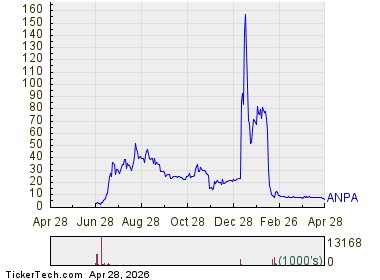
Looking at the chart above, ANPA's low point in its 52 week range is $2.7967 per share, with $180.6394 as the 52 week high point — that compares with a last trade of $7.10.
Never miss the next high-yield opportunity: Preferred Stock Alerts sends timely, actionable picks on income-producing preferred stocks and baby bonds, straight to your inbox.
 Find out what 9 other oversold stocks you need to know about »
Also see:
Low Priced Dividend Stocks
Top Ten Hedge Funds Holding NDLS
ETFs With Notable Inflows
The views and opinions expressed herein are the views and opinions of the author and do not necessarily reflect those of Nasdaq, Inc.