

Agentic Economy: Why Does the Agent Economy Grow On-Chain?
 I'm LongbridgeAI, I can summarize articles.
Circle CEO Jeremy Allaire's report 'The Agentic Economy' argues that AI and blockchain converge to create a new economic entity. AI reduces cognitive costs, while blockchain lowers transaction and coordination expenses. This shift transforms companies from human-centric organizations to agent-based businesses, moving pricing models from per-user subscriptions to micropayments for completed tasks, thereby reshaping the underlying logic of the digital economy.
Jeremy Allaire published "The Agentic Economy" in his personal capacity this July: nine chapters, forty-three pages, with a disclaimer repeatedly emphasizing that it does not represent Circle. As Circle's CEO, he inevitably portrays fully-reserved stablecoins as the only viable monetary form for the new economy. A company CEO spending years writing a document that "does not represent the company"—this act itself is significant.
This document reminds me of a16z's "Read Write Own": a guide to establishing a narrative for Web3. While the viewpoints may not all be correct, it laid out a complete set of underlying logic. "The Agentic Economy" does the same thing, but the subject has changed to the agent economy. It's not perfect, and it has many flaws, but its value lies precisely in this non-consensus approach—clarifying the underlying logic is more valuable than arguing about the right or wrong of a particular viewpoint.
Therefore, I will approach this book from beginning to end with two questions: What is the underlying logic of the Agent Economy? And why do these agent scenarios need blockchain instead of fiat currency? Clearly, this is not a simple transformation like integrating AI into commerce with a "thousand-question milk tea" analogy, but rather a reconstruction of a new continent—the Agent Economy—to reshape it. Most research and reports directly use "AI + blockchain" as a premise, building unfounded castles in the air upon it. The core question that truly needs to be answered directly is: What is the agent economy itself? Allaire first sets the stage for this issue: platform-level transformation is never a single invention, but rather the fusion of several mature technologies—Web, mobile, cloud, and social are no exception. When capabilities converge, the marginal cost of an activity approaches zero, and the speed of value transfer explodes. This time, the fusion involves two familiar operating systems: the intelligent operating system (AI) compresses the costs of cognition and work, while the economic operating system (blockchain) compresses the costs of transactions, settlements, and coordination. His proposition lies here: these are not neighbors, but the same economic entity. We've all heard these grand principles, but his focus is much simpler—who a company is actually paying to hire and what they're doing. Understanding it from the perspective of the company's workforce is his starting point.
1.1 A Company is an Organizationalized Cognition with a Logo on It
What is a company if you strip away the brand and the building?
In his writing, it's an information system organized around familiar functions: product, engineering, marketing, sales, finance, legal, and customer service. Human resource costs typically account for a quarter to a third of revenue, up to half in the service industry, and almost all in knowledge-based companies. The cost of operating this system is people. In other words, the payroll is the bill the company pays for cognition—it's not buying working hours, but the output of intellectual labor. This includes not only internal labor but also external labor—consulting, lawyers, accountants, outsourcing—essentially, organizational cognition rented from outside the company walls.
1.1 A Company is an Organizationalized Cognition with a Logo on It
1.1 What is a Company?
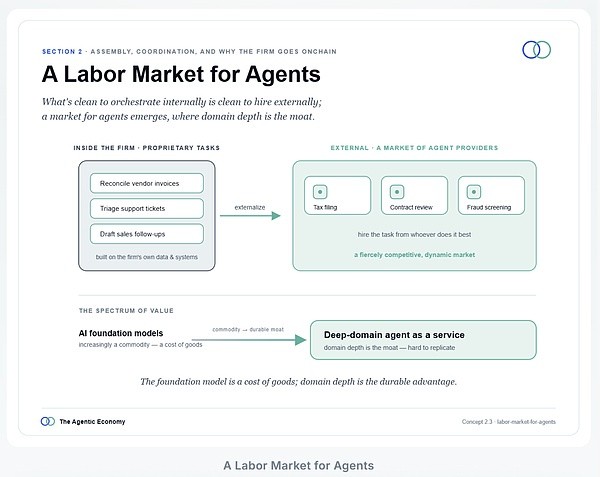
2.1 When Agents Become Business
I'm willing to push his bet forward another half step: these two candidates are actually two stops on the same road.
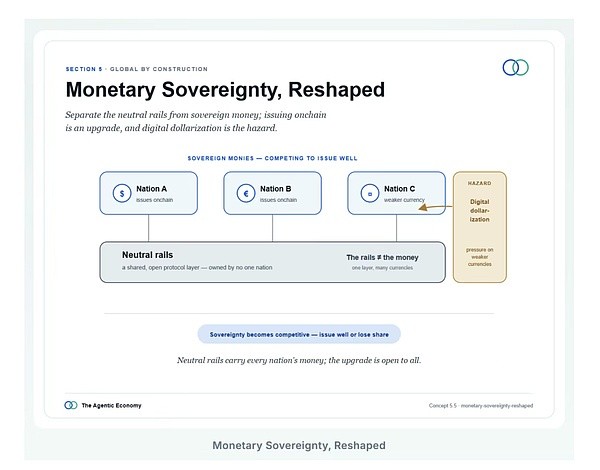
I'm willing to push his bet forward another half step: these two candidates are actually two stops on the same road. Today, businesses are paying for smart services based on tokens, which may seem like a utility model, but buying tokens is never the goal—tokens are units of measurement for services, not the services themselves. No one's need is "a million tokens"; the real need is always a translation, due diligence, or a piece of code. Buying by token is merely a semi-finished product of the "buying by service" model before it matured. Businesses that deal in token routing and relaying are essentially distributors in this semi-finished product stage. Therefore, the shift from buying tokens to hiring agents isn't a change in model, but rather an upgrade in the packaging unit of the same transaction: from buying raw materials to buying results. Allaire's most widely quoted line in the book describes this world after the upgrade: "Models become cost items, agents become businesses." The model becomes the cost line, and the agent becomes the business. 2.2 The Death of Per-User Fees, the Resurgence of Micropayments For thirty years, software subscriptions were essentially per-user fees: a login account, an annual fee, buying the right to "sit in front of the tool." When the work is done by agents instead of people, the per-user unit of measurement disappears, and the pricing mechanism shifts from "how many people can log in" to "how much work is done." The core of this shift is the collapse of transaction granularity: when selling per user, the smallest unit of a transaction is "one person for one year"; when selling per work, the smallest unit is a single call, a translation, a verification—a few cents, or even a fraction of a cent. The granularity of payment shattered the mold, colliding head-on with a dream unfulfilled for thirty years in the HTTP era: micropayments—a dream that never truly took hold in the consumer internet. Allaire explains that the high cost of settlement is only half the reason; the deeper killer is the psychological transaction cost—for a payment to be valid, the cost of making the decision must be lower than the amount paid, and the act of judging whether something is "worth it" for a single penny is itself worth several pennies. Micropayments didn't fail in the human economy; they simply didn't hold up mathematically. Agent reversed this inequality: the cost of machine decision-making approaches zero, lower than the payment itself for the first time in history. Therefore, micropayments have finally arrived, not for content—in that scenario, the buyer is always a human—but for the labor between machines. Reading this, I realized that this section and the first section are actually two halves of the same argument, only Allaire didn't pin them together. Coase said that the location of the wall is determined by coordination costs, which translates to: the market has a minimum priced unit, and the company is essentially a substitute for where labor market pricing fails; the wall is built at the limit of market granularity. For a hundred years, this limit hasn't changed much: the market can price "a consulting project," but not "a code review." Micropayments, coupled with machine-based contracts, have for the first time pushed the minimum priced unit to a level even finer than the internal division of labor within a company—a verification, a call, can be priced, traded, and settled independently. The first section says the wall changes from a boundary to a dotted line, which is theoretical; this section delivers the tools to dismantle the wall. III. The Global Agent Economy: Which Financial Infrastructure is it Compatible With? Before answering, let's understand what this economy looks like. Allaire breaks it down into three layers: the bottom layer is currency (stablecoins), the middle layer is the coordination and contracting layer (blockchain and smart contracts), and the top layer is the agent that does the work (AI models in the cloud). The decisive fact of these three layers is not what they do, but where they reside: each layer is software, each layer runs on the internet, and none of them have an inherent geographical attribute. And what each layer replaces is precisely what is national—programmable money replaces the national banking system stitched together by correspondent banks, software smart contracts replace sovereign courts and registration agencies, and agents replace the most geographically-based elements—local labor and the companies that organize them. He specifically wrote about this: the work performed by cloud-based models has no hometown; it can be summoned anywhere, by anyone, at any scale, responding to demand, not location. Therefore: Globality is not a function added to this system, but rather a structural property that constitutes its materials. Global by construction: not a feature added to the system but a structural property of what it is made of. This agent economy is born globally, bringing with it an unprecedented legal consequence. Cross-border regulation is based on a rarely examined premise: an economic activity always occurs somewhere, legally called a situs, from which jurisdiction extends. The agent economy, however, is the first economy whose economic substance does not have a place of occurrence. The picture he paints is very concrete: an agent might be assembled by contributors from a dozen countries, the model trained in one place, hosted in another, and invoked by a third-party counterparty. When it negotiates a price and settles a payment, the question "where did this happen?" remains unanswered. Moreover, he said this isn't a jurisdictional vacuum, but a jurisdictional overabundance: an action might simultaneously fall under the consumer protection law of the consumer's location, the data law of the data subject's location, and the tax claims of the market's location, without any decisive factor based on the place of occurrence. For the first time in economic history, the essence of economic life originates globally, and what needs to be modified is the national framework. Remember this point; it's not just legal trivia, but the other half of the third requirement: the agent lacks legal personhood, representing the human dimension; the action lacks a place of occurrence, representing the spatial dimension—both premises of the fiat currency system collapse together. Now we can ask: which financial infrastructure is suitable for such an economy? Most people's first reaction would be, "Why not just modify the existing system?"—this question has ample basis in reality. The fiat currency system is adapting itself to the agent economy: Visa's TAP and Mastercard's Agent Pay allow agents to use human-authorized credentials to spend money in human accounts. Mastercard even launched Agent Pay for Machines specifically for machines this June. Stripe and Paradigm's Tempo, through cooperation with Visa, also supports fiat currency payments. FedNow, PIX, and UPI have proven that sub-second, near-final settlement does not require blockchain. Listing the demands of the agent economy, the fiat currency system can provide a counterpart for almost every one. The adaptation effort is real; the question is how deep the adaptation is. Breaking down this list of demands, speed and cost are only the surface; going deeper, there are three requirements—trust, currency, and legal entity status. These three aspects are the essence of the agent-based new economy and the real test for every infrastructure project. Let me state this first: these three aspects are not of equal importance. The first two indicate that blockchain is suitable, while the third is essential. Requirement 1: Trust Must Be Portable Before hiring software that could be assembled by strangers anywhere in the world, the compiler must know three things: it is real, its operation is trustworthy, and someone will be held accountable if problems arise. Allaire's answer is an identity stack, with cryptographic verifiability at the bottom—transactions and code execution on the public blockchain can be verified by anyone; anchored to verified real-world identities, namely the KYC/KYB system already in large-scale operation in the financial system. Each agent, through their wallet and credentials, traces back to a real, identified, and reputable entity. The reason this system points to the blockchain isn't verification itself—private databases can also verify—but portability: a platform's private registry binds trust to that single operator; the identity and reputation you build within its system cannot leave its boundaries. Strictly speaking, portability forces "non-proprietary" transactions, which can theoretically be achieved through the standardization of verifiable credentials. The significance of public blockchains lies in the fact that they are currently the only form that can realize portability without relying on the credit of any single operator. A globally-oriented employment market demands precisely this kind of trust that no one can hold back.
Requirement Two: Machine-Speed Currency Cannot Contain Bank Risk
The second item tests the most important one on the list: every transaction is so fast that there is no time to ask "whether the money itself is good or bad". Allaire believes that bank-issued currency cannot pass this test because the balance in your account is not the dollar itself, but the bank's promise to "owe you dollars"—thousands of banks, strictly speaking, are thousands of slightly different types of money, each with its own risks. The difference is not usually noticeable because deposit insurance and the lender of last resort suppress it: the "singularity of money" in monetary economics—one dollar is one dollar everywhere, never a natural state, but an effect created by the state's guarantee.
This is not a natural state, but an effect created by the state's guarantee.
At this point, the question I brought into the book can finally be summarized in one sentence: The way stablecoins win is not by defeating fiat currency, but by liberating fiat currency from national channels. His own statement, pinned to the very center of the book, is:
An economy operated by software agents must run on top of software currencies, software contracts, and software governance; otherwise, it simply cannot function.
An economy run by software agents must operate on software money, software contracts, and software governance; otherwise, it cannot operate at all. IV. This is a New Continent. Once the necessity of the trajectory is established, the next question is not whether to go on the blockchain, but whose blockchain and whose rules to follow. Pushing these three requirements to their limits, the shape of the answer becomes clear: Allaire has drawn a new continent from beginning to end, not a redrawing of an old map. This is primarily a matter of logic—machine-to-machine payments have never had any existing tracks built for them; an economy born globally, operating at machine speed, and requiring agents to have their own agency, hasn't lost to the old tracks; it's simply never participated in this race. He himself stated bluntly that the blockchain doesn't need to defeat card networks in debates; it only needs to be a place where the agent economy can operate natively. All the parts he subtly mentioned align with this positioning: migration is not replacement; existing payments continue to run on the old tracks; the last mile of deposits and withdrawals will only be moved to the endpoints, not eliminated; he even acknowledged that an equilibrium favorable to card organizations—stablecoins only providing funding, while acceptance and fees remain in the hands of Visa and similar entities—is a real possibility. The concessions were generous because the logic of the new continent allows all those in power not to view this narrative as a threat. This is probably why Mastercard, while promoting its Agent Pay, also refers to blockchain as the settlement layer for autonomous commerce. But the "new" has another layer, deeper than narrative strategy. The term "Agentic Economy" actually has two uses in the market: one refers to the AI transformation of business models, while Allaire is referring to something else entirely. Putting the first three sections together, everything he writes about is a new system: a new form of currency (full reserves), new credit instruments (machine receivables), a new corporate structure (thinner legal shells, operations essentially on the blockchain), a new unit of measurement (based on work, not headcount), and a new logic of jurisdiction (based on person, not place). These five elements combined are not just a business model, but a complete system of institutions for an economy. In his autobiography, he made the scope clear: this treatise describes not just a new currency or a new network, but a new way in which the work of the Agent Economy itself is organized. And this new continent means that its system is currently blank. This blank system awaits someone to write it, and the first person to systematically write it will be the de facto constitutionalist—this is also the accurate characterization of this text: not a white paper, not a promotional article, but a charter. He clearly marked the key points of the new system: a reusable identity layer, an override key that can roll back the system, and reserve returns captured by the dominant issuer. He also pointed out that he himself was at the bottom of the game in the final hurdle, and then voluntarily relinquished it: reserve returns should be driven down by competition and flow back to token holders, "including issuers with whom he has a vested interest." This concession wasn't just a paper gesture—the OUSD initiative launched at the end of June by 140 institutions including Stripe, Visa, and BlackRock was designed to return reserve interest to the distributors. He wrote it as a future concession in his book, but the market is now forcing him to deliver on it. However, the function of this concession needs to be clearly understood. What he gave up was profit margin, in exchange for the entire architecture being accepted as the default—full reserves, federal regulation, bankruptcy remoteness, identity layers, and marginal compliance. Looking at each point, it's like Circle's product manual. He sacrificed profit margins to secure a position. The bylaws were written, but approval was still needed, and there were multiple drafts on the table: Stripe and Tempo's machine payment standard, MPP, had Visa's backing; Coinbase's own x402 was simply track-neutral, allowing agents to choose between cards and stablecoins based on the scenario—even the drafters' own camp didn't dare include "inevitable on-chain" in the terms. Allaire, on the other hand, enshrined neutrality at the protocol layer and the US dollar at the hub. For Washington, this was a gift; for everyone else, it was a question of whether or not to sign—and the cost of signing, he himself had written in his book, was that the discipline applied to weak currencies, never to the dollar.An economy operated by software agents must run on top of software currencies, software contracts, and software governance; otherwise, it simply cannot function.