

Samsung, SK Hynix Pull Back Sharply in October as South Korea Pension Fund Holdings Shrink About $132 Billion From Late June: Can Memory Stock Rally Sustain?
 I'm LongbridgeAI, I can summarize articles.
Samsung and SK Hynix stocks dropped sharply in October, dragging down the KOSPI and causing South Korea's National Pension Service to see its holdings shrink by approximately $132 billion since June. The decline was driven by higher US Treasury yields impacting tech valuations and concerns over AI capital expenditure returns. Despite recent rebounds, future performance depends on HBM4 order progress, DRAM prices, and competitive pressures from rivals like CXMT.
TradingKey - As of the close on October 19, Samsung Electronics has dropped by approximately 16.8% since the start of October, while SK Hynix has fallen by about 24%.
Recent sharp pullbacks in the stock prices of Samsung Electronics and SK Hynix have dragged down the Korea Composite Stock Price Index (KOSPI) and led to a decline in the market value of domestic stock holdings by South Korea's National Pension Service.
According to data from FnGuide, as of October 15, the market value of holdings by South Korea's National Pension Service in 287 listed companies in which it holds at least a 5% stake decreased by approximately 182.4 trillion won (about $132 billion) compared to the end of June.
This data reflects mark-to-market paper changes rather than realized investment losses. The market value of holdings in Samsung Electronics and SK Hynix declined by a combined total of about 131.1 trillion won, accounting for roughly 71.8% of the overall decrease.
Why Samsung and SK Hynix Shares Fell Earlier
After US September inflation data came in higher than expected, the market reassessed the Federal Reserve's rate path, sending US Treasury yields higher and putting pressure on tech stock valuations. Following the weakness in the Nasdaq Composite Index and the Philadelphia Semiconductor Index, South Korean semiconductor stocks were impacted in tandem.
Samsung Electronics and SK Hynix are large-cap semiconductor companies on the KOSPI, and their stock price fluctuations have a noticeable impact on the index.
Meanwhile, the market has turned its attention to the financing costs and return on capital expenditures for AI data center construction, with investors divided on whether demand for AI chips can sustain high-speed growth.
CXMT recently disclosed progress on its 4F² DRAM technology and plans to advance server DDR5 products. Its mass production timeline, yield rates, and customer certifications remain unclear. If mass production is achieved and shipments expand in the future, legacy DRAM prices and memory makers' profit margins could face greater competitive pressure.
In addition, South Korean media cited supply chain sources as saying that some of SK Hynix's HBM4 back-end equipment originally scheduled for deployment in the second half of this year may be delayed until next year.
This news has not been officially confirmed by the company, nor does it indicate substantive issues with HBM4 mass production, but it may affect market expectations regarding the pace of short-term capacity expansion and shipments.
Can the Rally in Samsung and SK Hynix Continue?
[Source: TradingKey]
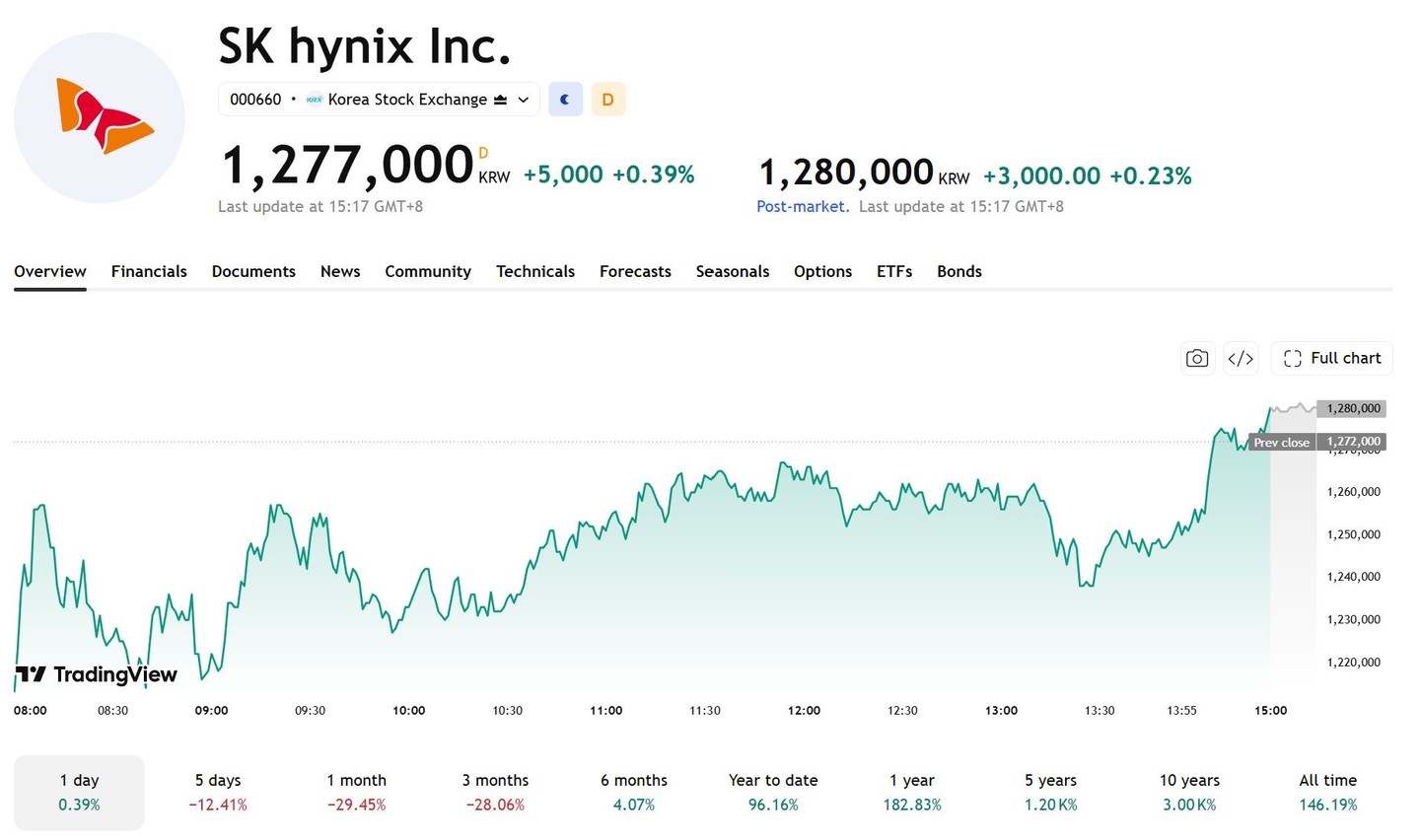
After a continuous decline, the two companies rebounded on October 16, with Samsung Electronics rising 2.62% and SK Hynix gaining 0.79%. The KOSPI concurrently rose 2.05%, ending a seven-consecutive-session losing streak.
On October 19, South Korean stocks continued to recover, with Samsung Electronics closing up 1.16% at 218,000 won (approximately $164), and SK Hynix closing up 0.39% at 1.277 million won.
Factors such as the KOSPI halting its decline, foreign capital returning, trading volume expanding, and the two companies reclaiming key prior price levels will impact the strength of the rebound. Subsequent performance will depend on HBM4 orders, DRAM prices, and earnings expectations.
Rising US interest rate expectations, declining returns on AI capital expenditures, or ChangXin Memory Technologies accelerating server DDR5 shipments could all increase pressure on stock prices.
Focus Turns to HBM4 and DRAM Prices
Stock price trends of Samsung Electronics and SK Hynix are primarily influenced by HBM4 customer qualifications, order and shipment progress, DRAM prices, mass-production yields, interest rate expectations, and foreign capital flows.
If AI server investment continues to grow, HBM demand remains strong, and DRAM prices stay elevated, earnings expectations for both companies could remain supported. Conversely, if AI capital expenditures slow, ChangXin Memory Technologies expands DRAM mass production, or conventional DRAM prices decline, valuations and profit margins for memory chip makers may come under pressure.
Find out more